
There have been some replies to my article correctly calling people who insist on using only Anglo-Saxon root words instead of Latin root words dishonest. The replies covered a lot of ground but none of that ground happened to be an actual rebuttal. Nobody was like “Oh actually Lyman was wrong on such-and-such a point, look here’s some evidence…” The replies are all are repetitions of what I said in the opening paragraph, namely, that the writers in question find some pronatalists to be cringe, and so they want to do a rebrand, and their proposal for the rebrand amounts to coming up with a name that hides their actual beliefs, i.e. lying. I will go through three examples from Ivana Greco , Jayson Fritz-Stibbe , and Patrick T Brown .
Before that, a couple notes: I’m not really going to hold back here on what I think. I don’t think any of the people I disagree with are bad people and honestly I imagine in any non-Substack setting I’d quite get along with them (one of them I know this for a fact because we have met in person and it’s friendly and collegial!). However, I think we have a duty as writers to signal to readers the creedence we assign to claims. If something is 0% correct and something else is 50% correct, it’s not proper for me to call them both “less than fully true.” The correct verbiage is “completely unhinged bologna only believable to the truly illiterate, or else the morally depraved” and “very likely wrong,” respectively. I am going to make use of adjectives to help you understand how wrong I think people are. But I want to be clear, I have no reason to think any of the three people I’m criticizing are anything besides decent and upstanding people with good intentions.
The next thing I’ll note is that at least one of the writers I’m engaging with here reached out to me in advance very nicely and made clear that he or she was in on the bit and game for how I do things around here. I’ll leave you to guess who that brave soul was.
And finally, I’ll note the two others did not send me such messages but they did actually tag me in their posts which is basically the same thing right?
As before I’m not going to paywall because the entire world deserves to enjoy this poetry.
Ivana Greco Says Several Pronatalists Are Cringe

Ivana acknowledges my article and says:
I don’t have a problem with the “freedom-focused” pro-natalists, even if they seem to be a small sliver of the movement. Lyman, you’re doing fine work, carry on! However, you also can’t make me describe myself as one of you, and here’s why:
To which I say bullshit. We’re not a small sliver, we’re like… I don’t know, at least 40% but not more than 85% of it. Currently my children are asleep in the hotel room in Hong Kong and I am writing this article after finishing up at a short conference here— a conference where I agreed with much of what was said and disagreed with much of what was said, but where none of what was said was especially shocking or bizarre, and where the most thunderous approval in the room to any proposal offered, the thing that got advanced most concretely as “yes we should do that” was “Get the UN to include fertility desires into sustainable development goal frameworks.” Room full of pronatalists, that was the thing that got heads nodding. You can see the event’s pre-conference principles statement here. It’s extremely boring, because 99% of actual existing pronatalists are pretty boring people trying to just do good things.
Ivana goes on to make this innumerate argument:
When you point out this very unimpressive track record to pro-natalists, they often respond (as Lyman has) that the problem is we simply haven’t spent enough money/done it the right way. Lyman is confident that “it would cost about 10% of total GDP to get fertility to replacement rate in America only via fiscal supports of this kind.”
Oh I’m sorry the two country anecdotes you’re aware of aren’t suitably impressive to you, if only somebody had done an actual meta-analysis you didn’t bother to read. Sometimes doing the reading really is the right call! It just factually is the case that fiscal transfers for kids cause more kids, refusing to accept this is a way of walking around with a post-it note on your forehead that says “2+2=5”
Now where I agree with Ivana Greco is we are unlikely to spend e.g. 10% of GDP on family supports. Sad! So it’s a good thing that most of the actual work pronatalists do isn’t on fiscal transfers. We also work on other stuff like restructuring work arrangements, finding cultural interventions that may alter the perceived benefits of children, looking for ways to change housing regulations, etc. And no, it’s not just me doing that stuff and fronting for a movement of creeps and weirdos: most actual pronatalists are just out there trying to figure out if childcare regulations are hurting family formation in unintended ways, or other pretty “this is not insane” stuff like that. The concerted campaign by “pro-family” people to smear those of us actually doing the work to figure out how to help more humans come into the world is a lot ickier than any brand name.
Ivana goes on:
I am conservative enough to think that the U.S. federal government should be understood as functioning best when it has both limited responsibilities and limited powers. There are plenty of initiatives in the orbit of pro-natalism that I have no issue with. The late Charlie Kirk, for example, famously told his fans: “Get married. Have children. Build a legacy. Pass down your values. Pursue the eternal. Seek true joy.” This is an effective, positive message for a popular media personality to tell his fans. It is a very different question whether the federal government in the United States of America should take it upon itself deliver the same message to its citizens, or attempt to boost the birthrates of its own citizens.
If only we knew what Charlie Kirk thought of family policy! Maybe there was a time the Vice President got in trouble for comments in an interview with Charlie Kirk where he said parents should have lower taxes, and Kirk nodded along agreeably? Was that a lowkey famous thing that happened (yes)? Did Charlie Kirk’s widow maybe tell us the platform Kirk hoped to advance if he ran for office? Oh, she did? And it was more pro-marriage and pro-birth policies?
Look, I really dislike the whole “St. Charlie Kirk says…” bit where we sockpuppet the dead but my goodness people on this one the record is so clear and it’s straight from Erika Kirk’s own comments right after his death: the guy was not opposed to the government putting a thumb on the scale for families!
Ivana Greco says:
Here is why I can’t consider myself a pro-natalist: I simply do not want the U.S. federal government to be in the business of caring whether birth rates go up or down.
I don’t want the federal government to be in the business of caring if good things happen or bad things happen! I don’t want the government in the business of caring about the country’s long-term future! I just want the government to live in the moment, think about the now, get really zen
oh wait lol no she doesn’t mean that:
I am happy for the U.S. government to be pro-family, as in seeking to support families in the choices they themselves make.
But only if those choices aren’t more babies, because the government shouldn’t care if birth rates go up or down.
This is incoherent rambling. It’s trying to govern by vibes.
She goes on in her argument to say
Our fertility rate is not broken; please stop trying to fix it.
And then to discuss cohort fertility. I’ve run through the cohort fertility data here. But what I want you to recognize is the series of pivots Ivana made:
First it was “well yeah I want more babies, but pronatalists are icky,” then it was, “well okay maybe they’re not all icky, but I oppose social engineering and intervention in private matters,” then it was “well okay yes you can intervene in private matters to be pro-family, just not pro-birth,” and now it’s “actually we don’t even need more births the birth rate isn’t a problem.”
And the final kicker in this long train of pivots is:
Our fertility rate, in other words, isn’t really broken yet. But the pro-natalists might break it. As Lyman points out in some very nice original research he has done for the Institute for Family Studies, there is a dramatic recent trend in which conservatives in are having more babies than liberals.
The 20% most Republican counties have an aggregate total fertility rate of 1.76. The 20% most Democratic counties have an aggregate total fertility rate of 1.37, less than the EU.
A worst case scenario, in my mind, is that having babies suddenly becomes politically polarized, and thus liberal women are shifted further away from having babies in reaction to their disgust at people like Elon Musk trying to raise the birth rate. Here, in my mind, is where the pro-natalist movement may end up being ironically counterproductive.
Did you catch it? The real problem is… conservatives having too many babies! We wouldn’t want liberal women to be disgusted; won’t someone please think of the liberal women? We’ve got to stop being in favor of babies until we can figure this thing out.
And in case you think I’m being unfair, oh, read on:
Into this fragile ecosystem — again, mostly not mucked around with to date by the U.S. federal government — comes stomping the pro-natalists, who are overwhelmingly male, mostly conservative, and shouting about looming catastrophe if women don’t have more babies.
Emphasis added because WHAT!?!?! The federal government isn’t mucking around with fertility!?!? We’re supposed to pretend like Roe and Dobbs didn’t happen? Like Title X doesn’t exist? Like the Office of Population Policy doesn’t exist? Like marriage penalties don’t exist, or Medicaid coverage of birth, or military pay differentials for marriage, or any of a million other policies that influence fertility? We’re supposed to believe that it was the pronatalists who first suggested the U.S. intervene in population!?!?!
Are you serious? No, not serious, not serious at all, none of this is serious, this entire article, this entire perspective, is beclowned.
Okay so what’s really going on here? And I think here we’re at the crux of the matter:
Is this going to help? Will we increase Americans’ sense of agency over their own lives if we claim they won’t/can’t have babies without the right government support? We will increase their optimism if we start yelling about looming catastrophic population collapse? Will we help connect them to higher values by saying ladies need to get pregnant to prop up the Social Security system?
And here I want to say, yes, there’s truth to this argument which is irrelevant to the entire rest of the article. I’ve A/B tested exactly this issue. I did a survey where I asked people “Do you support the government implementing policies to increase birth rates?” but respondents were exposed to three different priming texts at random. One was neutral, “Birth rates have declined X% in Y years. On that basis, do you support…” One was “catastrophic,” where I said, “Birth rates have decline X% in Y years, which researchers say will cause [list of very scary bad stuff here]. On that basis, do you support…” And one was “freedom focused,” where I said, “Birth rates have declined X% in Y years, but the number of children American women say they want has been stable at Z; more and more women are unable to have the children they want to have. On that basis, do you support…”
I found that catastrophic language was the most effective at getting people to say “Yes I support government policy!” BUT… also caused people to have slightly more pessimistic answers about their own personal fertility intentions. I’ve written about this in many contexts: Korea won’t be able to convince Koreans to have babies by saying “We need young people to conscript as cannon fodder against North Korea!” Catastrophizing language can scare people into voting for some favorable policies, but Ivana Greco is right that it also damages their actual fertility intentions.
The freedom-focused approach, however, had no effect on any measure of their own fertility dispositions, but did modestly boost support for pro-birth policies.
One of many reasons at IFS we adopt that perspective! Because it works! And we know it works because we’ve tested it extensively! I am not out here vibing on the best message, giving you my feels on what words poll-test well, etc! I’m telling you how the math shakes out!
And most pronatalists… aren’t catastrophists! At a recent conference I was at, the only pronatalist present who was an actual public official insisted that we shouldn’t talk about “extinction” or “end of civilization” but focus on how families lose out on experiences of joy. And I agree, we should do that! That’s what 99% of pronatalists do!
So what’s really going on here is what I said from the beginning: Ivana Greco simply dislikes Certain People (not me, she insists in several parentheticals, and fine, I believe her, not me), and she doesn’t want those Certain People to be in power, because having the Right People does magical policy stuff that wouldn’t happen if the Wrong People do it:
This is part of why I am so wedded to the idea that good family policy must be done by people who are humble about the role of government, and motivated primarily by an attitude of service and a sense of following, not leading, family desires.
We simply need better boyars, is the takeaway here. Or in other words: all this ever was was Ivana saying “There are several cringey pronatalists” in various ways. And this is true there are several cringey pronatalists. So what? There’s no actual argument here.
Jayson Fritz-Stibbe Was Not Told There Would Be Math

Jayson Fritz-Stibbe starts off saying:
There’s a reason why abortion debate is dominated by a Pro-Life side and a Pro-Choice side. Each side named themselves and deliberately selected virtuous labels to evoke emotion and make their side harder to refute. To oppose the Pro-Life movement is to be anti-life; to oppose the Pro-Choice side is to reject individual liberty. These are immediate, visceral reactions strategically created by people who want to persuade on an emotional level.
This is so credulous.
Pro-lifers are obviously anti-abortion, and pro-choicers are obviously pro-abortion. The names are silly, and persuade nobody, and if you swap the names in polls for “abortion” you get no change in the distribution of opinions. Voters aren’t fooled. Activists like to tell stories about themselves so they do logomachy about the names but we all know the truth. And yes, I’m anti-abortion, because I’m anti-killing-in-general-actually.
But more to the point, the pro-life movement is interesting because of what it succeeds at and what it fails at. The pro-life movement succeeds at bringing together diverse people to oppose abortion. The pro-life movement has never succeeded at mobilizing that coalition for life-but-not-abortion-issues. We try! We try so hard! I so want to be able to mobilize pro-lifers for other pro-life-but-not-just-abortion stuff, but it’s really hard because actually the pro-life coalition is held together by anti-abortionism. That really is the glue. If abortion wasn’t an issue, the pro-life coalition wouldn’t exist as it currently does.
Because, see, a concrete policy goal makes it easy to build a big tent! If we’re just whipping votes for one thing, we can all hold our noses about other coalition members. But don’t ask us to actually be these peoples’ allies across tons of issues. Concrete policy issues enable the creation of political coalitions which cannot be created around philosophical perspectives. Protestants and Catholics have a whole lot of philosophical perspectives we cannot form a coalition around— but we can ignore that because our different theologies alike motivate anti-abortionism.
The problem for pronatalism is that we are currently in an awkward stage. We know low fertility is bad (“anti-low-fertility-ism”), but unlike the pro-life movement that had a simple ask (“reverse Roe”), pronatalists haven’t settled on a clear policy ask. Partly because people like Ivana Greco keep saying “Let’s never have an actual clear policy ask because social engineering is bad!”
Because of this weird position where there’s a clear problem but not yet a clear solution statement, there’s ambiguity about how you should optimally coalition-build. Should you narrow the tent as you would for building a multipurpose political alliance? Or should you broaden the tent as you would for a specific issue area project?
My view is you should treat low birth rates more like a specific issue area than as a “durable alliance of persons and interests.” Sometimes bad people support good things; I don’t vote against a good thing just because a bad person also voted for it.
But many people see pronatalism as something else: not a set of policy asks, but an affiliative tribe where they are philosophically marrying everybody else in it. But you’re not! It really is just a series of policy asks! We want kids to be covered by their parents’ Global Entry status! We want speeding mitigation design on residential roads! We want a bigger child tax credit! We want reduced marriage penalties! We want childcare regulations that protect kids instead of lobbyists! We want specific laws and regulations to be rewritten in specific ways. Because our asks are not one policy (“End Roe!” “Legalize marijuana!” “Decapitate all pit bulls!”), it can create a kind of social illusion wherein it appears that pronatalism is an affiliative tribe where we owe each other team-player-ship across other issues. But that ain’t it! It’s just a long list of small-to-medium-sized political questions where we can form temporary coalitions. That being the case, “big tent pronatalism” is the correct pronatalism.
But it also means “I’m a pronatalist but I don’t have any policy asks” is a non sequitur. What it means to be a pronatalist is not simply that you are worried about falling fertility, but that you enlist yourself into at least some of the temporary coalitions around policies which will yield more births.
He goes on:
When you’ve won the ideological battle, but so many people who agree with you still do not want to take up your cause, and they tell you it’s because they do not like the label, it means that the label is bad.
No, it is the cowards who are bad.
He goes on:
The term “pro-natalism” is a title that seems designed to remove all emotion from what should be an emotionally-charged topic. It makes people anemic because it takes a deeply personal and philosophical question (how many children should I have?) and drags it into a sterile laboratory. Once there, we are told: every woman should have 2.1 children; true believers should have 4.2; the average woman currently has a completed family size of 1.6 children and we need it to be 0.5-0.6 higher; etc.
But here’s the thing: If you’re using decimals to describe how many children a woman ought to have, you have already made a fatal mistake.
His argument here is that if you’re doing math you’ve made a fatal mistake. That’s the actual argument! Now to be clear, literally no pronatalist actually ever said every woman should have 2.1 children, nor true believers 4.2. These are made up statements.
Let’s get to the heart of what’s happening here: people have low literacy and they associate Latin-root words with science and they dislike the idea of science being involved in family. But the people are simply wrong and science is good, and also Latin is good.
He goes on:
It’s not an effective strategy, either. Prospective mothers are not going to be swayed by macro-economic graphs. Potential fathers will not look at population pyramids and decide to have kids because there’s an impending solvency crisis for social security. My lovely wife made the graph below to help illustrate3:
First of all, somewhat wrong: I actually do pre/post surveys on desired family size in some lectures I give, and I happen to know that 10-20 graphs is a sweet spot for increasing desired family size by approximately 0.2 children per respondent.
But more importantly— of course I agree, as I said above, “Have kids for the population pyramid!” is stupid, which is why not many pronatalists say that. I am begging any of these people to actually interact with a pronatalist for more than 5 seconds.
There is an interesting wrinkle, here, of course, specifically related to Substack: what are we doing here? Is Substack a place where we are trying to influence the individual behavior of people by modeling a beautiful life? Is it Instagram for wordcels? Or is Substack a place where we are trying to argue about ideas and assess claims about truth?
I agree that to the extent you’re trying to persuade someone to have kids, graphs are a pretty bad way to do it. My preferred strategy is to ship them a copy of Catherine Pakaluk’s book Hannah’s Children which is fantastic! Catherine and I spent much of the evening before I wrote this article tag-teaming an evangelistic/apologetic conversation with a secular colleague, as it happens. Or I just invite the person to hang out at my house. I dragged a soon-to-be-first-time-father around Hong Kong all afternoon; he’d never done international vacationing with small kids, so he got to experience navigating the busy streets of Hong Kong with jet lagged toddlers. And he had a blast! You can travel with kids and it is AWESOME!
I would go further and say if you’re trying to convince someone to have kids, not only don’t show them graphs, get the hell off Substack. This article is already too long but someday I will write the piece living in my head summarizable as, “Any online interaction which is not affirmatively and explicitly pro-marriage or pro-birth is by default antinuptial and antinatal and probably destroying your family life.” I genuinely believe online media by virtue of being online are actually antinatal. My wife and I talk about my work as being a firefighter: I go into the hellscape wearing special equipment (a Camus-inspired lust for the hatred of the mob) to protect me from the flames so I can be part of solving the fire. But my advice w/r/t Substack and persuading people to have babies is “Unsubscribe to Lyman Stone, cancel your social accounts, go harder IRL.”
But I’m not trying to persuade people to have kids with my writing! I’m trying to explain what laws should be changed in order to make it a bit easier to persuade people to have kids and what kind of strategy might work for changing those laws! Some people boldly cross the streams of “lifestyle influencer” and “policy analyst,” and I have occasionally done so, but in general my view is in these types of environments like Substack or twitter, we should have as our main focus “analyst.” Or if you don’t, stay out of the way of the Lyman Train.
A bit later he says:
The self-labeled “pro-natalist” with the highest emotional intelligence, Darby Saxbe
Objection!
Some of us have high emotional intelligence we intentionally decline to use because it’s important to be unkind on Substack!
Going on, Jayson Fritz-Stibbe does make an actually useful contribution when he says:
There are many possible names for this movement that would dramatically strengthen it. The one that I will recommend is “pro-child”. To be pro-child is to recognize the value of children, both as ends of themselves and as necessary, good components of a functioning society; to be pro-child is to hold optimism for the future, and to want to influence it by raising more and better children. Contrast that with the word pro-natal, which sounds like a mislabeled vitamin created in a lab.
Lyman tells us we “shall not lie” about the importance of children, and I agree with him. But let’s make it easier for people to tell the truth. Be honest about what it is you’re fighting for and change the stupid name.
I’m not categorically opposed to a different name, though accepting a different name would involve very publicly eating crow for me and changing the name of the organization I run. But all the other options are just as bad!
Pro-child? Okay first of all let’s clear something up: there’s not a hyphen in pronatal, pronatalist, or pronatalism, people! I don’t know how you’ve all be brainwormed into thinking it’s pro-natal:
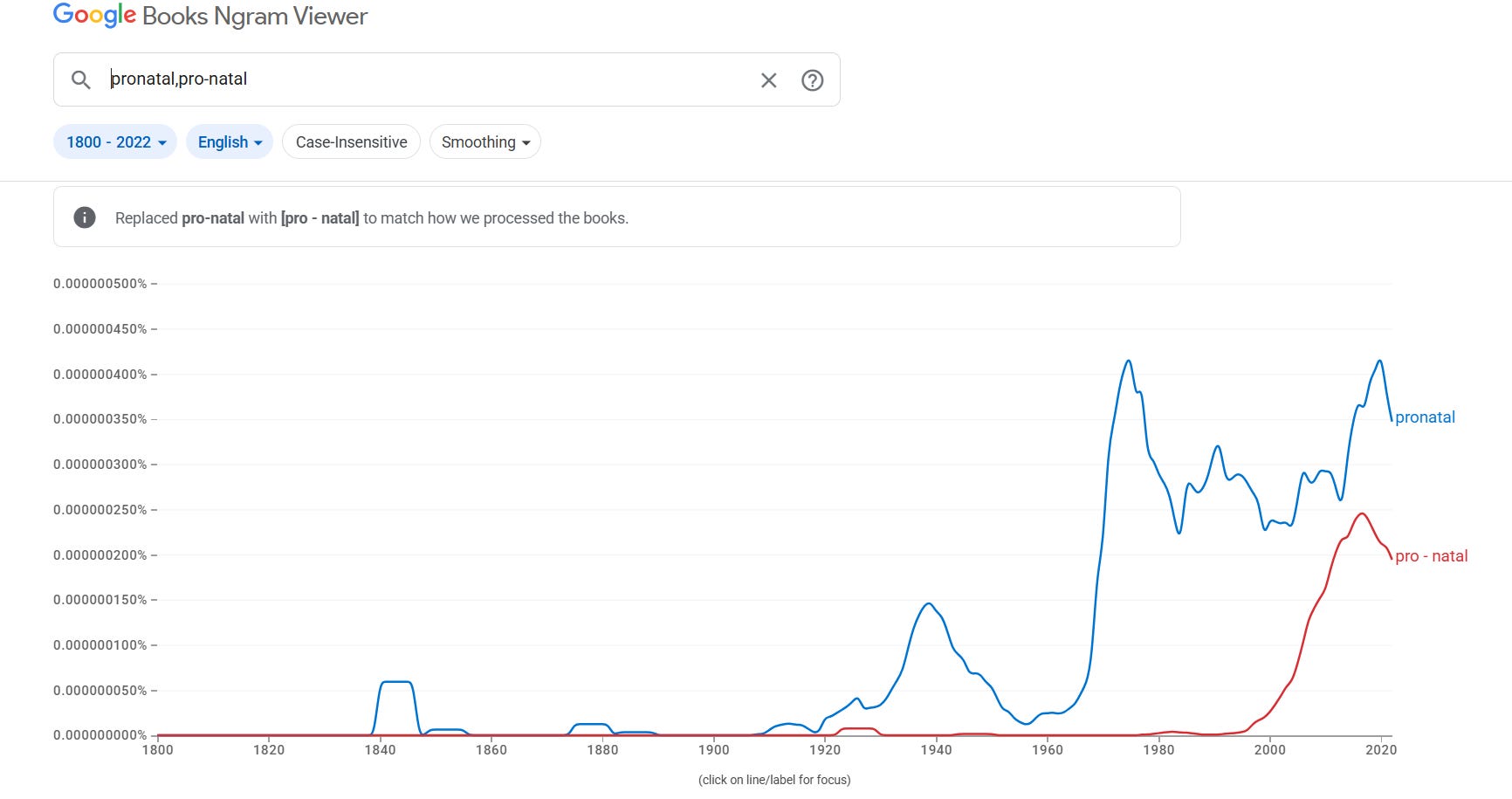
It comes from French, which doesn’t use the hyphenation approach. I’m aware that Substack and Word put the squiggles under it, but, in fairness, Substack on my browser puts squiggles under the word “Substack.”
This may seem like a weird tangent, but the fact that all the critics of pronatalism literally can’t even spell the world correctly and don’t realize they’re spelling it a way nobody who’s a pronatalist does tells you a lot about the extent to which these arguments are based in scrupulously honest thinking vs. “beef is good for clout.”

So okay, why not pro-child?
Well, pro-child could be pro-birth. Or it might not! Quality-Quantity tradeoff believers can very easily argue that having (additional) children is anti-(existing)-children! The name is a bad one because it doesn’t say what you’re for. Obviously, I also do want kids to have good lives, but that really is a separate set of issues to some extent! At some limit you could say, “Lyman why not just rebrand as being pro-good-things and anti-bad-things?”
Because you need a label that says what you’re about. We are not living through a world-historic rise in child mortality or child abuse. We are living through a world-historic decline in child birth. Hiding the ball on births really is dishonest, and adopting a term that obscures the birth issue simply isn’t going to succeed in moving the ball forward. People eventually realize you want to raise the birth rate, and if they realize it under what feels like false pretenses, they appropriate treat you like a liar and a trickster.
Patrick Brown Wants Everyone To Get Along

Patrick’s title is his thesis: you should be kind of pronatalist, but really, please don’t be cringe.
Are those of us in the pro-family tent all, as Lyman Stone would suggest, pro-natalists now? Is it possible to seek pro-natalist ends without involving public policy means, as Ivana Greco wants to see? Can you ignore the, frankly, off-putting behavior of some of the most vocal Pro-Natalist advocates and nonetheless adopt the label yourself, as Richard Hanania says he has done?
The short answers, respectively: Somewhat, not particularly, and not especially. You can, and should, want to see more babies born, and more policies instituted to help more families start and thrive, without ever going full Pro-Natalist™.
So to clarify that, he’s saying that I’m more-or-less correct that anybody who wants more babies is a pronatalist, that Ivana is wrong that you can’t involve public policy in this stuff, but that, indeed, if the pronatalists are cringe, you must maintain a safe distance from them.
So this is the third of three articles whose actual substantive argument really is “Pronatal guys are cringe, stay away, even if they’re substantively correct.”
And I just don’t accept that! And as it happens, one of the people I often disagree with but whose work I also enormously respect (Catherine Pakaluk) seems to disagree with “hiss and stay away” as well, since, like me, she spoke at NatalCon, which was a major epicenter of the stuff that was cringey, weird, bizarre, offensive, etc, etc. You really can just be a pronatalist without endorsing every single thing ever said by another pronatalist!
Patrick T Brown goes on:
But certainly not everyone with pro-baby/-family sympathies can find much worth cherishing in the Pro-Natalism™ movement as it stands today, the one that holds conferences and hosts podcasts and gets endless media profiles. By my lights, Pro-Natalism™ offers both too much and not enough to get us to a healthy societal trajectory.
Seriously? We’re supposed to act like the rise of pronatalism wasn’t a major force lurking behind the CTC increases under Trump I and Trump II? We’re supposed to pretend Elon’s public presence isn’t related the rapid growth in the share of people who think low fertility is a problem? I’ve been very critical of a ton about Elon, make no mistake— but this bit trying to claim that the cringe pronatalists didn’t do much of note, son the only reason pronatalism is a conversation is because the cringe fertility-worriers are successfully winning the public relations battle. The establishmentarian hemming and hawing is very much losing the public conversation, the cringey “It’s the end of the world! A civilizational collapse!” take really is winning hearts and minds, like it or not, and the result of this is that there’s real pressure on the administration to actually do stuff. Are we supposed to act like JD Vance’s public pronatalism is divorced from the online culture of conservative dude pronatalism? That’s insane! We’ve all listened to the podcasts! It seems obvious to me the actual subtext in all of this is just a desperate hope that Vance will not be the nominee. That’s what all of this really is right? When we talk about Certain Online Fertility Catastrophe Bros, the people being subtweeted are the richest man on earth and the Vice President of the United States of America, and I just think that I’m not 100% confident betting against that hand.
You can hate the cringe pronatalism I guess, certainly there’s plenty I have beef with, but pretending like it’s not the reason we are getting any movement on family policy is absurd. It obviously is. Pronatalism is the force driving family policy, not the other way around.
Next, Patrick T Brown criticizes two perspectives. He criticizes Ivana Greco for saying she doesn’t think the USG should care about fertility, because yeah it really would be super bad if our country dwindled! But he also criticizes me for the desires-based pronatalism. He says:
For instance, much of the movement’s energy is currently rhetorically grounded on there being what we might call the “desire gap” — the gap between desired and actual fertility that Hanania foregrounds his contribution with. I (along with Stephanie H. Murray, for The Dispatch,) find this far too thin a reed on which to hang the justification for pro-family policy. Individual desires hardly spring from a vacuum; they are a function of the culture, economy, and society in which they are formed. After all, there are two ways of closing a “desire gap” — realized fertility could go up, or ideal fertility could go down. And we are seeing signs that preferences for children are shifting downwards. If the desire for children converged down to where fertility rates are today, I would not consider that to be a win, even if more people were technically “realizing” their fertility goals. As Murray wrote last year, “We’ve got to hold two truths at once: that no one ought to be coerced into parenthood, and that we will all suffer if no one raises kids.” A pro-natalism, or Pro-Natalism™, that doesn’t speak to that reality — that only rests on the ground of “unfulfilled fertility desires” — will sound tinny when rising affluence and ever-expanding options for consumption continue to make parenthood feel less appealing in relative terms.
So think about the argument here. Patrick thinks we should worry about falling fertility, we should not be bound to consensual, voluntaristic policy… but that other people are the cringe ones! You see the issue right? If we’re not bound by the preferences of people, then we’re… well… well we’ve been here before. Here’s how it ended:
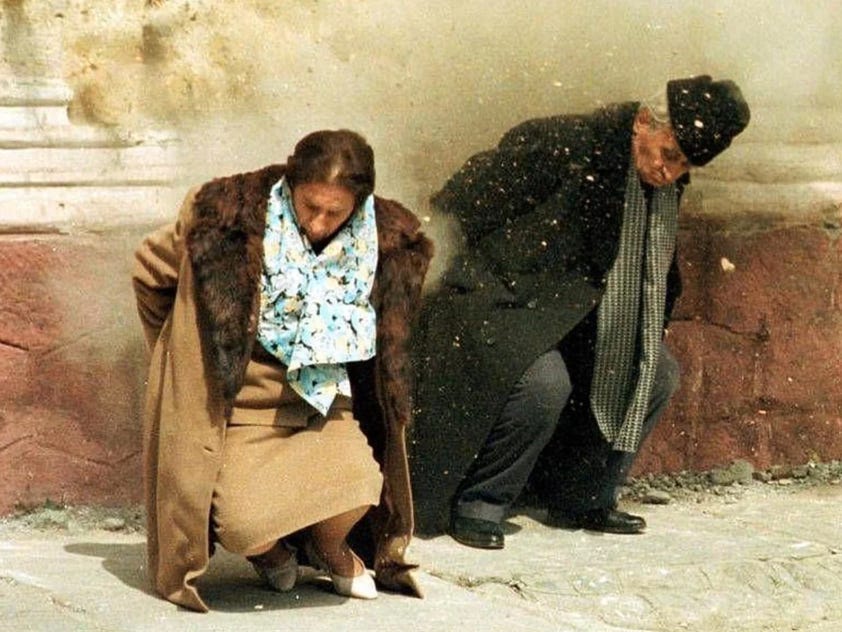
Now, I want to be clear: I don’t think Patrick actually favors Romania-style coercive policies! He obviously doesn’t because he’s an extremely decent and thoughtful person!
But not everybody is as decent and thoughtful as Patrick T Brown (it’s well established fact I am much less kind, for example)! Once we start telling policymakers their demographic policies don’t have to be bound by what people say they want, we really are playing with fire. I think it’s a horrible choice. Authoritarianism is on the march all around the world in various flavors. I want fertility to recover, but I don’t want fertility to be a weapon in the hands of authoritarians. The best way to achieve that is to make policymakers publicly bind themselves to stated preferences, for all their faults.
Now, to the broader point, I totally agree with Patrick T Brown that a world where the desires gap closes simply because desires fall would suck. I have worked with a foreign government in the past where they’re confronting an issue not totally unlike this. And my advice was basically: don’t bother with tax credits or baby bonuses. You need to start by figuring out what went wrong on the desires side and try to persuade your people kids are even a good idea at all, then we can talk about pronatal policy. I have refused to work with a government in the past precisely because they wanted to raise fertility above what people reported desiring for themselves. I will not be a part of the 21st century’s Decree 770, and I worry that a lot of people of good conscience and good intentions are not read in enough on the state of this issue in governments around the world to realize where things are headed, and as such are willing to play faster and looser with the sovereignty of human individual choice over state priorities than they should be. Before the 21st century ends, there are likely to be widespread coercive fertility campaigns in many countries. I would prefer America not be one of those countries of course, but I would also prefer American pronatalism to be clearly positioned not to be implicated even by association with those looming campaigns. Patrick is worried about being tainted by cringe today. I am worried of being tainted by the blood of what is coming. Those saying today that fertility preferences can safely be ignored by governments will rue their words once governments start listening.
Patrick T Brown goes on to discuss pronatalism and family life:
Take a look at Noah Smith’s recent entreaty to “save the human species” by devoting tens of billions of dollars to fertility research. I like a lot of the energy and am glad to welcome Smith to the pro-child cause! We actually have some really good hypotheses on a lot of the questions he’s asking, and I can tell that he hasn’t read up on them yet. Because of the 3,000 words in his post, how many times does he mention marriage, something that has a profoundly intimate relationship to fertility goals and preferences? You guessed it — not once.
As John Burn-Murdoch wrote last year for the Financial Times, the breakdown in marriage and relationship formation is one of the biggest (though not the only) factors driving declining fertility in the West. Even if Smith isn’t aware of that, or won’t admit it, perhaps you might be able to get a Pro-Natalist™ to admit marriage is important in a sheerly instrumental way — after all, married women have higher fertility than unmarried ones. But you will have a hard time getting them to criticize the way that Contemporary FertilityMaxxing is playing out on the cutting edge, raising more troubling areas of disagreement.
I agree with all of this but, at risk of pulling back the curtain too far, I can say with pretty high confidence that both John Burn-Murdoch and Patrick T Brown were familiarized with the empirical argument that marriage is the key lynchpin through direct ideational borrowing from overt pronatalists. I happen to know that both John and Patrick would have gotten their first empirical demonstration of the essentiality of marriage to fertility decline, and almost certainly their most repeated reminders of it, from… me. Because I’m the guy who published about 90% of the public-facing work demonstrating the claim! “Pronatalists ignore this thing that has entered the discourse because pronatalists introduced it” is a super weird argument to make!
He goes on:
If you cannot condemn Elon Musk’s modern-day harem, using surrogates and NDAs producing his “legion” of genetic heirs, your version of pro-natalism is different than mine.2 If you cannot distance yourself from the red-pilled men deliberately getting multiple women pregnant because of the “civilizational crisis facing the West,” your version of pro-natalism is different than mine. If you cannot look at the speakers invited to Pro-Natalism™ conferences and realize how uncomfortably quickly they veer into eugenicist or racialist rhetoric, your version of pro-natalism is different than mine. If you cannot look sufficiently down the road to realize that “hacking babies” with embryo screening will lead to a world that is less hospitable to the vulnerable (and possibly even fuel more selective entry into parenthood, lowering birthrates overall), your version of pro-natalism is different than mine. If you can’t see how blithe entreaties to “have more kids than you can afford” or mouthing off about how “a fertility rate of 6.5 is ideal from a utilitarian perspective” puts tremendous pressure on women without asking men to step up on the home front, your version of pro-natalism is different than mine.
And here, for the record, I whole-heartedly agree with all of this, I’m glad that Patrick T Brown has not grammatically admitted that he’s a pronatalist, since admitting to be a version of pronatalist is admitting to being a pronatalist. So in some sense, QED?
Nevertheless, he persists:
Of course not every Pro-Natalist™ falls into each one of these traps. But once you’ve added in all those caveats and differences of vision, the overlap between my hope for public policy and culture, and that of where Pro-Natalism™ currently stands as a movement, ends up going far beyond just aesthetics and tactics. They reflect different understandings of a life well-lived and a society well-ordered.
The issue with this is that the number of actual pronatalism events Patrick has attended in his life can be counted on— okay, literally on zero fingers, as far as I know. I go to pretty much every pronatalism event on the calendar. NatalCon was an epicenter of a particular variety of pronatalism Patrick and I have some disagreements with, but there’s a few problems with treating this as indicative of pronatalism generally:
NatalCon interestingly branded itself primarily with the word “natalism.” Conspicuously not the same as “pronatalism.” They took Jayson Fritz-Stibbe’s advice and rebranded to something simpler with less baggage. In fact, online, you really can spot a subtle varietal difference between people who talk about “pronatalism” and “natalism”! Yes, they’d I’m sure also identify with pronatalism, but it’s just wild that in all the discourse treating NatalCon as dispositive for pronatalism, nobody seems to have recognized that NatalCon intentionally distanced themselves from the pronatalism brand in terms of flagship brand asset choices!
NatalCon is not the only pronatalism event! I attend and speak at these things many times a year! I’m sitting in the dark on the floor of my hotel room after one right now! It had basically zero of the weirdness! It had mainstream respected demographers, it had politicians, it had business elites! And I can tell you, the actual money going into pronatalism, the places where there’s actual serious corporate sponsorship happening, is almost all “non-weird.” So much so that the “cringe natalism” side often gets upset about how slow and hesitant these things are.
My point is, Patrick speaks as if he has some substantive familiarity with pronatalism— he doesn’t. He hasn’t participated in virtually pronatalist events, he’s not even aware of basic discursive tells like the spelling of “pronatalism” that are typical of these groups. When he talks about “Pro-Natalism” he’s talking about a movement with which he has exceedingly little familiarity beyond replyguys on twitter.
None of this is a huge knock on Patrick! He’s a busy guy; he and I are both work-from-home-think-tank-dads-of-small-children, “You can’t have an opinion because you haven’t attended enough conferences!” would be a stupid argument, obviously Patrick is honestly reporting his impressions, and his impressions aren’t nothing. But I hope the reader understands his impressions reflect a comically narrow range of the world of pronatalism.
He goes on:
But it’s also because I think we owe it to the products of all this attempted pro-natal policy to enjoy the most stable and beneficial childhood arrangement possible — all else equal, two married parents — and avoid turning children into consumer products bought and sold by adults with dreams of various utopias.
This is a tricky thing. See, I wholeheartedly agree. Yes, two married parents. That’s what IFS is all for!
But… without providing biographical detail, I once was having a conversation with a very senior conservative thought leader about this. And we reached this point in the argument, and I asked him, “Sure, look, pronatal policy might increase unwed births somewhat, and I agree that unmarried parents are suboptimal for kids— but we both know that those conceptions were not summoned into existence by pronatal policy. For low-income unwed moms, we both know the whole leverage here operates through abortion: the conception behavior for that population is insensitive to policy, but the abortion choice is sensitive to policy. Are you really telling me it’s better to abort the child?”
This conservative thought leader told me, “Yes, it’s better they be aborted than born to an unwed mother.” This person, I checked, has described themselves as “pro-family” within the last five years. I’ve had a similar conversation with two other conservative think tankers who, likewise, describe themselves as pro-family. I want to be clear: none of these people are Patrick T Brown nor anybody else I have mentioned in this article! Patrick is genuinely a good and decent person and I feel confident Patrick would say, “Of course I’d rather the child be born than aborted!”
And that’s why you have to be pronatal, not just pro-family. Because there comes a time where welcoming a child into the world makes the family stats worse, where the child being born maybe leads to a divorce, or a disemployment episode, or the revelation of an affair. There comes a time where you really do have to choose: are you for babies, or are you for Respectable Conservative Family Policy? As for me, I am for babies. I will be the somewhat crass, definitely arrogant and obnoxious, way-too-mean-and-flippant-on-Substack guy that I am, in no small part because I’ve pretty much had it with the sins I have seen “pro-family” cover. There are no few pro-family conservatives, even many pro-life pro-family conservatives, who in fact, as a policy matter, are hesitant about pronatalism because they worry it means they might actually have to celebrate the lives of the poor. And my answer is: yes. Yes it really does mean that.
And that’s why it’s a good brand.
Been thinking about this a lot, and…in the words of British pediatrician D.W. Winnicott “There is no such thing as a baby…there is a baby and someone.”
The term “pronatalism” doesn’t even specify that the baby is born alive. It literally means “pro-birth” and gives “throw spaghetti at the wall, see what sticks” vibes.
The whole movement feels eerily quiet on the issue of how babies come into the world, what experience their mothers have of pregnancy and childbirth, and how that impacts their own health and how many children they have.
Just this week I was asked to explain to a 22 year-old why she should “never have kids again” (severe scarring and hemorrhagic blood loss with a second C-section).
I feel like I am constantly beating a dead horse, trying to get people to care about “my issue” (high quality maternity care) and no one gives it much thought, including in the pronatal camp.
I just want to say that I appreciate your work on this topic. I'm not a public intellectual of any kind, just a progressive mom who considers herself a pronatalist. I'll add, I think there's something beyond the unpleasantness of the racist/misogynist pronatalist fringe that makes progressives squeamish about associating with the *brand* even when they align with the goals. To be pronatalist is, I think, to assert that having children is better than not having children (putting things in the simplest possible terms), and I think that's something people in the progressive coalition are uncomfortable with. I think this is at least partly because there are so many childless people in progressive circles (including people for whom it's less of an active choice, like LGBT couples, or people who have unintentionally remained single) and it feels unkind or at least socially awkward to say outright that they have both missed the boat on the most valuable experience life has to offer, and simultaneously failed a vital civic duty. As a group, we're committed to the idea of all life paths being equal, and pronatalism feels like a violation of etiquette. I'm genuinely always nervous discussing pronatalist topics with friends in person, because I'm afraid to imply anything negative about my (many, many) childless friends.