Fertility Really Isn't Dysgenic
And some thoughts on international IQ measures

In this post I’m going to continue some reflections on dysgenic fertility. The reason why is pretty straightforward: I’m a conservative pronatalist, there are some other people who are conservative or, if not conservative, adjacent to conservative circles, and/or who are pronatalist, who worry a lot about dysgenic fertility. I think that worry is wrong, and I think that worry leads to inefficient policy preferences and really bad political choices, and these preferences and choices contribute to lower fertility. Simpler: I think dysgenic worries are part of the low-fertility complex. Freeing people of these worries, I think, will open up more possibilities for pronatalism.
As an aside, Emil may write a response to this article. If he does, I won’t write a rebuttal. Arguing about this online is literally his job. For many reasons, that means no protracted debate is likely to be productive.
Also, I’m making this whole post free.
This post has several main points:
1. “Within” dysgenesis is basically the only dysgenesis worth caring about; “between” dysgenesis doesn’t matter at all.
2. Even if “between” dysgenesis did matter, African intelligence estimates may or may not be psychometrically correct, but it is very obviously not phenotypically correct
3. And also some hereditarian estimates of selection coefficients seem misunderstood and possibly wrong.
4. There’s still no evidence that dysgenesis is a meaningful problem (and the latest genetic evidence shows a positive link between intelligence and fertility).
1. Within vs. Between: How Does Selection Happen?
I wrote an article on dysgenic fertility saying we shouldn’t worry about it, based on evidence showing there was little/no actual measurable dysgenic fertility within industrialized societies. Emil Kierkegaard wrote a response. You may or may not know Emil. He is a well-known advocate of a strong hereditarian thesis; basically, the idea that the traits important for much of human flourishing and life together are highly heritable, relatively straightforwardly so, and that these heritabilities can be easily estimated using existing methods. Note that the opposite position as Emil’s is not “heredity doesn’t exist.” The opposite position is, “Traits important for human flourishing are moderately or variably heritable” or “Heritability of important traits is complicated or not straightforward” or “Heritability estimates from currently-available methods are not very reliable.” Nobody in this debate says “heritability doesn’t exist.” The debate is one of relative degree, relative complexity, and judgements of the credibility of current methods. Emil thinks future science is unlikely to find anything overturning prior studies.
The implication of this is that Emil believes that e.g. Africans on average have quite low IQs, and these low IQs are not mostly due to environmental differences (like childhood stunting due to malnutrition, or childhood malaria exposure, etc). If I’m misunderstanding this view, Emil is welcome to correct me.
My article was about selection within societies. Emil did respond to that. I will take those responses at the end of this article. But Emil also used the classic debate strategy of spread, and introduced a new argument unrelated to the existing one:
He shows these two graphs, which point to his concern that because countries with higher IQs have few babies and countries with low IQs have many babies, there is therefore dysgenesis:


So, Emil says that humanity is getting dumber even if people in industrialized countries aren’t.
I’m going to dispute that in a second. But to start with, we should realize that:
It doesn’t matter if the average human gets dumber via composition effects even while people within countries are not getting dumber.
Think about this, really, think about it! A world where Europe’s population share is 50% lower than it is now is a very different world of course, but national-level fertility rates are unstable and falling everywhere. Provided that within-country dysgenesis isn’t an issue, we would have a brief episode where humanity gets dumber, then by 2100 or 2150 everything will go back to normal. In the meantime, Africa will be much bigger, but the Congo isn’t about to build a navy capable of making an amphibious landing in Portugal or something (especially if Emil is right that the average African IQ is 70— you’re not gonna build ballistic missiles at that IQ). Literally the only way the growth of a supposedly low-IQ African population is a problem is if the wider world chooses to make it one. Even if their average IQ is 70, there will be many geniuses among them, talent the West can recruit to its own advantage. Even if there are billions of Africans, again, there’s just no way they are going to go and conquer Korea or something, unless Korea chooses to invite them in as immigrants. Emil is probably very opposed to letting in lots of African refugees, but the key point is:
A large number of allegedly low-IQ Africans are only a problem to the extent the wider world chooses to make it OUR problem.
Seriously, what’s the threat to me if Congo has twice as many people in it? When I was born, the DRC had 35 million people. Today it has over 80 million. This harmed me not at all. This kind of dysgenesis doesn’t matter at all.
And at a broader level, I’ll drop a landmine here and say that if Emil’s argument is actually that selection primarily occurs at the level of very large population groups and not at the level of individual kinship lines, then, lol. Goofy.
2. Africans Aren’t Idiots
Now let’s get to the most explosive kernel here: intelligence. I’m not going to rehash the entire debate on international intelligence data, nor even link to it. I’ll just lay out my beliefs plainly: the data is all very poor quality and it’s not really clear that either side is very honest about their inclusion/exclusion criteria, and absolutely nobody has actually worked out the right way to compare all these different data sources. Nonetheless, virtually all of the data we do have points to a greater or lesser degree of overperformance in cognitive tasks by Asian-ancestry people, and a greater or lesser degree of underperformance in cognitive tasks by African-ancestry people. Almost everybody today accepts this descriptive fact. There is of course a lot of debate about why these trends exist. Hereditarians when they’re tweeting and meme-ing seem to say it’s basically all about genes; when they’re writing long form pieces they seem to say it’s mostly or predominantly about genes. Environmentalists say the opposite.
I’m not going to wade into that debate. Rather, I want to think about what intelligence even means, and point out why “Chad has an average IQ of 67” is such a strange and uninterpretable sentence.
Almost all people who live in clinical institutions due to mental disability have IQs under 60, and most under 50, and the most severe cases under 40. Tested IQs under 30 are quite rare. The reason why is that IQ is more or less normally distributed in the famous “Bell Curve.” So if a group’s average IQ is 90, IQ generally has a standard deviation within a group of 10-20 (conventionally 15 in benchmark populations), so you’d expect 2/3 of people to have IQs between maybe 75 and 105, 95% of people to have IQs between maybe 60 and 120, and 99.7% between 45 and 135. As you can see, extremely few people would have IQs under 50, i.e. extremely few people would have IQs requiring institutionalization.
Now imagine a society with average IQ of 65; say, Malawi (the IQ data that Emil cites claims Malawi has an IQ of 65). Let’s assume a standard deviation of 15 as is conventional.
What share of Malawians would have IQs under 50? The answer is about 16%. So the claim that Malawi has an average IQ of 65 is, correspondingly, a claim that 16% of people in Malawi are so cognitively nonfunctional that if they lived in America, we would institutionalize them for clinical disability.
Think about other claims implied by an average of 65. This, correspondingly, implies extremely low executive functioning and very little ability to make numerate long-term plans. Kids with an IQ of 65 are kids who got put in special ed classes at your primary school— think about their ability to make mathematical plans.
Now realize: Malawians are overwhelmingly subsistence farmers. Every year they have to make months-in-advance plans about fertilizers, pesticides, and seed varieties, tend those across months, and then harvest. How plausible is it that these decisions are all being made by the 1% of Malawians with IQs over 100? Extremely implausible!
As it happens, I used to work on African agriculture as a cotton analyst at USDA. I spent a lot of time talking to illiterate rural farmers in the cotton-growing regions of the world. I’m not gonna say the cotton growers of Chad or Uzbekistan or Turkey or Texas are crypto-Nobel-prize winners, but I will say that there were not phenotypically obvious behavioral differences in most cases. The guy in Africa knew his yields about as well as the guy in Uzbekistan or Alabama, and could talk about his plans about as clearly. There were some differences (the guy in Alabama had drones and computers to help his estimates, while the guy in Africa had a very small plot to estimate simplifying his math), but if you travel around Africa, what you will see is tons of uneducated people doing math. Making change at markets, avoiding getting cheated, making plans for fertilizer, etc. What you won’t see is one-in-every-six people being a barely-verbal person incapable of managing their own affairs.
I’m not arguing here that the IQ-test-proxies in Africa are “wrong.” They may or may not be psychometrically valid.
But the phenotype that arises from a given tested IQ in America is clearly vastly worse than the phenotype arising from the same tested IQ in Africa.
Now, some people will say “But Lyman, at the societal level, IQ and GDP per capita correlate well!”
Ah…. but do they? See, the IQ database, such as it is, is almost always crushed down to the national level. But at its underlying level, it’s a series of estimates across many countries and different times. So we can actually look at change over time. What happens if we drop these national IQ estimates into a panel model? We get 318 country-year datapoints. Here’s how it looks cross-sectionally vs. fertility and GDP per capita:
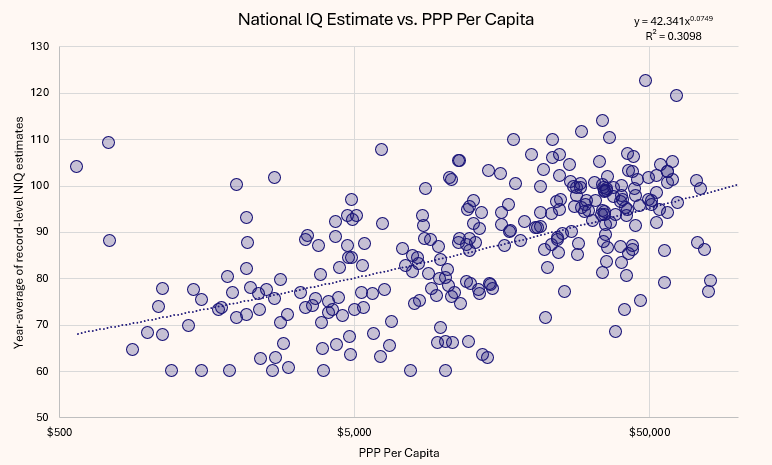
Besides two upper-left outliers due to China in the 1970s, it is indeed positive: more IQ, more PPP per capita, though it’s fairly noisy.
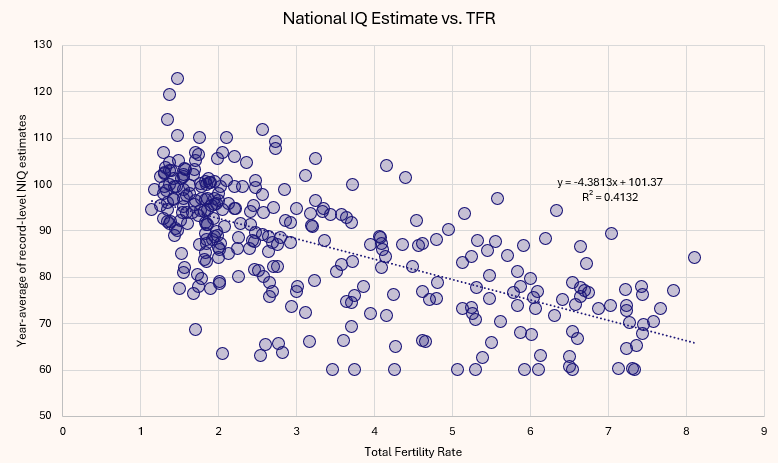
TFR is also as expected.
Okay, but now, what about a panel model?
Bupkiss:
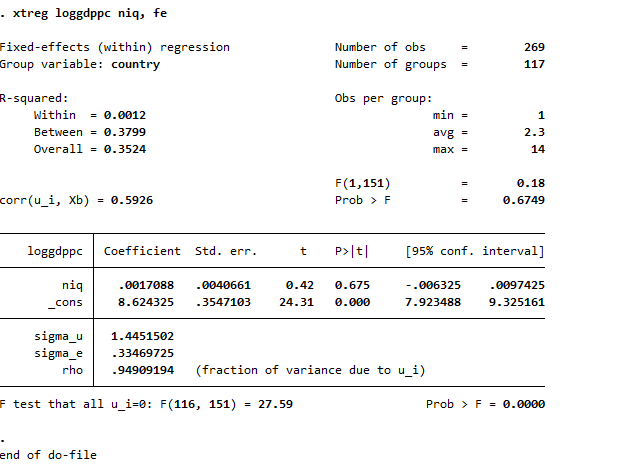
Same is true with any controls I throw at it.
And while the hereditarians may tell you “IQ doesn’t change much,” this is bologna. Here’s Cambodia, for example:
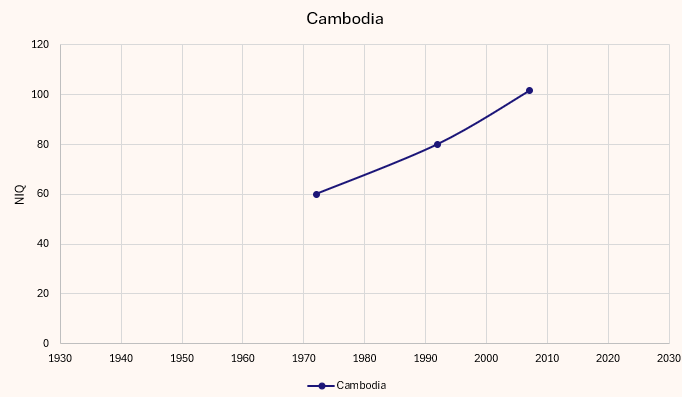
What’s so funny about this is between the early-1970s estimate and the early-1990s estimate, the Khmer Rouge systematically hunted down and killed virtually the entire intellectual class in Cambodia. So either high education in Cambodia didn’t proxy for IQ, or killing smart people raises IQ!
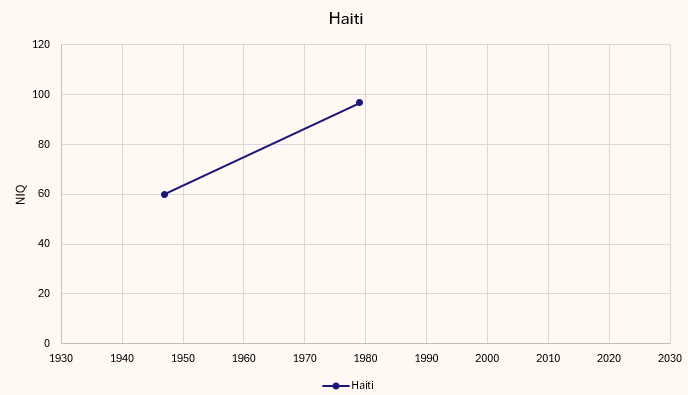
Or consider Haiti. Haitians are quite smart these days!
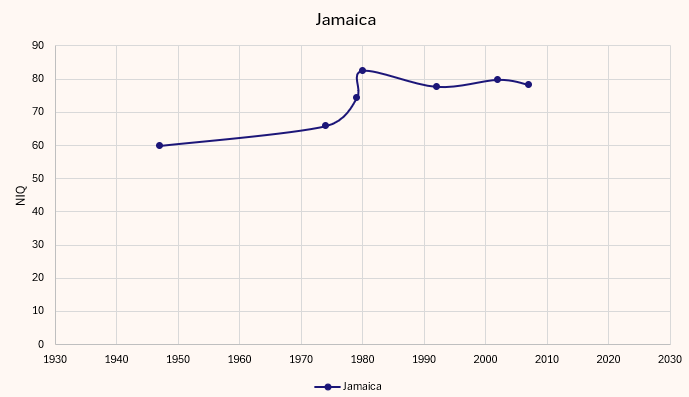
We have lots of datapoints for Jamaica, and look, it went up!
Here’s just a cluster of alphabetically close countries:
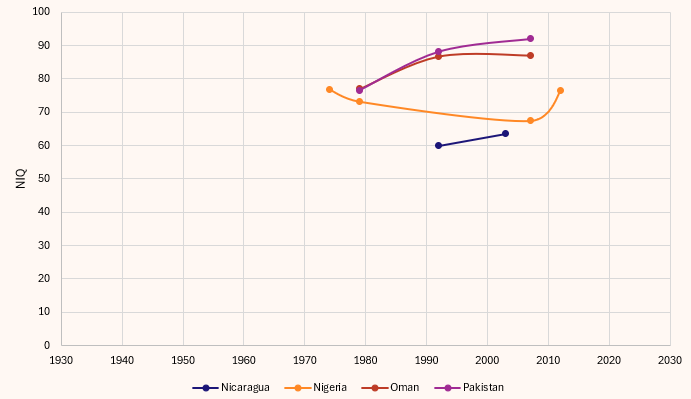
So national IQ apparently changes a lot. It rises, it falls, etc.
And those changes aren’t correlated with the supposed correlates of IQ. If IQ causes GDP per capita, then rising IQ should be strongly associated with rising GDP per capita. In reality, there’s no correlation. The IQ data is just noise with respect to this stuff.
And so, we should be very skeptical that, whatever the African IQ is measuring, that it’s anything like the phenotype of very-low-IQ that Westerners may have in mind. I’m not quite willing to say the data doesn’t mean anything, but it clearly doesn’t have an obvious connection to discernible phenotypes.
(By the way— a pure hereditarian would insist that African IQ is around 80-90. Why? Because in the highest-quality data on African-ancestry people, namely, tests in the U.S., African-ancestry people tend to score around 80-90 on average. If you’re really a strong hereditarian, the U.S. environment should not boost IQ very much, which implies that the national IQ data is incorrect)
3. Measuring Selection Is Hard
Now, Emil posts this graph. This graph purports to show, based on data on IQ and fertility across countries, how much IQ changes per decade:
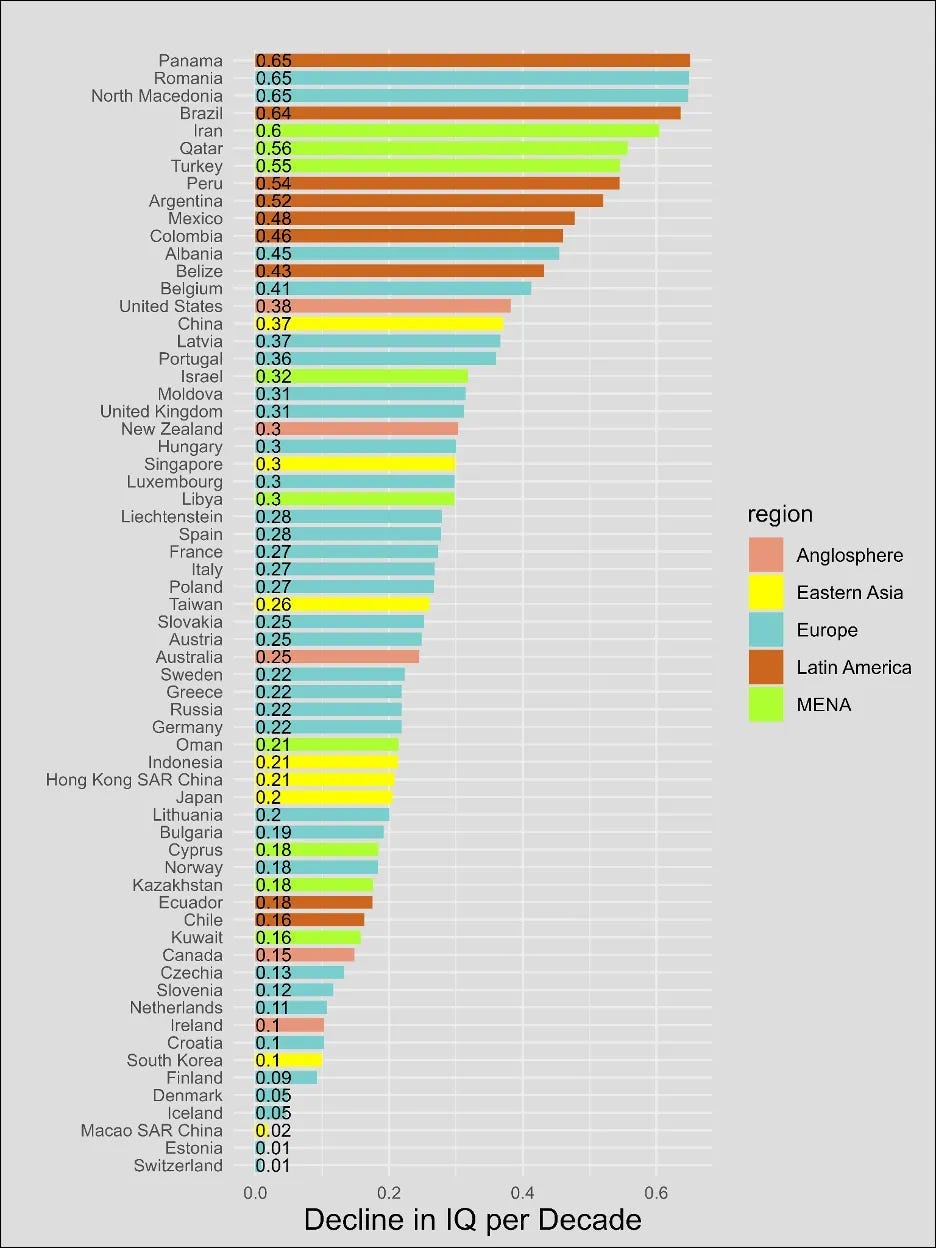
Luckily, we have data for some of these countries from the nation IQ database! Let’s see what really happened!
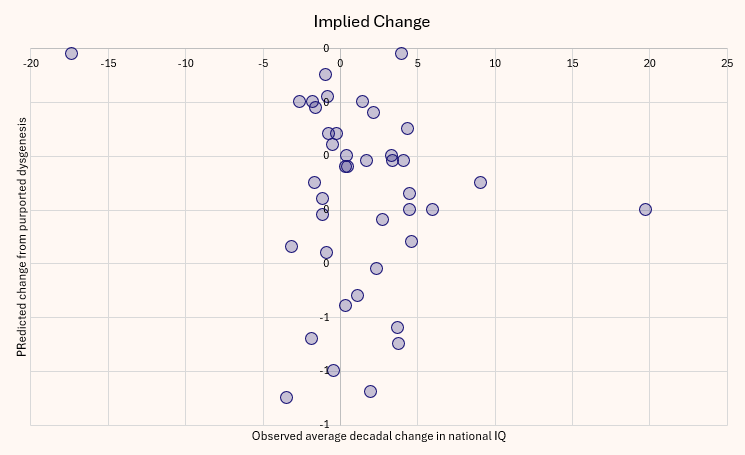
While dysgenesis predicts fertility should fall, observed changes are mostly positive, and uncorreleted with predicted dysgenesis.
So the hereditarians need to pick a side here. Is the national IQ data correct, or is their dysgenesis estimate correct, or are dysgenic effects so trivially small that they’re swamped by the large effects of changing environment?
For my money it’s some combination of incorrectly measured dysgenesis, incorrect national IQ data, and meaningful environmental effects.
Speaking of dysgenesis, what if we use a shorthand? I assume that Emil broadly agrees that educational attainment is very intelligence loaded. The DHS surveys can give us estimates of completed fertility and educational attainment for tons of poor countries over time. Let’s see what that tells us! Doing all DHS rounds is a huge computational lift, but I happen to have all the Bangladesh rounds on hand, and the national IQ dataset has IQ data for Bangladesh, and while Emil’s graph doesn’t show a selection factor for Bangladesh, their replication files have data which I think implies that Bangladesh should have negative election around 0.2 to 0.4 IQ points per decade. So Bangladesh should have a lot of negative selection.
Here’s the national IQ data for Bangladesh:
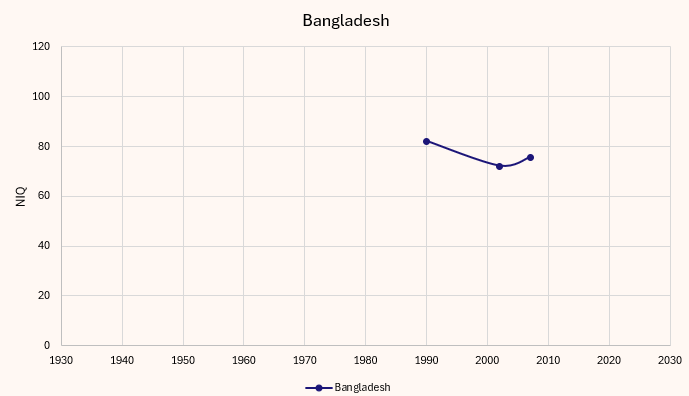
So between 1990 and 2010-ish, about 2 decades, IQ fell allegedly 7 points. That’s about 10 times as fast a decline as the selection coefficient suggests.
But what’s actually happening with fertility and education?
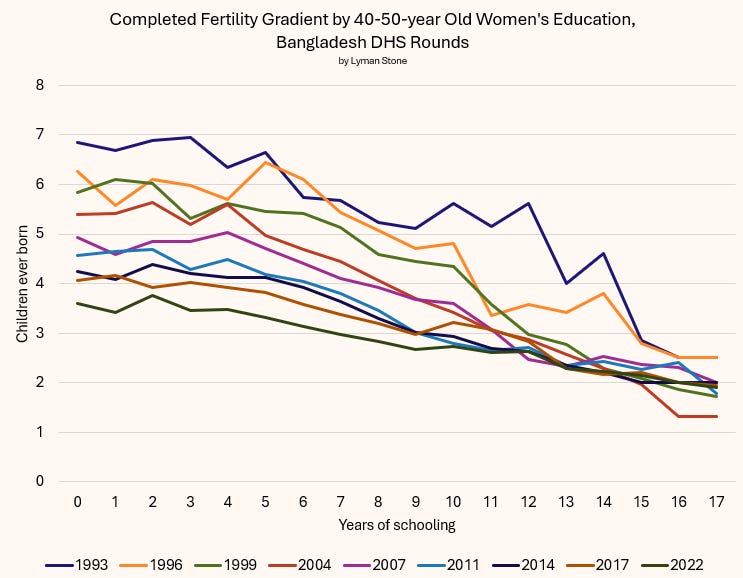
The dark blue line up top is the education-fertility gradient in 1993. Orange below it is 1996. Green below that is 1999.
At the very bottom, that dark green line is 2022. Brown above it 2017.
Look what happened! There was virtually no change in fertility for people with 12+ years of education between 1993 and 2022. But fertility for women with <12 and especially <8 years of schooling plummeted.
Here it is again, but now just the average for women with 0-10 years of education as a ratio of women with 15+ years education, over time.
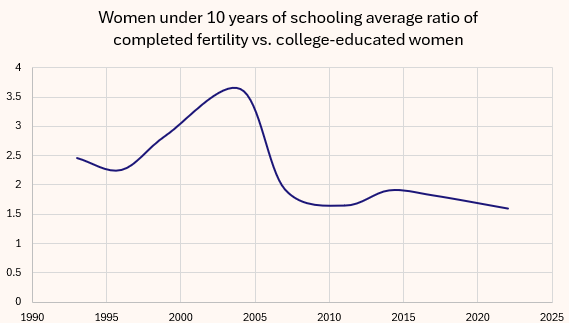
There’s some oscillation, but the degree of negative selection by education attainment has definitely fallen over time. Before 2005, women who didn’t finish high school averaged maybe 2.5 times as many kids as highly educated women, whereas since 2010, just 1.6 times as many. I suspect this will continue to be the case.
Why? Well, here’s the history educational selectivity in the U.S.:
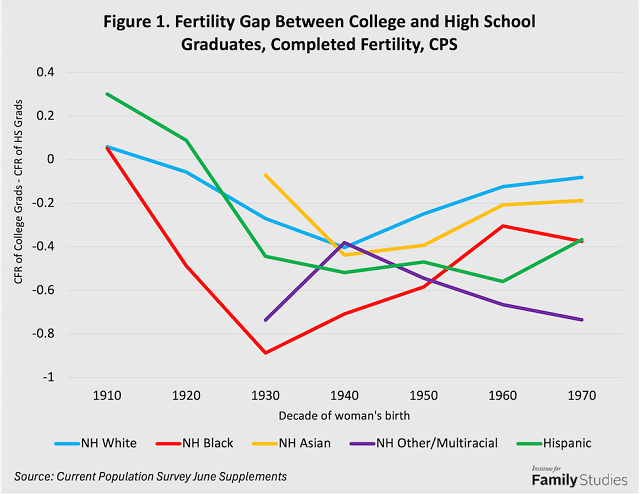
You can see a U-shape. Fertility had little/no relationship with education, then a negative one, and in the latest cohorts, again less and less relationship.
Here is the correlation between genetic markers for cognitive ability and fertility across US birth cohorts:
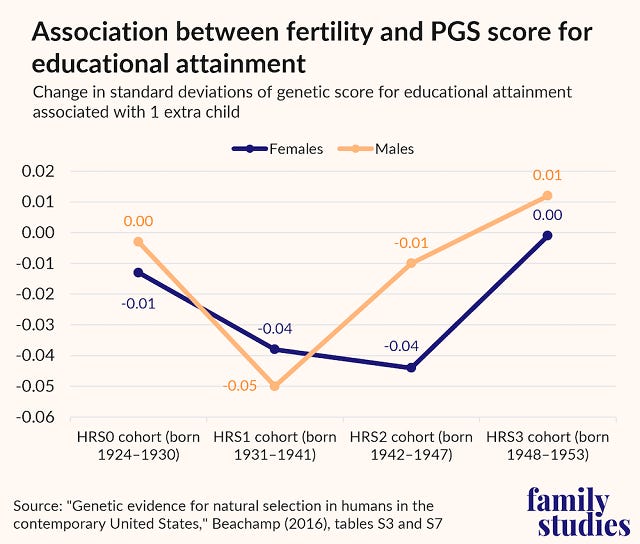
In fact, it’s widely known among demographers that fertility is becoming less-and-less negatively, and in some places positively correlated with educational attainment!
The ephemeral negative correlation between fertility and educational attainment is because of the class-biased spread of developmental idealism.
Early adopters of developmental idealism tend to be high-status. So high-status fertility falls first. Then low-status groups catch up, and eventually the human evolutionary norm re-establishes itself. This process takes a few generations. Right now, a lot of low-and-middle-income countries are at the bottom of the U-shape. This process will right itself. No need to wet your pants.
In other words:
Hereditarians interpret highly time-variant indicators, whether national intelligence or selection coefficients, as time-invariant, and so assume huge long-run dysgenic effects when there are none.
4. Back to Within Dysgenesis…
This brings us all back to “within” society dysgenesis. Here, Emil’s critique was, well, not much of a critique. I’ll take it bit by bit:
Icelandic Survival
I pointed out that genes related to fertility and education both bias survival, so estimates from point-in-time registries aren’t credible. Emil responded by noting that the Iceland paper tries to control for this by looking just at people born after 1940, i.e. who were between 58 and 74 when sampled. He believes this approach is suitable. It is not. Emil should look up the Age-Period-Cohort conundruum. And yes, genes have no “period” effect besides measurement/sampling error, but it remains the case that only age was credibly observed. A small country like Iceland would of course also have the problem of emigration.
The way to do this properly is to take, say, 1 out of every 1,000 of the blood samples taken from newborns (they’re all pricked for a sample), sequence that whole genome, do that for 30 years, see how average PGS scores change. Anything else is a biased estimate since parents move, people die, people fail to get sampled, etc. A sample need not be large to be representative, and a sample which is large may still be very biased (the second-largest regular social survey in the U.S., the Current Population Survey, is notoriously biased with respect to sampled population and household status, despite having tens of thousands of people sampled every month!).
Moreover, longevity is a tricky beast. Imagine a bunch of genes regulate longevity. What kinds of longevity-regulation are we most likely to detect? Well, generally, stuff that kills people after age 30, but before age 70. Why? Because we don’t have a bunch of cohorts of people whose genes we sampled before they were 70, who are now over 70. Why? Because large scale genetic databases are quite recent things! Most of the longevity variation we can predict from genetics probably is not variation in stuff that kills you after the average life expectancy anyways! It’s still that would kill you prematurely because those are the strong signals that occur early enough in life to be easily detectable in the cohorts we have. So no, limiting to people ages 50-74 isn’t enough. We need to limit to only cohorts under age 30 or something like that. Dysgenic fertility isn’t a set of predictions about the genetic mix of 65 year olds; it’s a set of predictions about the genetic mix of newborns (or, perhaps, schoolchildren).
Estonia and Finland
Emil is confused how I did the Estonia PGS estimation. Simple: Estonian population geography is reasonably well-known back to 1900, so I inferred the population shares from that and multiplied. It shows essentially no meaningful decline. He says somebody else is working on the data and finds a decline. I shall wait with baited breath.
But in Finland where we have data, Emil helpfully found more precise data than I had! Anyways, here’s all the raw data:
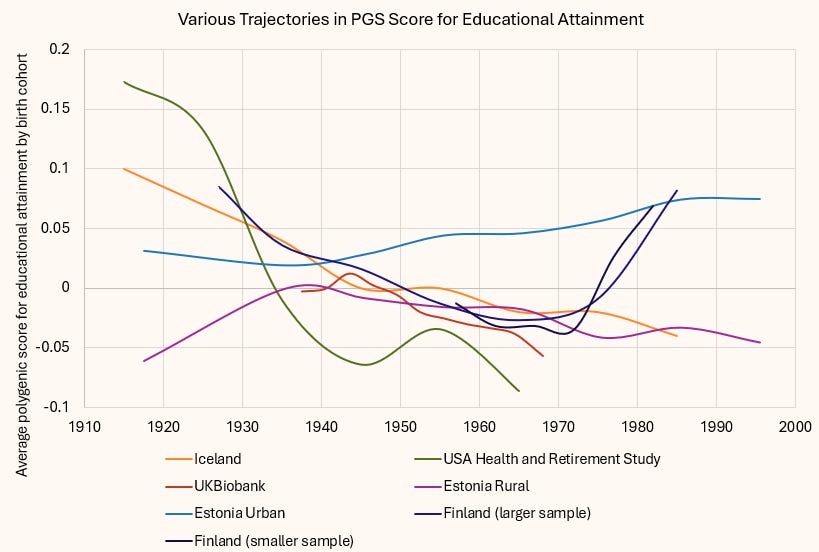
If you think that’s a picture of a uniform dysgenic decline, you’re on drugs. Estonia’s two regions go opposite direction but plausibly offset. Iceland does have a steady decline. Also, Icelanders are basically all cousins. In fact there are so many “not immediate kin but not that distant kin” Icelandic marriages that we actually have studies quantifying this kind of “incest-adjacent” union’s effects on fertility. Closer-kin Icelanders have more babies, there are lots of close-ish-kin Icelanid couples, inbreeding is bad, hello Iceland.
UKBiobank is definitely the actually most persuasive case here. Big dataset in a “big society.” In fairness Brits also have bizarrely high rates of incest. But still, the UK case is interesting.
On the other hand we have Finland. Trends looked dysgenic…then suddenly wasn’t. Emil suggests this is probably a sampling error. Right, sure, the exact same sampling error occurred across multiple different sample populations across several thousand people. It definitely could happen. Or maybe… maybe there just isn’t a general rule of dysgenic fertility! It’s weird because in his post, Emil seems not even to notice that the first, large sample showed an increase across two recent cohorts, not just one!
The U.S. has a massive dysgenic change 1910s-1940s. That’s definitely not just fertility. Especially since the identical paper providing that estimate, again, gives us this graph, which shoes that the actual EAPGS genes predict virtually no difference in fertility:
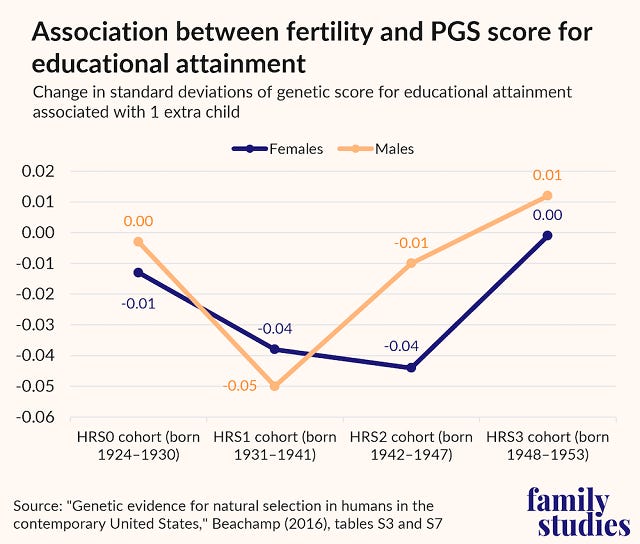
I want to end on this chart. This chart is what we actually need to know. We need to know how big a difference in fertility is predict by the PGS score for some cognitive trait. That is the actual direct measure of dysgenic fertility. Cognitive phenotypes are measured with lots of error and have environmental components, and heredity is not 100%. So “fertility of people in group proxying for IQ” tells us almost nothing. We need to know actual CognitionPGS—>Fertility linkages.
Luckily, a new study does this, and it does it within families, meaning with the best current method for controlling for environmental biases, essentially leveraging Mendelian randomization but across the whole genome. What does it find? If I’m reading supplementary table 7 correctly, it says that “when a sibling has 1 standard deviation higher cognitive performance than another sibling, they average 0.25 more children.” This same paper shows that without sibling controls, “1 standard deviation higher cognitive performance is associated with 0.08 fewer children.”
Smarter siblings make more siblings.
But we already knew this! Why? Because smartness is strongly correlated with mental health! And we already knew that bad mental health has massive negative effects on fertility (broader review of evidence here). It would be truly bizarre if mental illness reduced fertility, mental illness was strongly negatively correlated with cognitive ability, but cognitive ability also caused reduced fertility.
So there it is folks. No need to worry about dysgenic fertility.
I think part of section 1 seems a little flippant. You’re right that the Congo isn’t going to invade Portugal militarily, but recent history has shown us very clearly that a) millions of people can and will move from the third world to the first world and b) stopping this from happening is extremely hard, if not impossible, for democracies. If even a fraction of the 3 billion Africans that will exist in the near future come to Europe (or indeed America), then between dysgenesis will matter for these countries.
IQ alone is no longer, and has not for a very long time, been the deciding factor in whether or not someone is intellectually disabled
The reason that an IQ of 60 is considered intellectually retarded in the Western world is not because the IQ of 60 makes someone retarded, it is because this level of intelligence is so rare in the general population that it is more likely than not that that person has such a low IQ for a reason other than simply being on that end of the bell curve. For example, being intellectually disabled. There is some environmental effect in Africa.
Flynn effect is mostly explained by non-g, some studies score differently because they are just bad studies for some reason or another or there is just different methodologies that produce some noise. and Haitians definitely do not have an IQ of 98. https://www.sebjenseb.net/p/average-iq-of-haiti
Most hereditarians I’ve spoken to agree that African IQ is low partially because of environmental factors, most likely those non-g factors that cause the flynn effect. If Africa was like the US it would probably be more like 75-80. Also, Africans in the US are a bad proxy for Africans proper because all African Americans have White admixture, sometimes very high amounts, and American-Africans are undergoing a selection effect.