
Recently rationalists have been arguing about if the Fatima miracle is real or not. I am a Lutheran and so not very invested in this. I am also a WASPish American with this man as my direct ancestor and so I sort of reflexively snicker at Mariolatry. This is a delayed Reformation Day post by the way and I’m going to be doing some dunking on Rome.
But Richard Hanania had an interesting piece about Fatima, and he makes this argument which, for the record, I think (as you’ll see) is quite credible as a rebuttal to Fatima’s authenticity:
One reason I don’t put much stock in the testimony of early twentieth century Portuguese peasants is that my mom’s side of the family are poor rural people from the third world. They often report on supernatural events in their lives. From a very early age, I never took any of this seriously, with first-hand experience leading me to conclude that they were very bad at thinking and educated Westerners were much more in touch with reality. My Arab relatives would see their deceased family members in dreams and witness miracles large and small in their personal lives, particularly during moments of personal turmoil or tragedy. They would lie constantly in order to avoid social awkwardness, and discounted things said to them by fellow Arabs on those grounds, while considering the words of white Americans to have more credibility. If there was something you needed to believe for tribal reasons, you were shunned by the rest of the community if you dissented. I haven’t done research into the culture of early twentieth century Portuguese peasants, but I wouldn’t be surprised if there were similarities. The fact that so many people showed up expecting a miracle, based on nothing more than the words of a ten-year old girl who claimed to speak with an imaginary being and her cousins, is itself pretty discrediting for that community.
None of the articles I’ve read on Fatima have taken seriously the later social pressure that one could imagine would’ve been applied to get others to claim that something supernatural happened on the day of the supposed miracle. Some have pointed out that the Portuguese regime was anticlerical at the time and there was a secular intelligentsia. That is presented as indicating that it was less likely that a delusional belief in a miracle could have taken off in such an environment, but it can just as easily be argued that the politicized nature of overt religiosity contributed to the community coalescing around a story that could serve as a rallying cry against a hated regime and put their little village in the middle of nowhere at the center of the cosmos. I’m no historian of Portuguese politics, but I don’t think anyone else who has written about this is either, and it’s annoying to see people cite the existence of an anticlerical elite as clearly making claims of a miracle more credible. After all, when Khomeini was seen on the moon, the Shah was still in power.
In response, Scott Alexander said “Richard seems to think that religious people - including educated ones - have weird enough mental structures that they can hallucinate basically anything if it’s congruent with their religion.”
To which Richard Hanania replied:
More precisely, they have weird enough mental structures to either 1) hallucinate; or 2) lie or misremember things to bring them into conformity with the views of their community. It doesn’t require the people actually saw the miracle, they just had to at least say they did later. I think this is well supported by anthropological evidence.
“Suppose that 10,000 eyewitnesses say they saw Richard stab someone in broad daylight. Can the defense argue ‘Well, people often hallucinate, and most of the witnesses were liberal, and the liberal worldview makes it attractive to imagine a right-wing blogger stabbing people, so who knows if he did it or not?’”
A key claim of mine is that societies that are at a much more primitive state of development are more likely to have this happen. 10,000 liberals, whatever their flaws, are not prone to the same kind of conformity-based disconnect from reality (yes yes, what is a woman and all that).
Enter Lyman. I said:
I think the simple exercise of asking modern liberals to define “woman” reveals liberals are just as prone to mass hallucinations as any other hypothetical group.
There was some additional back and forth, and Richard Hanania responded:
Absolutely terrible analogy. Liberals don’t believe that “men can get pregnant” in the way rightists pretend they do. If you ask them if George Clooney or Donald Trump could get pregnant, they would say no. If you asked them if a biological woman who identifies as a man can, they would say yes. Claiming trans women are women is more like Putin asserting Donbas is part of Russia, which you can disagree with but it’s not that he’s hallucinating something.
In this post, I’m going to make an argument for why I think the Fatima miracle is probably not real in the sense of an objective miracle anybody in the region might have seen, and but also offer a rebuttal to Richard Hanania’s view that modernity has changed the dynamics in play. On the way we will discuss several case studies suggesting that Roman Catholicism is a millennium-long exercise in preference falsification, we will review my preferred form of gender denialism, and you will get to read an excursus on the resurrection of Jesus which, unlike the Fatima miracle, probably did actually objectively occur. We will also discuss the religious histories of Bosnia and Egypt because they are very relevant. There will be no shrimp content.
Imperial Nudism and Preference Falsification
You know the story of the nudist emperor. He’s a capricious, powerful tyrant, and vainglorious too. A charlatan sells him magical clothes invisible to him but gorgeous to everyone else. Everybody is so afraid of him that they won’t tell him he’s naked. Finally a naive child unafraid of the emperor tells him the truth. There are some variants of the story but this is the gist of it.
Scholars call this dynamic preference falsification. Preference falsification is the notion that, when expressing an opinion has very high costs, people will tend not to express it, even if they think it is true. This is not rocket science. All of us have bit our tongue before saying something true because we were worried how others would respond. What many people call “being polite,” scholars call “preference falsification” if it reaches a sufficiently society-wide and oppressive scale.
A related dynamic is “social desirability bias.” People say what they think other people want to hear. Preference falsification is basically that, scaled up.
The argument that Richard Hanania is making is that this kind of bias is less common in modern societies.
Now, this feels like something we could measure, but it turns out to be surprisingly tricky. You can’t just ask people “How bad is lying?” because, spoiler, their answers may be lies. What you really want to do is find some clever way to elicit true preferences and then compare them to stated preferences. One way to do this is with list experiments. I won’t belabor what they are, just suffice to say, they’re a somewhat plausible way to estimate the extent to which people lie about their beliefs in surveys.
One study ran a list experiment of U.S. and Indian MTurkers to see if Indians or Americans lie more about their survey motivations. If being a western, wealthy, educated society makes people less likely to falsify preferences, Americans should lie less than Indians. The actual answer? American MTurkers lie more.
Now, this is a surprising result, because a lot of people are aware that India is a more corrupt country in general than America. And I suspect we can evade this result easily: maybe American MTurkers represent the bottom rung of American society, but Indian MTurkers represent the top rung of Indian society. If MTurkers are all paid the same wage, this is plausible: $10/hr wage for Americans gets you low-skill workers, but in India gets you pretty far up the skill distribution.
Okay, so let’s consider more representative data. One study looked at some subtle measures of self-censorship (basically a version of item nonresponse) in the World Values Survey to see how much people falsify their preferences. Here’s the distribution:
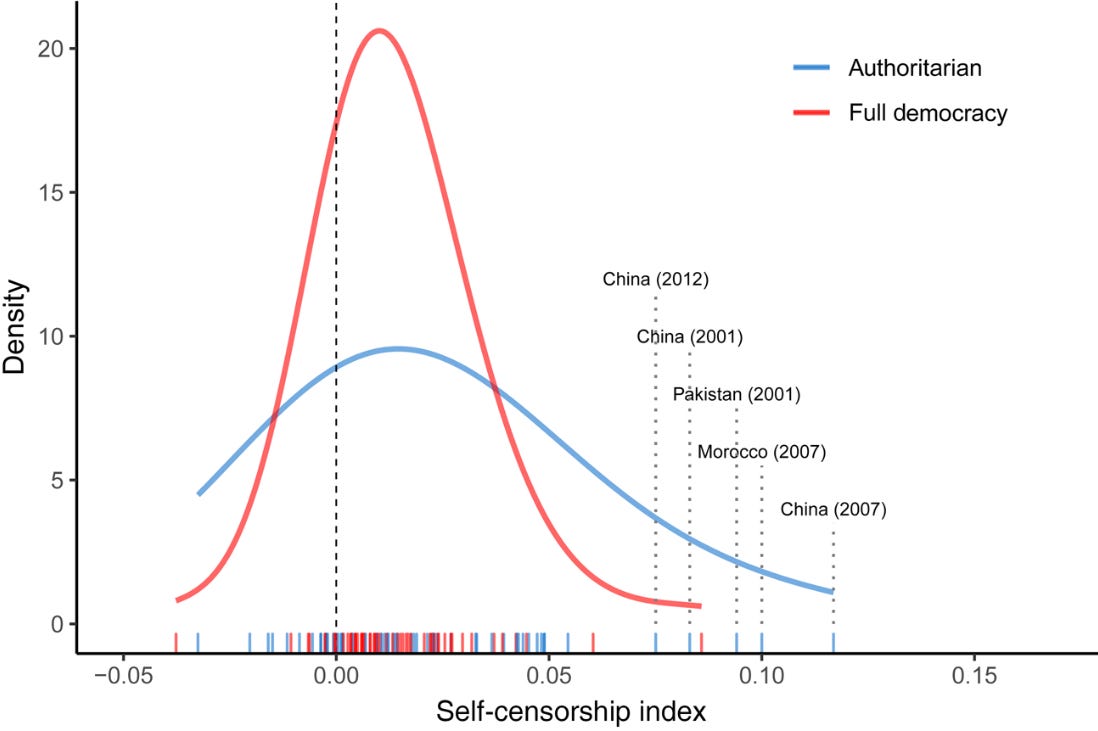
You can see that democracies and authoritarian states actually have fairly similar modal rates of self-censorship, and probably not terrible dissimilar means, but that there are a few authoritarian states with super high rates of self-censorship, in particular China.
So while maybe in a few authoritarian states preference falsification is higher, for the most part there actually is not tons of evidence that preference falsification is a lot higher in authoritarian states. Also the highest preference-falsification countries are not the least educated ones: evidently China is full of liars?
But survey experiments may not be credible. Do we have other measures of honesty? Yes we do. Here’s a study of wallet return rates:
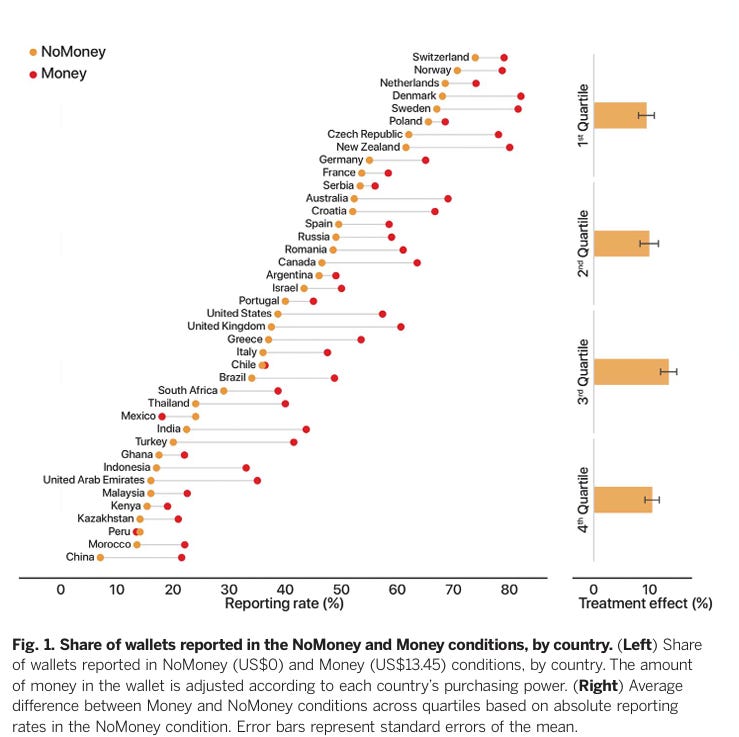
Before I go on, a hilarious sidenote: some Chinese researchers felt that the grade given here to China was very unfair. So they ran a replication and extension to defend China’s honor. But it was horribly mangled; they mis-specified the regression, mis-interpreted their survey results, and mechanically produced an erroneous treatment effect. So it seems like the honesty of China was measured correctly after all.
Anyways, how does this relate to Richard Hanania’s point?
Well, he says that as countries get richer and better educated they correspondingly become more truth-telling. That’s his point. Uneducated Portuguese peasants (or Syrian peasants) tell lies, but if their society were more thoroughly industrialized, urbanized, and educated, they’d tell the truth and admit they saw nothing at Fatima. The difference between Richard, who would not tell lies about seeing miracles, and his peasant Syrian family, who would, is not genetics or something like that, but that Richard is educated and western and being educated and western makes you not lie so much.
But there’s a different direction any relationship could go: maybe it’s not that education and prosperity makes countries honest. Maybe it’s that honesty makes countries educated and prosperous.
Here’s the correlation between PPP per capita and wallet-return rates:
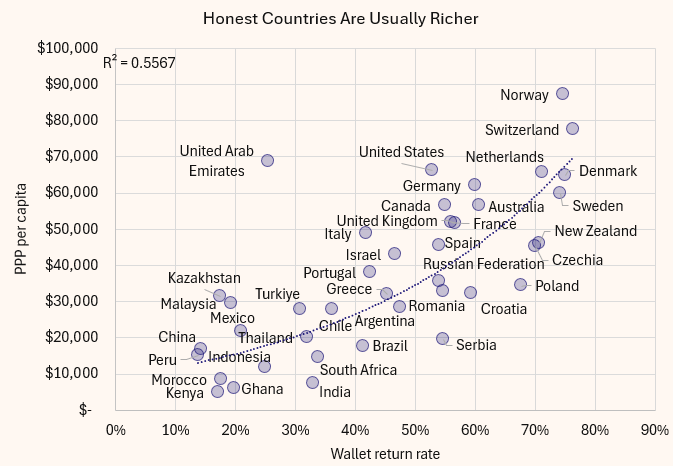
Do you notice anything?
First of all what I notice is the UAE. The UAE got rich within the last two generations and did not do it by generating a productive and innovative society. They did it by finding oil. This is cool because it means we have an exogenous shock to prosperity to see if modernity and prosperity causes honesty! The UAE is very modern now!
But still not very honest! If getting better educated made you more honest the UAE would be a very honest place, but in fact the UAE is not a very honest place, on average. And lest you think the issue here is migrant workers, notice that two more oil-rich countries, Kazakhstan and Malaysia, are also far above the trendline. Windfall income is associated with countries being “richer than they should be for their honesty.” The same is even true of oil-rich Norway and the United States! I don’t know how the lying Italians end up so far above the trendline.
Unusually poor countries for their level of honesty are disproportionately post-colonial or post-Soviet situations. Turns out foreign powers running your economy to benefit the metropole is Not Great.
And before you trip all over yourself trying to say that PPP is a bad indicator we should use education…
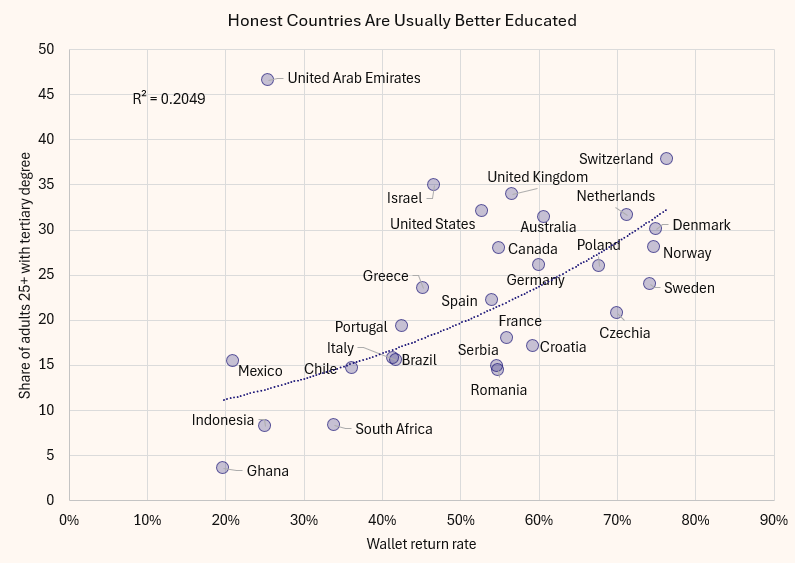
The UAE is actually the best-educated country in the sample. Unfortunately education data wasn’t available for some of the others.
The key point here is simple: the view Richard espouses that modernity somehow frees people from the dishonest culture of the past is wrong. Countries become rich and educated partly because they have functional and honest cultures, but becoming rich and educated doesn’t make them functional and honest.
Let me clarify my argument more. Portugal today has a rather low wallet return rate. It remains a rather dishonest place. I suspect that Portuguese people today would lie about seeing the Fatima miracle if you primed them correctly to see it with, say, months of drip-drip-drip miracle-teasing by charismatic divinely anointed children.
Now, before we go further, I absolutely am not arguing that these honesty rates are immutable. I’m sure they can and do change! I am simply arguing that their changes are probably not caused by economic growth and expanding education. The factors that encourage people to tell lies are not about urbanization or factories or schools.
A Toy Model of Beliefs
Here let’s model beliefs.
Let’s dispense with the notion that people usually believe things for reasons like “having good reasons to believe things.” They believe things for purely social reasons in most cases. 99.9% of your beliefs don’t arise from having good reasons based in experiences of validating theories, but because other people with whom you affiliate give you tribal signals about belief. You can lie to yourself and say this isn’t true. I’m willing to grant that for the extreme rationalist crowd the social formation of belief might account for as little as 99.3% of the things you believe. See? I can be reasonable.
But mostly you believe things because other people believe them. A large share religious conversions are timed close to romantic connections to people who are of the religion you convert to, for example. My own was, for example. Am I coping for myself? No, this is just true: tons of conversations are via marriage.
Okay, so, we can imagine that belief formation works like this:
Believe Something IF Benefits of Believing > Costs of Believing
We’re doing science here!
Benefits of believing may be things like “people respect me for believing this” or “if I believe this it morally permits me to have sex this way” or “acting as if I believe in combustion thing means I can drive a car.” Costs of believing are the opposite: “people disrespect me for believing this,” “the government murders people who believe this,” “believing this limits my moral permission to do a desired thing,” or, in the extreme case, “my observed sense reality flatly contradicts this belief.”
But here’s the key intuition: truth only obliquely enters into this conversation! It does matter somewhat: it’s true that printing presses work and this fact alters the kinds of social influences I and others around me experience. So I’m not saying truth doesn’t matter, just that the degree to which truth matters still itself ends up working through social costs and benefits.
Internetbrained weirdos will say “But I changed my mind without being peer-pressured! I was the Black Sheep of my town!”
Are you still? Or do you now have a community that endorses your beliefs? Probably you do, because if you didn’t form such a community you’d probably revert. And if you maintain your Black Sheep beliefs without getting a community, you’ll likely experience a lot of long-term discomfort and distress of the kinds most humans strongly avoid. Some people will carry on like that but not many.
This also tells us what kinds of beliefs may end up being more truth-disciplined! First of all: costly ones! If a religion requires you to do really uncomfortable and awful stuff, you’re more likely to take an exit when one presents itself. If your religion says “Stick a thorn through your penis,” you may convert when missionaries arrive with wealth giving strong truth-creedence to an alternative way of life faster than if your religion said “Stick your penis in whatever you want to,” because that first belief is a lot more unpleasant. At least for penis-havers.
Second of all, this tells us that societal religious conversions should usually be quite fast. You should not usually expect religious conversion to proceed gradually in a society. An emergent religion (all beliefs are religions so when I say religion I just mean belief) will experience some gradual growth as it spreads through social networks and persuades key social influencers of its truth or, more importantly, its usefulness. But eventually it will hit a tipping point. It will either run out of converts who see it as useful and putter along for a while until some new emergent movement is more useful and replaces it, or else it will demonstrate usefulness to enough social actors that it starts to create its own momentum: now more and more people observe the usefulness of converting to the new religion not because it is actually true or anything about it, but because everybody else is converting and if you don’t you may face social costs.
Is this how conversion happens? Heck yes it is! We have good data on Egyptian religious shares over time due to papyri records and onomastic practices, as well as Islamic tax records and modern censuses. Here’s what they show:
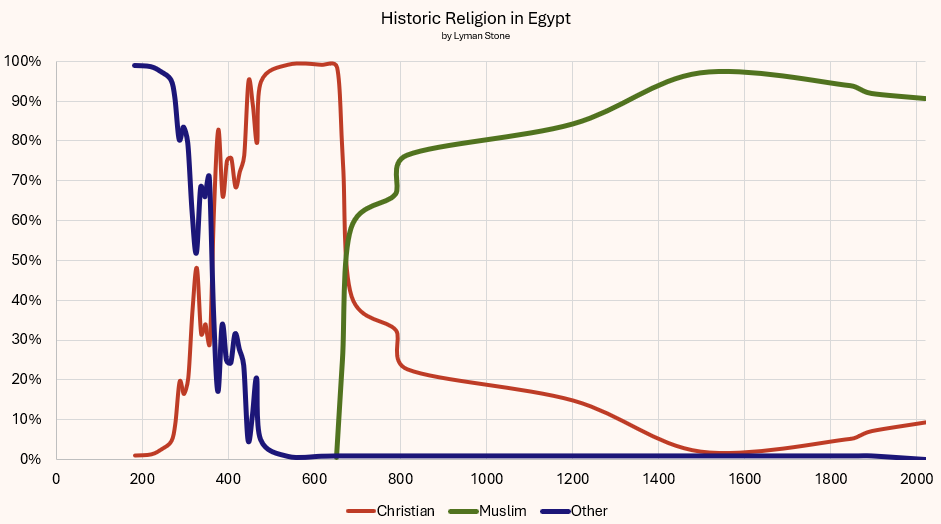
You can see that Egypt went from <5% Christian to ~80% Christian in the space of under a century. That’s very fast, only about 3-5 generations. It went from 0% Muslim to 60% Muslim in even shorter time.
In Bosnia, we have a study telling us why conversion to Islam was so fast, while conversion to Christianity so slow. Here’s Bosnia’s conversion:
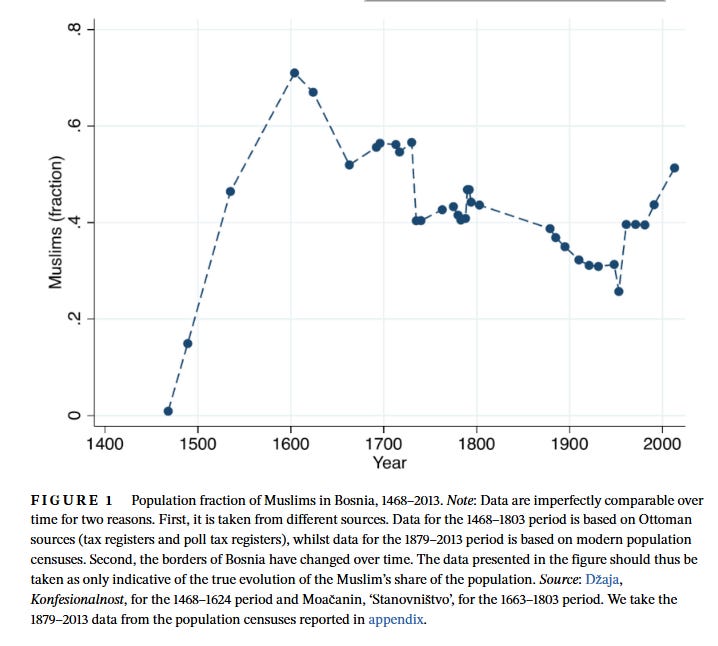
And here’s the second-stage regressions showing that richer households converted less:
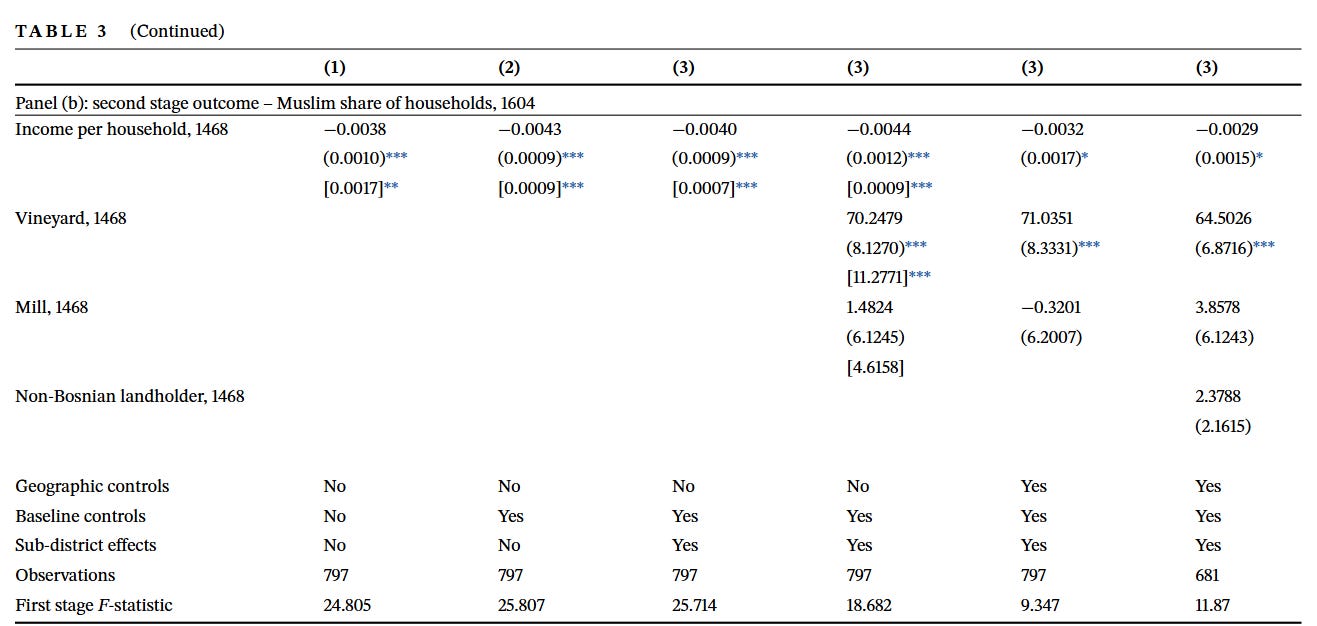
Why? Well, Islam institutes a religion-specific tax: non-Muslims pay jizya. But Bosnian soil is very bad. In areas with poor soil, the jizya was sufficiently high that paying it could cause starvation. So people converted. In places with good soil, incomes were high enough to not starve and pay the tax, so conversion was low.
Put simply, when the cost of Christianity rose, people (in fact most people) converted. A similar dynamic occurred in Egypt, and everywhere Islam went. Christianity rose slower because the Roman empire sort of frogboiled paganism, not completely favoring Christianity everywhere all at once, but moving incrementally across local areas, and with ebbs and flows of Christianization under different emperors and local leaders. Islam imposed extremely sudden and, interestingly, very bureaucratically clear and efficient changes in the costs of religion, whereas Christianity’s rise came with slower-shifting changes in costs.
The benefit side actually may have worked against Islam. Giving up pigs, some restrictions on alcohol, and religious life being actively managed from Istanbul instead of the general neglect Bosnia had experienced under Christian rule, may actually have made Islam costly.
So for something like 40-80% of the population at any given time, historically-not-too-uncommon changes in tax policy and governance can cause a complete shift in religion. For the remaining 20-60% you probably have to push a lot harder. But the point is, 40-80% of people really will just go along with the path of least resistance.
Now, let’s think about truth again.
Truth does matter a lot in certain cases. Being good enough at math and metallurgy to produce good cannons matters a lot. When societies compete, they have incentives to pursue truth in areas where truth influences the competition. So you should expect peer-polity competition to generate a lot of innovation and, yes, this is what actually happens. Polis-level competition is the famous case in the ancient world, but nation-state level competition can have some similar dynamics. In these cases, failure to pay the “costs” of believing the truth means you get conquered. The inability of Ottoman society to adopt new technologies of governance and economic production led to the society that conquered and converted Bosnia to gradually retreat and finally be replaced.
Thus, as the stakes of knowing the truth grow more intense, the likelihood that debate is truth-oriented increases. When two scholars debate obscure terminologies for their niche topics, we don’t even need to act like there’s a high probability they are truth-oriented, because not many people will die or suffer greatly if one side is factually incorrect. But if factual error will lead to serious ramifications, then conversations become more truth oriented.
This Keeps Happening to Rome
Let’s take a nice historic case study: the Roman Catholic church. The problem the Roman Catholic church has is everything goes swimmingly until suddenly they lose a whole country to godless communists or Protestants. They’re usually very surprised by these losses.
For example. Here’s monasteries in Germany (I produced this chart from their replication data to get a longer time series than they published in the paper):
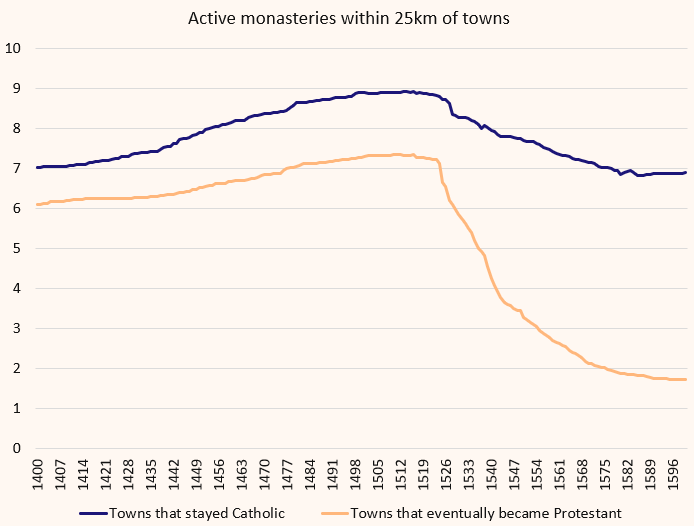
You can see monasteries were slowly-but-steadily increasing through the early 1500s. Here’s data from another source on just Cistercian monasteries active over time (note: I believe this source understates closures post-1500 considerably, but captures openings well):
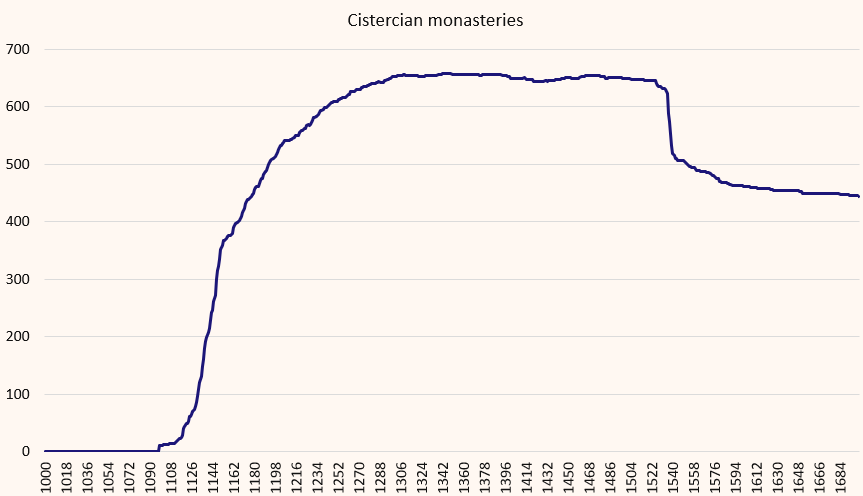
Cistercian expansion stopped after 1270 or so, but other orders like the Franciscans picked up and grew considerably. But then you can see that basically without warning, monastery activity collapses. That’s called “the Reformation.”
The key point to understand is that there was nothing in 1510 to suggest the Catholic church was about to implode. Heck, there was nothing in 1517 to suggest this was likely! Protestantism wasn’t even the first time Protestantism had happened! The first attempt at Protestantism came in 1173, with Waldensianism. It was suppressed. Then came Lollardy. Suppressed. Then the Hussites. Suppressed.
Why did these groups with basically indistinguishable beliefs keep cropping up? Well, it helps to see them in light of the three earlier “great medieval heresies”: Bogomilism, Paulicianism, and Catharism. These heresies also had considerable doctrinal similarities and, except for Catharism, came much earlier. And Catharism is, needless to say, a very contested historic concept, and may barely have even actually “existed” as a heresy. Paulicianism was far to the east, so Bogomilism was the only real biggie in the west, and it stemmed in some part from isolated areas able to escape Papal supervision. Waldensianism, Lollardy, and Hussitism were not that. They were theological revolts in parts of Europe well-integrated into the Christian mainstream.
They all emphasized vernacular texts. They all emphasized communion in two kinds. They all questioned clerical celibacy, monasticism, the treasury of righteousness— they all clearly thought Rome had build excess appendages onto the biblical faith. Why did these similar heresies start springing up every century or so after 1100 AD?
The obvious answer is— the Gregorian Reforms! The reform movement in western Christianity 1000 AD-1200 AD advertised itself as cracking down on corruption, abuses, false teaching, etc. In practice what it actually did was centralize ecclesiastical and political authority on the papacy. The classic case of this is the investiture crisis— people often forget that investiture remained a central issue of debate in the Reformation too! The Gregorian reforms and expansion of papal-approved monasteries were part of a campaign of homogenization to the version of the faith preferred by a relatively narrow range of mostly north-Italian/South-German/French ecclesiastical elites. This campaign was ultimately catastrophically unsuccessful— it caused the Great Schism with Eastern Orthodoxy and sliced historic Christianity down the middle, it generated centuries of mostly unsuccessful and wasteful crusading in the east, and it provoked recurrent intra- and inter-state conflicts within Christianity, most famously the Hussite wars. Moreover, this Gregorian system was ultimately to give birth to a rival movement for “reform”: the Reformation. Luther thought he was original but he wasn’t: he was really just brushing the dust off of some arguments that had been made repeatedly for about 400 years by other dissenters from Gregorian Imperialism. It is perhaps no surprise that Protestantism was most successful in the areas where the Catholic church’s reform efforts had been least successful in standardizing the faith— Scandinavia, north Germany, and England. The Netherlands and Switzerland are sort of wildcards here but sometimes history throws you curveballs.
My point here is simple: on the surface the Roman church was healthy. But the recurrent rebellions of proto-Protestants are strong indicators that actually all was not well under the surface. The apparent quiet of European religion was a case of massive preference falsification, which is why as soon as one of those theological rebels got his hands on a printing press and was able to spread his ideas faster than Papal jackboots could march, the alleged heretic became a heroic reformer. Minor and major princes could “come out” as never having really liked the Gregorian system, really actually pretty peeved about it, always suspected the Bible was on their side after all. It’s crucial to recognize that the Lutheran princes were often sincere Protestants, but that their sincerity acted just like all other beliefs we described.
For many European elites, it was costly to subscribe to the Gregorian system! Monasteries had lots of tax-free wealth! The Pope got to choose who ran wealthy and powerful bishoprics! A lot of your common peoples’ money got siphoned off by pilgrimages and indulgences into other princes’ territories! Going on Crusade is expensive! There were some advantages of course— elites liked being part of a “European republic” of sorts, a common elite bound by church-supervised marriages. The church gave a nice way to deal with younger sons (clergy or crusade). If your territory happened to have a pilgrimage site or nice relics, you might come out ahead from the money-shuffle. The church cooperated in keeping peasants in line.
The Waldensians and Lollards failed for two clear reasons: first, their ideas simply couldn’t spread fast enough to achieve critical mass for a social tipping point before the forces of the church smashed them; second, they paired their theological critiques with significant class critiques that threatened the princes who might have backed their play. The Hussites still had the 1st problem, so Hussitism was limited to Bohemia, but they found a way to work out the 2nd issue, and so while Hussitism was contained by Rome it was not completely crushed by Rome, because some elites saw it is a viable counterbalance to Rome.
Protestantism managed to do both. The printing press enabled protestant ideas to rip through Europe at unprecedented speed. Protestantism didn’t even spread “spatially” as might be expected— it could crop up and appear almost anywhere. In the already politically-patrchwork Holy Roman Empire, the sheer portability of Protestantism (all you need is a bible! no monastery assembly required!) was handy. But secondly, Luther was a committed collaborator with political power. When the peasants rose up, he certainly exhorted the German princes to just behavior and chastised them for their abuse of the peasantry, but he was also unambiguously in calling for the heads of the peasant rebels themselves. Lutherans demonstrated the feasibility of politically compliant reform; we might even say, a rolling back of the ecclesiastical victory in the investiture controversy. Thus, Lutheranism provided a new, energetic religious movement… which nonetheless provided handy justifications for continuing supremacy of elites, and in fact for reduced social power of religion! Same paper I cited above:
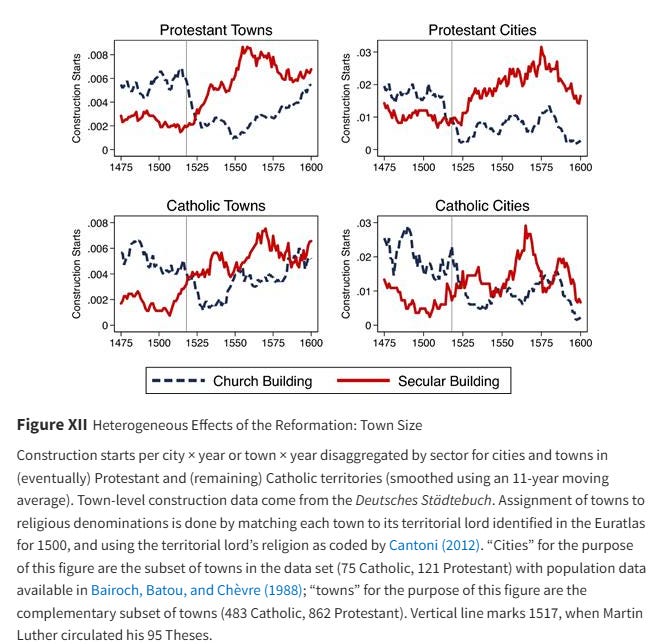
You can see that Protestants shifted towards secular construction, especially administrative, military, and palatial buildings.
But this tells us a couple things.
First, again, conversion was fast. Too fast for it to be really about persuasion. This is obviously just bandwagoning. When enough influencers and elites realized the net present value of Lutheranism exceeded that of Roman Catholicism, they switched. There was a lot of preference falsification in late-medieval Western Christianity, whereby individuals came to lightly believe in Roman Catholicism and regularly practice that faith because doing so was socially advantageous, but almost the instant alternatives presented themselves, Roman Catholicism collapsed in much of Europe.
But before you think this is just about the Reformation— not it isn’t!
You see, this kept happening to Rome. In some places, the collapse of Roman rule came later. In Quebec, it came in the 1960s.
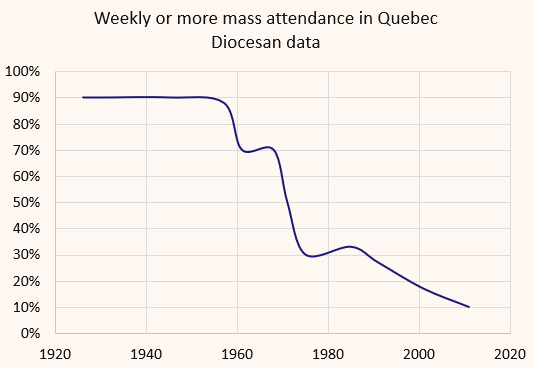
Between about 1960 and 1980, Quebec went from being a society of ~90% mass attendance to ~30%. I won’t belabor exactly what happened, but for anybody who has read about the Quiet Revolution, preference falsification is obviously a huge part of the story! While a certain configuration of Anglo-Canadian power tolerating church-run-quasi-autonomous Quebec prevailed, Quebecois people would comply with the church, the deal being this meant the Anglos would leave them alone. When Anglo-Canada decided to conscript Quebecois people to defend England in the world wars and then church-associated Quebecois leaders reneged on promises to get justice for this alteration of the deal, Quebecois people turned en masse. They voted for a new society almost overnight, and they got it. What happened in Quebec was not that between 1960 and 1980 60% of people in Quebec lost their faith due to exposure to new ideas and arguments which gave them doubts and made them into religious skeptics! What happened in Quebec was that the social forces holding up Rome vanished, and so belief collapsed.
I wish we had data for Mexico 1890-1950; I suspect we’d see similar oscillations during waves of anti-clericalism. On the other hand, the rise of Christianity in Korea is closely associated with resistance to Japanese Imperialism. There’s no reason this had to be the case— but it so happened that some Christians object to worshiping idols, including the Japanese Emperor, and their resistance on non-nationalistic-religious grounds became a symbol of national resistance, and Korea began its shockingly rapid march towards becoming a quite Christian society for east Asia.
The point here is not to dunk on Roman Catholics. Well, I mean, okay, it’s not just to dunk on Roman Catholics. It’s to show that Islamic conquest is not the only way religion can change really really fast. Most big changes in societal religion are quite fast, and this is because most beliefs are not based on reasoned arguments about what is true, but about people bandwagoning with what is popular and advantageous.
I’ve focused on religion but it’s not just religion— when new technologies are invented, how many of their users pause to personally verify that the theories explaining why they work are true? Almost none! I don’t understand how or why my cell phone works! However, I observe that other smart people seem to think there are good reasons why it should work, and I observe that it does actually have benefits to me to act as if I believe the science behind cell phones working, i.e., I can call people and doomscroll social media, and this is fun for me. Conscientious refusal to use cell phones because I am not persuaded on some rational grounds that they should or ought to work would be inefficient, it makes more sense for a rational actor to simply bandwagon. Bandwagoning is the most efficient path to truth in the vast majority of cases.
Preference Falsification Continues Apace
Let’s look beyond religious claims to political claims.
Most liberals who say “trans women are women” do not believe that a biological male who self-identifies as a woman can bear a child. This is surely a very uncommon belief. In my Substack notes there was a dustup because I noted that I actually do have a friend who refuses against all efforts to admit that trans women cannot have children, and who insists on statements that definitely imply trans women can have children, and thus I think it’s reasonable to think my friend believes trans women can have children. My noting this caused some confusion; readers appeared to think I was saying all liberals have this extreme belief. I don’t think that. Surely almost none do.
Yet they continue saying trans women are women, i.e. to reject the use of additional adjectival qualifiers to separate biologically female women from non-biologically female “women”! But the definition of the female sex in any species is indeed based on gamete size, i.e. reproductive capacity under healthy conditions! You can’t just used sexed terms then act like they mean something other than reproduction!
“Well but sex isn’t gender!” This is another thing many liberals say but don’t really believe, or at least I hope they are lying about believing it. If you ask someone “What’s your gender?” they will usually answer you based on their biological sex. They will rarely introspect and say, “Well, do I display masculine-typical or feminine-typical traits?” They will simply report a term corresponding to their genitalia. It’s not a spectrum.
The invention of the fraudulent concept of gender identity has complicated this, but less than you might think— some people who are of one biological sex will insist on a social gender at odds with that sex. But hold on, what is a social gender? If I say something is “masculine” what do I mean? Aggressive? Hairy? Likes football? What makes something masculine? The answer is simple: traits are masculine because they are typical of male-sex individuals. Thus, gender simply reduces to “stereotypes about sex.” There is no concept of gender which is non-sex-referential. Consider for a moment an analogy to political party: you can have a Democratic Party without a Republican Party! The Republican Party could go belly up and the Democratic Party could still be as coherent an entity as it is today.
But there is no concept of gender without sex. Genders just are designated kinds of stereotypical relationships to sex. If humans had three gamete sizes instead of two, we would not have a “gender binary,” we would have a “gender trinary,” because gender just is stereotypes about sex. That’s it, and that’s all. And gender ideas are highly arbitrary stereotypes. If a woman is a lumberjack does her gender change? Why not? If an individual actually has no masculine traits but identifies as a man? i.e. a fem-presenting-masc-identified-bio-female (I know one!). This is all nonsense. If I wrote that my gender is “demographer” you would say that’s absurd, that’s crazy, that’s not a gender, but why not? Why shouldn’t my gender be demographer? Because of course, we all recognize gender is just sex in a liberalism trenchcoat. That is to say, gender is a nonsense concept. It’s a classic case of actual philosophical bullshit. If tomorrow we invented a new category, “blurg” vs. “zorp,” and we assigned everybody as either blurg or zorp, those categories would be just as socially meaningful as gender-as-separate-from-sex is. You don’t actually have a notion of gender you can define without talking about biological sex, such a definition does not exist, because the whole concept of gender is really just stereotypes about biological sex.
This is all very obvious to anybody who has not had their brain fried by the particular psychoses of the extremely online west from 2005-present. But if you immerse people in social environments that raise the benefits to believing crazy things and lower the costs, people will believe crazy things, or at least say they do. People will identify as not-straight— even though they only watch straight porn and want to marry someone of the opposite sex. People will identify as transgender (or, better yet, genderqueer or nonbinary)— without pursuing any intervention and without investing in significantly different presentation. These kinds of low-cost affiliative changes, which actually explain most of the statistically observed change in sexuality and gender identity in the last 20 years, are almost textbook examples of preference falsification. The share of people having sex with somebody of the same sex has risen a bit over time, but 75%+ of the rise in non-heterosexual identification is among people who behave like heterosexuals. Likewise, there has been a rise in people taking cross-sex hormones or receiving surgeries to alter the presentation of sex-typical traits: but the vast majority of the rise in non-cisgender identities is among people who are not undertaking any interventions and in fact have no plan to do so at any time in the forseeable future.
Modern educated people falsify their preferences and beliefs to comply with social pressure exactly like Portuguese peasants at Fatima. And in both cases, they saw rainbows!
(okay that was a horrible joke. sometimes i worry people don’t get that i average about 1 joke per 5-10 sentences)
Consider other cases— climate catastrophism. Many people profess to believe that catastrophic climate change is at hand. And yet they fund their 401k. People say that democracy is dead and we have a dictator— they are not training at the range.
On the other side, you see the same thing among conservatives on many issues! Social pressure requires you to say you think anti-Semitism is bad, but Candace Owens and Nick Fuentes’ viewerships aren’t shrinking. In fact an extremely common refrain among conservatives is basically, “We have to tweet on anon accounts in coded language because we would be #cancelled if (((they))) knew who we were.” In other words, a common complaint by conservatives is that they are being forced to engage in preference falsification and that they in fact comply with that social pressure! They stand up, look in the camera, and say, “I am a bootlicker.”
But it does go the other way for conservatives too— Richard Hanania’s based ritual was apt on this: young conservatives often do a kind of performative “who can be more based” thing, and this leads many of them to falsify their beliefs. They just lie. One guy says it’s bad single women vote for Democrats, so the other guy, to show his True Basedness, says we should repeal the 19th amendment. He has never really thought about repealing the 19th amendment, has no actual argument for it, and to be honest doesn’t care about the issue, and to be extra honest the idea of telling his wife (or, idk, his mom or sister— the guy is an incel usually) that he voted to yank their vote away is pretty scary for him and not because they would hurt him because he realizes that he actually on some level doesn’t think his mom should be a second class citizen. He’s engaging in preference falsification. But by terrifying chance this guy was just appointing to The Committee on Repealing the 19th Amendment. I’m not saying preference falsifiers won’t legislate their false preferences!
In fact, I would argue we live in a golden age of preference falsification! “Luxury beliefs,” “virtue signaling,” “vice signaling,” “trolling,” these are all just names for preference falsification. People saying things they don’t believe very much because of the social advantages of being observed to say it. Some people are even starting to admit they lied about their earlier, more woke beliefs.
And this is why Richard Hanania is right about Fatima— but wrong about himself. He’s right to be skeptical of Fatima, because, yes, groups of people pretty routinely make up insane things and lie about it. Portugal remains a pretty dishonest place today. Don’t lose your wallet there. Catholicism’s institutional structure and its view of how faith works makes it recurrently vulnerable to exactly this kind of failure mode: zealots who don’t realize the other guys are faking create enough momentum that all the normies feel they should go along for reasons of advantage, especially since the costs of doing so are fairly low. Believing in Fatima didn’t get anybody killed AFAIK.
But Richard sees himself and westerners as different. We don’t do that. We don’t claim we saw things we didn’t see. And yet, we do. You cannot go a day on social media without seeing an educated, modern, well off, apparently intelligent person saying something they probably don’t believe, or believe simply because of their social circles. Richard Hanania should be familiar with this dynamic: he said his own period of extremist rightism was basically a product of personal things in his life and his social influences! The fact that preference falsification is so universal should not just give us pause about Fatima, but should lead us to downgrade our view of how stable any belief set is likely to be. The constellation of values and beliefs which make our lives coherent and possible might come crashing down tomorrow.