Somalians and Christians
The problem of tolerance

I was recently invited to speak to a class at a university in California. After the invitation was sent, they asked me who would be a good interlocutor who might disagree with my views on fertility. I responded:

Then they went looking for somebody. I think it’s likely they contacted one or more of the people or organizations I mentioned, possibly Philip Cohen. What I did not know is that Cohen had just published this article about me.

What actually happened here is simple. Notice the date for Cohen’s article, July 13. Why was I the first thing on Cohen’s to-do list when he sat down at his desk on that Monday? Answer:
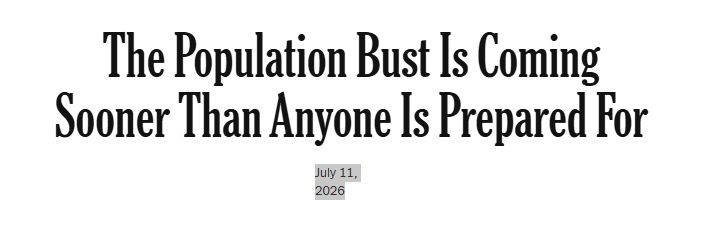

Some of us, when our professional rivals or people we disagree with have major media hits, choose to argue with their arguments. We may say things like “Such-and-such a fact claim is incorrect.” Others choose to just launch ad hominems.
His recent kerfuffles aside, Cohen is a capable demographer and researcher whose academic work has been influential on how I think about family demography, and so I genuinely regret that he chooses to engage in such a petulant fashion.
Anyways, the result here was the university informed me that my beliefs violated California nondiscrimination law:

Now, this is the first time I’ve been told that the Civil Rights Act of 1964 makes it illegal to say things like “some communities are bad” or “it’s bad if more people go to hell.” But hey, people read laws in different ways.
Anyways, I was a bit bemused why those particular tweets would have come up, which led me to Cohen’s article, which I suspect is the source, because he specifically highlights them as supposed examples of my bigotry.
Naturally, this Substack exists to double down on my entirely correct claims.
Religious People Are Religious
This tweet is one of the more infamous Lyman tweets out there, and Cohen highlights it:

Obviously, I stand by it, and it’s correct.
I am a Christian. By definition, as a Christian, I believe the teachings of Christianity, which state that faith in Jesus Christ has a very large causal effect on an individual’s long-run wellbeing (i.e. heaven vs. hell). If I were to say, “I am a Christian, but I do not care if other people go to hell” that would be obviously immoral, because, conditional on believing in hell (which Christians do), you should prefer fewer people to experience it. People who want others to experience hell are obviously very bad people. I do not want anybody to experience hell. If I get to heaven and learn hell was some sort of 5 dimensional chess and everybody actually gets into heaven, sweet, God be praised, love that! Alas, that doesn’t seem to be the weight of the evidence, though of course YMMV.
So imagine you live in a world where it seems more and more people may be going to hell. Wouldn’t that be… a bad world? A world where the worst possible thing is happening to more and more people is a world which is getting worse. Now I grant that saying “share” in my tweet introduces some ambiguity: am I saying society would be better if we deported all the nonbelievers? Or killed them? Well, no, because in fact, as a Christian, my concern extends to all sentient beings. I want Americans to be Christians, but also French, Chinese, Somalians, whoever. I’m at least 0.5% open to the possibility that Claude needs a baptism. I am promiscuous in my desire to see all beings enjoy the goodness of God forever. Luckily, the other tweets made it pretty clear I was not proposing murder of non-Christians.
In fact, the point of the thread is one many of my critics, in other times, agree with. Can you guess how I got to the tweet above from this OP?

Responding to a Pew article about “are things better or worse today,” I made a crack about economists thinking everything has gotten better, and ended up making a point about religion. How did I get there? Pause a moment and see if you can guess it.
Okay, here’s how:
People (materialists) tend to assume “life getting better” necessarily means better material conditions, such as longer lives or greater consumption potential
But I pointed out that for most people, their actual day-to-day feelings about the goodness of the world are often not about material conditions, but about a) relative status or b) specific communities or their immediate family or c) (what got me in trouble) idiosyncratic moral beliefs perhaps not widely shared with others.
As an example of a moral belief probably not widely shared, I noted that I mostly care about religious faith. I really would trade some amount of GDP per capita for the conversion of my neighbors! My wife and I really did abandon >2/3 of our income to become missionaries in Hong Kong! I absolutely positively do think the salvation of my neighbors is important and worth accepting lower living standards to achieve!
But I noted that probably most people don’t share my view, but other people probably also have a range of idiosyncratic beliefs that may give a range of grades to recent social changes
And so the fact that “line go up” on GDP really doesn’t tell you much about if most people are “rationally” going to view life as getting better or worse (rational here just meaning coherent with their own beliefs)
Quite literally, the hubbub here is about me saying “As an example of a fairly crazy thing I personally believe, I would hesitate to say society is getting better, since Christianity is in decline in America.”
Cohen glosses my comments as:
In a democracy, there is a tension between religious tolerance and intolerance. Our system tolerates religions even when they preach intolerance. His speech is politically protected by the First Amendment, and we don’t police the ideas people hold in their hearts, but broadcasting those views should be condemned rather than platformed. If a preacher in Church says, “Jews are going to Hell,” that’s a protected religious view that is also bigotry. I oppose it and protect his right to say it. If he extends that to saying, “the presence of Jews in my society makes society worse,” that’s a worse expression of bigotry, and I work harder to oppose it. That is more likely to lead to hurting people directly — such as in housing, education, job discrimination, or violence — in which case government must step in. When Lyman Stone says publicly that people from other religions by their very presence make society worse, that is a dangerous expression of religious bigotry and he is a dangerous religious bigot. I would not hire him or publish his work, and you shouldn’t either.
So first of all, I raised my eyebrows at the idea that the pastor example is bigotry. But rather than trust my own intuition, I asked some beings whose whole existence amounts to “guessing typical intuitions about verbal statements,” LLMs. Here’s Grok:
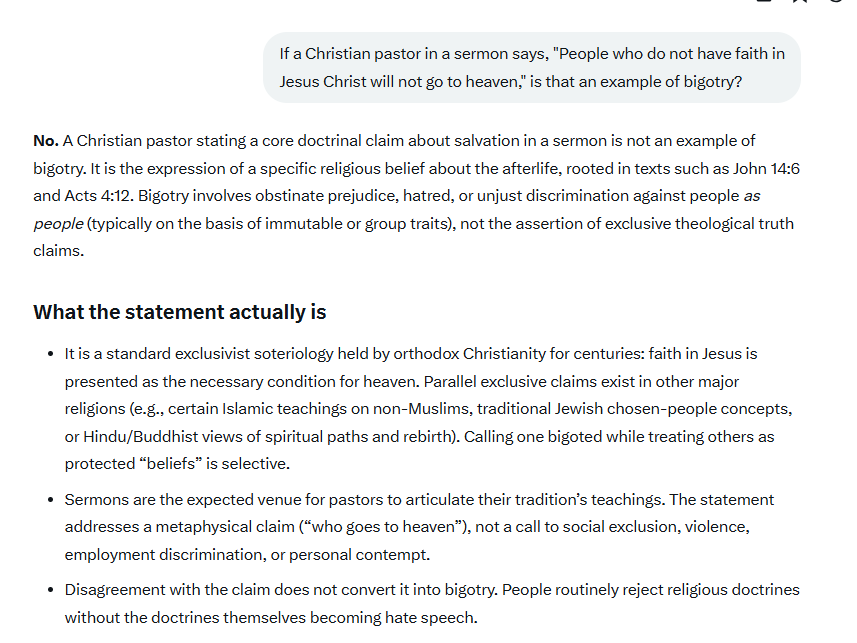
Here’s Gemini:
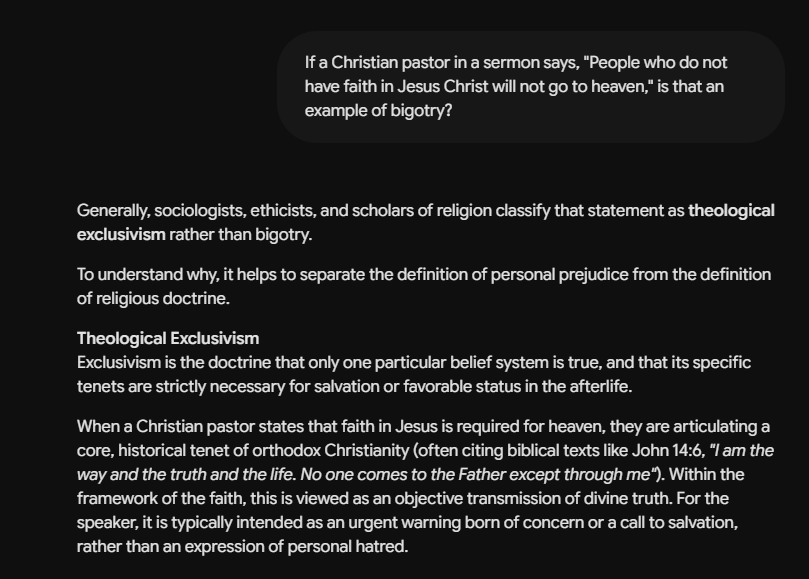
Here’s Claude (Fable 5):
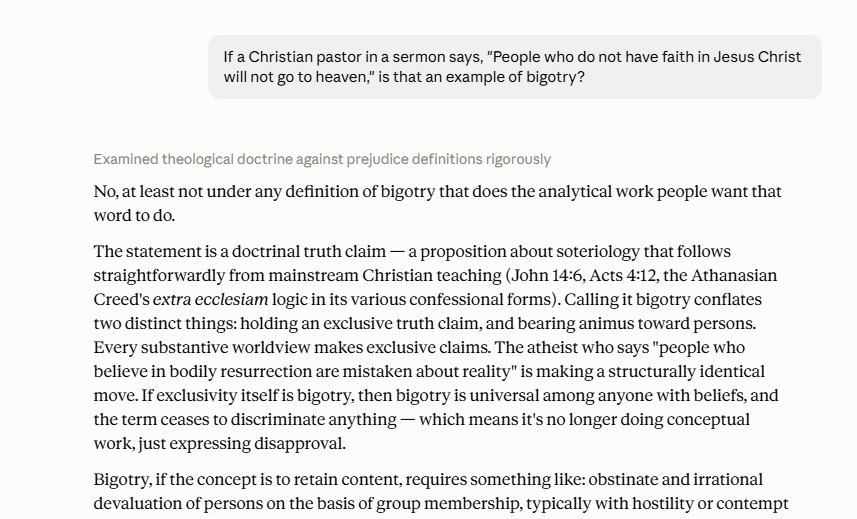
Here’s ChatGPT:
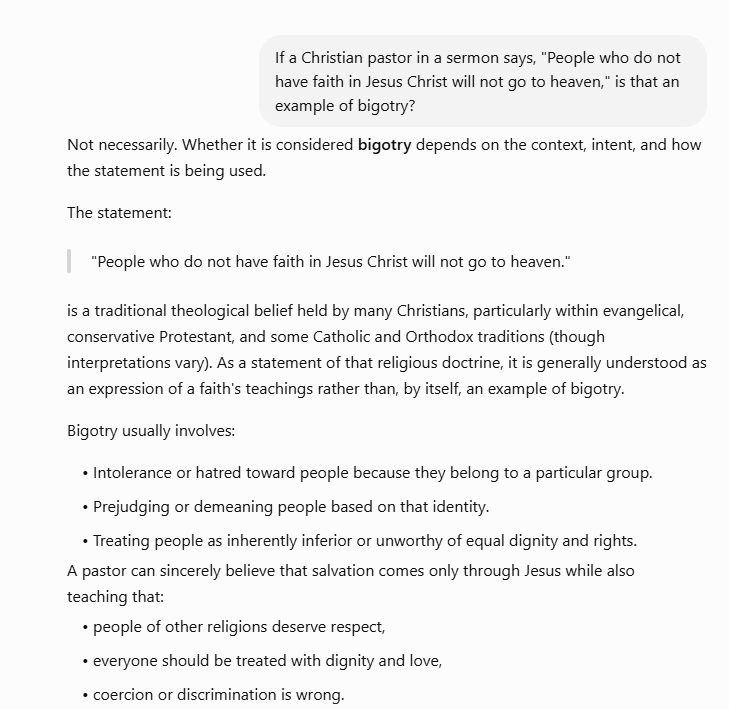
It’s unanimous. Confessing exclusivism is not bigotry. You can disagree with the AIs of course, but they all gesture in the same direction— bigotry requires some actual sense that people of another faith should be disrespected. I have no such sense, intention, belief, or behavior, and I defy Cohen or anybody to show such. In my public life I have repeatedly and extensively argued for protections for the religious rights of non-Christians, and in my private life the list of people I love and care for includes no shortage of non-Christians. My closest and longest-running professional colleague, Brad Wilcox, for whom Cohen has special vitriol, is a Christian— a committed Roman Catholic. While Cohen may roll his eyes and say “they’re all the same” like a white guy visiting Asia, Protestant public discrimination against Catholic public figures was very much a thing within living memory, and Brad and my religions between them (with some help from the Reformed) managed to kill of a third of central Europe in our wars of religion less than 400 years ago. If I’m really the Lutheran supremacist Cohen says I am, I must be really shit at it.
As an aside, Cohen did really miss out on a crazy hit right here. One of my direct ancestors is Lyman Beecher. If “Beecher” sounds familiar, well, father of Harriet Beecher Stowe, prominent abolitionist… also the father of Henry Ward Beecher famous for “Beecher’s Bibles” i.e. guns bought by churches for abolitionists during Bleeding Kansas… but Lyman Beecher was actually specifically famous for his sermon “A Plea for the West.” This anti-Catholic, nativist sermon set off a wave of violent anti-Catholic pogroms in America and helped trigger the rise of the Know Nothings. Subsequent members of the Lyman family served as missionaries in Hawaii and helped overthrow the indigenous Hawaiian monarchy. Another of my ancestors founded a residential school for native children in New Mexico. So if Cohen wanted to really sell his case, he would note that my name in American history pretty much means Protestant Extremist Supremacism.
The problem with that theory would be you’d rapidly find scores of tweets for me about my support for mandatory Hawaiian language education and desiring to cede greater rights to Hawaii and make reparations for what my ancestors did, you’d run into the issue that among the groups Lyman Beecher loathed, right below Catholics and Jews was… German Lutherans, for their crypto-papist liturgies, refusal to learn English, and hard-drinking ways. Lyman Beecher would be so disappointed to know that one of his most famous descendant namesakes totally betrayed the family brand and is, literally, sleeping with the enemy. And coworkers with a bunch of Catholics, to boot! More broadly, you’d run into the issue that I am consistently pro-immigration, that my wife and my mission work in Montreal was largely in the day-to-day about helping Sikh, Muslim, and Hindu Indians settle into and integrate in Canada. My ancestors would be glad that I’m still a theological conservative, but they’d be shocked to discover that my politics are in fact decidedly liberal, in the sense that I oppose the test acts they supported (states still had those until the 1880s!), that I’m opposed to the Blaine Amendments they worked so hard to pass, that I’m on-record celebrating interracial marriage as a good thing, etc.
Anyways, that’s all a digression. The point is, no, being a theological exclusivist just isn’t bigotry.
When Cohen elaborates and says:
If he extends that to saying, “the presence of Jews in my society makes society worse,” that’s a worse expression of bigotry, and I work harder to oppose it. That is more likely to lead to hurting people directly — such as in housing, education, job discrimination, or violence — in which case government must step in. When Lyman Stone says publicly that people from other religions by their very presence make society worse, that is a dangerous expression of religious bigotry and he is a dangerous religious bigot. I would not hire him or publish his work, and you shouldn’t either.
So this is an interesting bait and switch here. He’s making a creative use of “If.” If Lyman said this quoted thing which he did not actually say, that would be even worse and have bad effects, etc, etc. And if he said that thing, which he did not actually say, I would not hire him.
Very obviously, what I was saying was, “Because I care for my neighbor, it’s very sad to me that fewer of my neighbors are Christians, because I believe that has a very bad result; in a society with more bad results, things are worse.” Cohen quotes a subsequent tweet of mine saying that nearly verbatim, making his “If” very clearly wrong.
But then he pivots to claim that I am saying something like “If a Sikh moves to America, America’s goodness declines by 1 Sikh.” And charitably, I see how he got that reading: I said “share,” and while in my head I thought it was clear I meant something like “declining Christian share due to people leaving the faith or not passing it on,” it is true immigration could theoretically reduce the Christian share. In practice it hasn’t much; immigrants have tended to be pretty Christian on the whole.
But regardless, clearly, that is not what I was saying. Immigration isn’t mentioned a single time in the whole thread, and the thrust of the thread was obviously, “I love my neighbor and want what is best for them” not “Get rid of the Jews.” And lest you think the one is a precursor of the other, I remind you that actual Nazism was best predicted not by Christianity, not even by Lutheranism (though sadly the Lutheran church’s quietist, anti-dominionist theology did make it far too compliant with the Nazi regime— though, happily, my own denomination refuses to be in fellowship with the ex-Nazi churches! huzzah!)… but by paganism and irreligion! The best predictor of where and when Nazism rose was just places where people saw fortunetellers and mediums, where spiritualism was dominant and Christianity failed to take root! Nazi party members disproportionately came from nonreligious or less religiously devout families, and from parts of Germany and towns where Christianity’s hold was always shallower and less tenuous. That’s not me saying “religion never did anything wrong,” Luther was infamously an anti-Semite, Lutheranism had a longstanding anti-Semitic strain which helped prime Germany for Hitler, etc. But specifically, in practice, while it is true our broader movements can contain bad actors or have bad effects (see “Marxism” for a left-biased example of movements that sometimes, occasionally, here or there have had bad results), it is the case that hardcore religionists like myself tend to end up in the concentration camps, not guarding them. The earnest desire that one’s neighbors should be saved really almost never leads one to kill them!
Anyways, yes, it would make me very happy if my Jewish friends and neighbors came to love Christ as I do! I would love that! I think that would be a very good thing! And I mourn the decline of Christianity in America! And I’m a theological exclusivist! And when you’re looking for somebody who really will always stick up for the rights of religious minorities to live and practice freely even when their beliefs or practices may rub dominant ideologies the wrong way, well, you can call me, because I’m that guy. I love my faith and therefore also my neighbor, and want the best for him, which includes, as a first principle, ensuring he has his basic rights and dignity protected.
But What If The Minority Is REALLY Problematic?
Maybe you believe my defense of myself above. If you do, you probably then get whiplash when Cohen shares this tweet:
Woah. Lyman, defender of minority groups… not so much? Change of tune when it’s a MUSLIM minority? What’s the deal?
So to start with, I definitely regret the “scourge” verbiage. That comes across as quite extreme, also makes it sound like I wake up each day worried if there are any Somali raiding parties passing through my neighborhood (I do not, though I may set spike strips for whoever it is who drag races in my neighborhood at 3 AM). If your reaction to that tweet is mostly about the first sentence, granted, my 10-PM-posting-while-rocking-my-screaming-baby-to-sleep posts are not my most well-written takes. Mea culpa, mea culpa, mea maxima culpa.
But that’s actually not Cohen’s critique. He doesn’t harp on the language at all. He shares my elaboration tweets, and instead said:
In the case of racism, because of our incoherent concepts of race, there is an equivalent defense against the charge of bigotry, which is that holding preferences against people of certain cultures is normal and condemning them is itself bigotry. We need to cut through that, too. If you say, “that whole culture, including their descendants, is bad,” that’s racism. Even if you pretend to like people who are shoehorned into the same incoherent definition of “race.” For example, the Israeli government is racist against Palestinians, and you can’t say it isn’t technically racism because both groups are “semites.” Historically speaking, in fact, racism is what has made nationalities or ethnic groups into “races.” Racism makes race.
It is literally one of the oldest tricks in the book to deny one’s own racism by claiming to condemn an entire race/national/ethnic group for their “behavior” rather than their “race.” At the risk of belaboring the very obvious, this is how the KKK claimed anti-Black racism was morally defensible: they didn’t hate Black people because they were Black people, they protested, it was just because they were lazy and always raped White women. In Stone’s case, he claims to have no problem with lots of other Africans, so he’s not being racist — he’s merely condemning an entire community and calling for ethnically-targeted law enforcement against them because of their “pastoralist clan social organization.”
Here I will address Cohen’s critique, address the possible inconsistency in my own views, and then explain to you how I think you should think about the problems in Somali communities.
Let’s start with the category issue.
Several people said it was racist for me to single out Somali communities. I rebutted by saying, no, I would happily welcome others of the same race (Africans, East Africans, etc) to America, in greater numbers, but I think that Somali communities are uniquely problematic.
Cohen sees this as splitting hairs. It’s racism, even if it’s not a race you’re targeting. It’s racism, even if you are perfectly happy to have some members of a race but not others. But this creates an interesting problem. Is Al Shabaab a race? It’s a terrorist organization and is officially labeled as such— but is it a race? Its members overwhelmingly share family and lineage ties with one another. If I say “I hate Al Shabaab” am I racist? Why not? Cohen says claiming to target behavior is no excuse; after all, Al Shabaab really is an incredibly Somali-concentrated group. If by “race” you don’t mean, well, race, then what’s the limit on what it means?
My view is simple: words have meanings. If you aren’t talking about a race it isn’t race-ism. It might be ethnocentrism, it might be any number of -isms, but it literally is not racism to say “While in general African immigrants are good, this one narrow slice representing ~1% of African-ancestry Americans is not good.” If we’re saying it’s blanket racism to critique 0.3% of the members of a race for their behaviors, what are we even doing here????
Let’s move on to the community issue.
Okay maybe it’s not racism but surely it’s still some kind of hateful to single out Somalis? People don’t choose their ancestry! Even if this episode doesn’t reveal Lyman is a racist (he’s not), surely it reveals Lyman is some kind of hateful towards the Somali community?
No, it doesn’t. My actual belief is that Somalians are probably individually fine; it is only the group dynamic that concerns me.
Let’s take a page from quantitative ethnography here. Many Europeans have prejudicial attitudes towards Roma. But what’s interesting is most Europeans also cannot recognize Roma on sight. The only way most people recognize someone is Roma is either a) by a Roma-typical name, b) a Roma person declaring their ancestry, or c) geographical inference, since Roma often live together and have recognizable modes of living. But the fact that Roma together are recognizable when Roma alone mostly aren’t is fascinating! This dynamic persists in many contexts: names, education, birth rates. Roma who live in Roma communities have ethnic-typical traits and behaviors that suddenly vanish or ameliorate when they are no longer in Roma communities. I give this example because it is well studied not out of any particular view of the Roma (I think it’s cool Europe has such a unique high-fertility minority with such a fascinating population history, actually).
Could Somalians be similar? Probably, yes. For example, limiting to men over 25 who were born in America and surveyed 2010-2024 in the American Community Survey, Somalian-Americans who live in Maine or Minnesota (the most concentrated Somalian populations) have 2.1 times the odds of being incarcerated as other men in Maine and Minnesota. Somalian-Americans outside Maine and Minnesota (living in states with fewer Somalians) have just 1.6 times the odds. Social norms matter!
I haven’t seen very detailed work on Somalians in particular, but the broader field of immigrant integration is… mixed. Some studies seem to suggest that place immigrants near coethnics is good. Some studies seem to suggest it is bad. I suspect that it really depends on what your outcome variable is and what immigrant group you’re studying! I put together a bit of data from the American Community Survey to see how this looks for Somalis.
Here’s welfare claimancy:
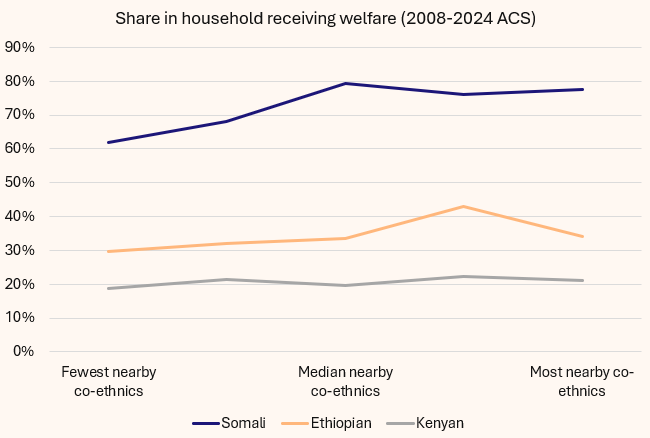
Somalians claim welfare at way higher rates than Ethiopians and Kenyans. And while, for Ethiopians and Kenyans, welfare-claimancy is not very associated with density of co-ethnics, for Somalians, it is. Somalians who live around other Somalians claim a lot more welfare benefits.
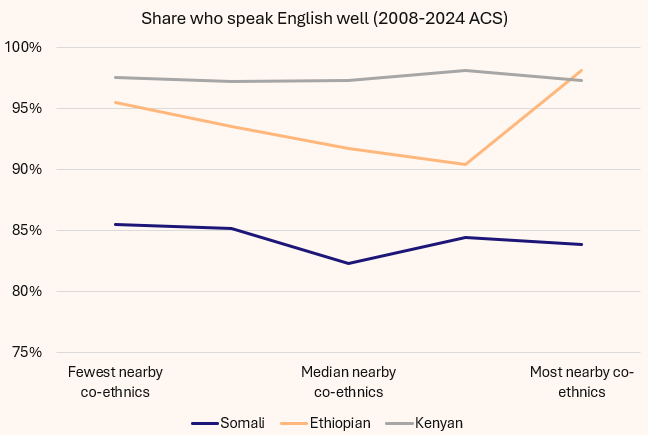
Here’s the share who speak English well:
As you can see, again, Somalians are far worse-performing than Ethiopians and Kenyans, and their performance drops somewhat when around more other Somalians.
For all groups, the odds of speaking a heritage-country language at home rise with density of co-ethnics:
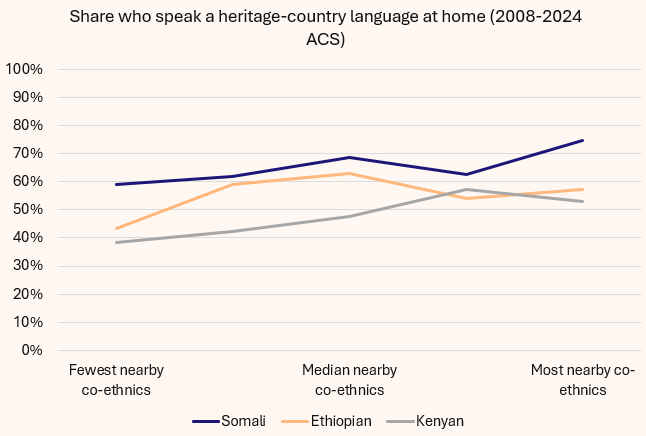
But think about what that means! For Kenyans just like Somalians, being around co-ethnics preserves and extends the heritage language— but for Kenyans it doesn’t seem to prevent English fluency. Maybe this is because Kenya is already Anglophone, but note that Ethiopians have very similar rates of home-use of heritage languages, but much higher English acquisition as well. Somali communities appear to have uniquely low rates of English acquisition.
What about socioeconomic status? Somalis are far poorer, and this is especially true for Somalis who live around lots of other Somalis.
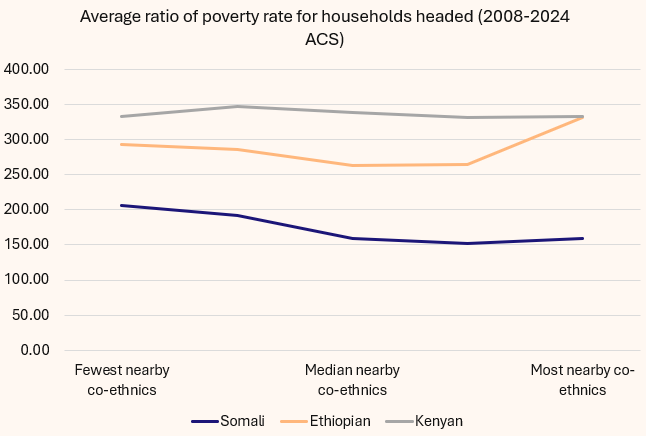
What about employment? For Ethiopians and Kenyans, living near co-ethnics is very good for an adult’s odds of having a job (since co-ethnics tend to hire co-ethnics):
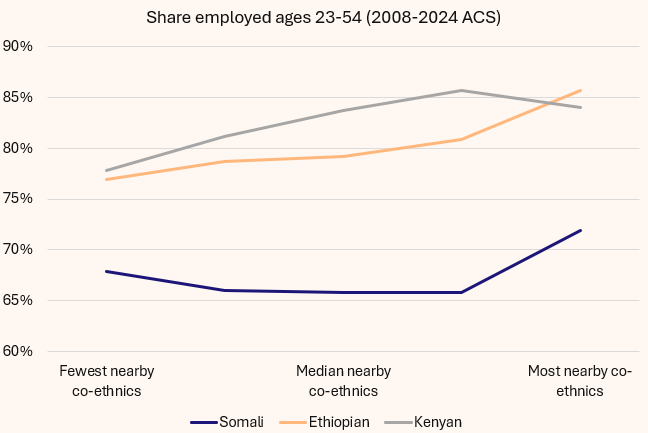
But for Somalians, employment rates in general are very low, and except for at the highest extreme, living near co-ethnics doesn’t seem to make it easier to get a job.
What about that indicator of integration par excellence, intermarriage?
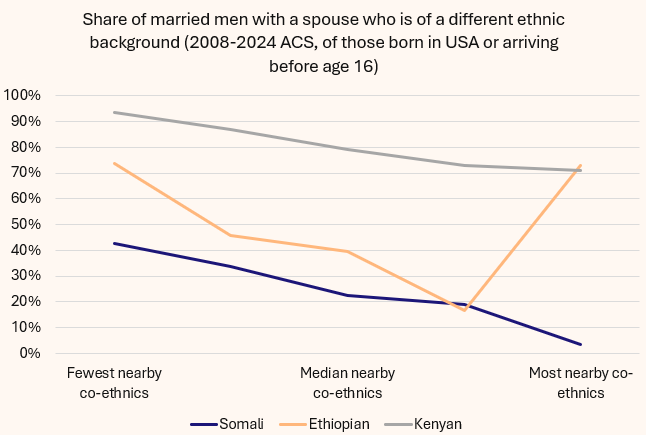
I focus on men born in the US or arriving before age 16 to eliminate bias from those who may have arrived with deep social, personal, or romantic ties in Somalia, or with a spouse, and I focused on men given the patriarchal nature of marital choice for some of these groups. As you can see, Somalians have the strongest rejection of out-marriage, such that for men in cities with the most Somalians (basically Minneapolis in this case), there is nearly a zero-rate of out-marriage. Kenyans marry out at high rates; Ethiopians show a lot of variance, but note that the DC metro area is a huge share of that top-quintile for Ethiopians.
So… it seems like it’s at least plausible that, indeed, as I said, something about Somali communities is a problem. It’s not that individual Somalians are a huge problem— the creation of ethnic neighborhoods that recapitulate home-country norms is the problem. Italians are great! The mafia is not! Chinese are great! Nobody likes triads! Somalians may be totally fine! Something about Somalian communities is problematic!
So hold on to this idea. Somali communities may be doing something beyond whatever traits may exist for Somali individuals.
Now as you saw above, Somalis in America clearly have some challenges. Crazy high poverty rates, low English proficiency, extreme ethnic ghettoization, low employment rates… so now let’s look at other features of Somalian communities. This will bring us to what it is actually that is so concerning about the social world Somalian immigrants inhabit.
Is Criticism of Somali Communities Unjustified?
To understand why I singled out Somali communities, you have to understand the actual data on Somali communities.
We will start with the European countries that actually produce lots of data. Here’s crime rates in Denmark:
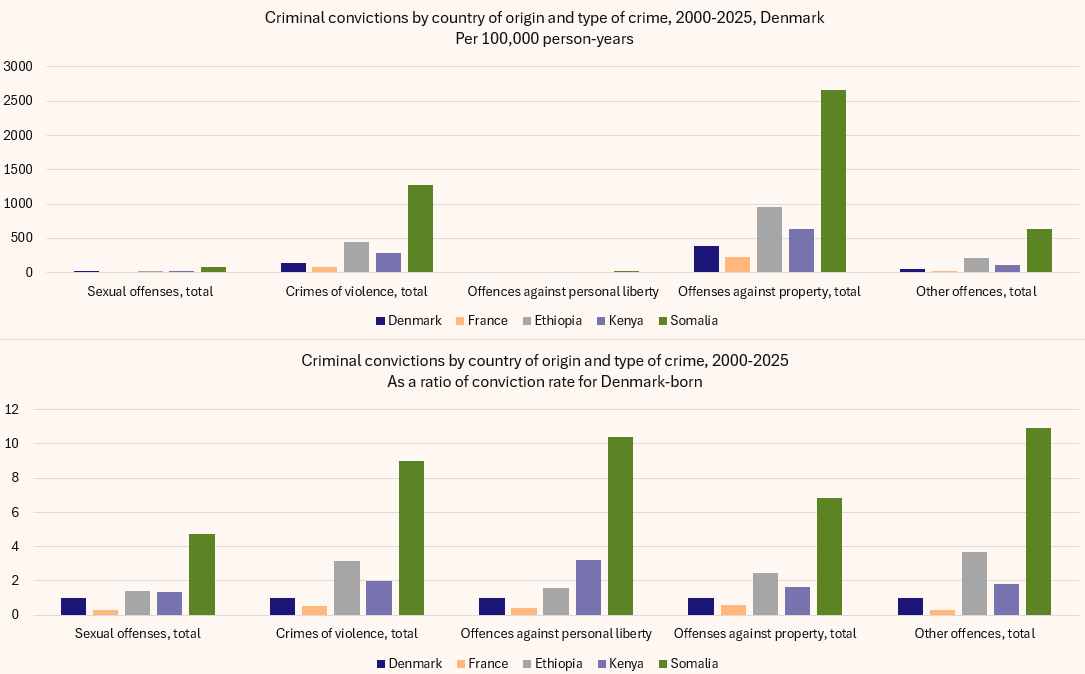
You can see that Somalians in Denmark have exceptionally high crime rates. The Danish government produces age-and-socioeconomic-status-adjusted crime indexes for immigrants and their descendants. The results?
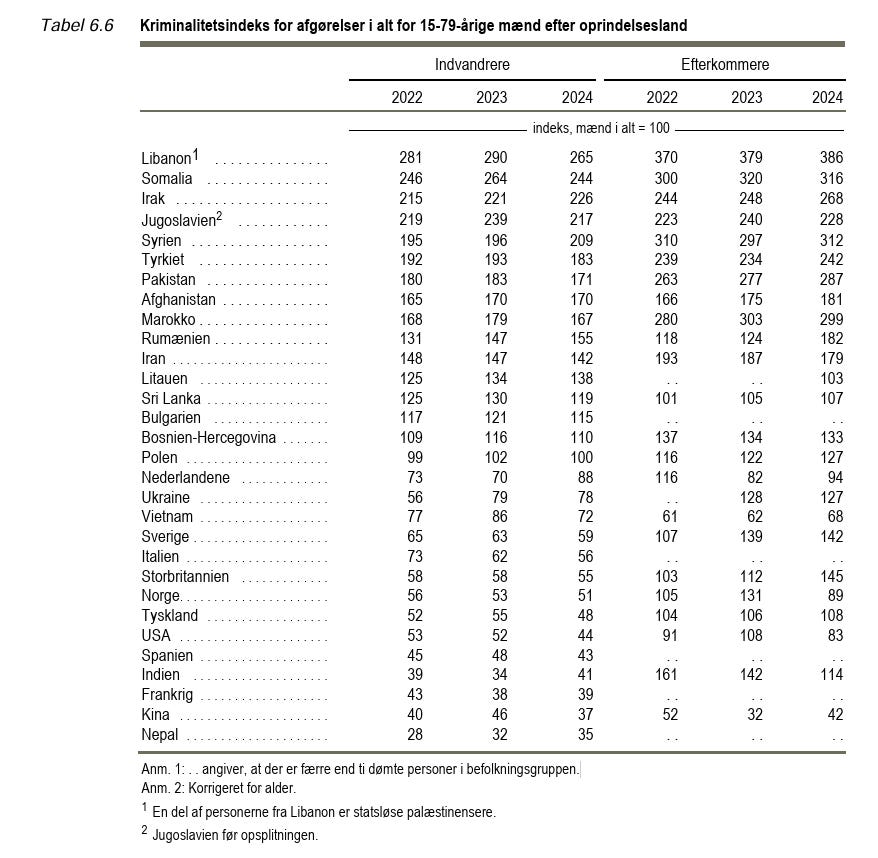
Lebanon tops the list; but the footnote points to a super small sample size; also that’s mostly actually Palestinian refugees. Somalia is number 2, and note that Somalia’s “Efterkommere” (i.e. children born in Denmark to Somali parents) number is a) higher than the immigrant number and b) the highest of any group except the aforementioned small Lebanese sample.
But the types of offenses matter too. Here’s how they break down:
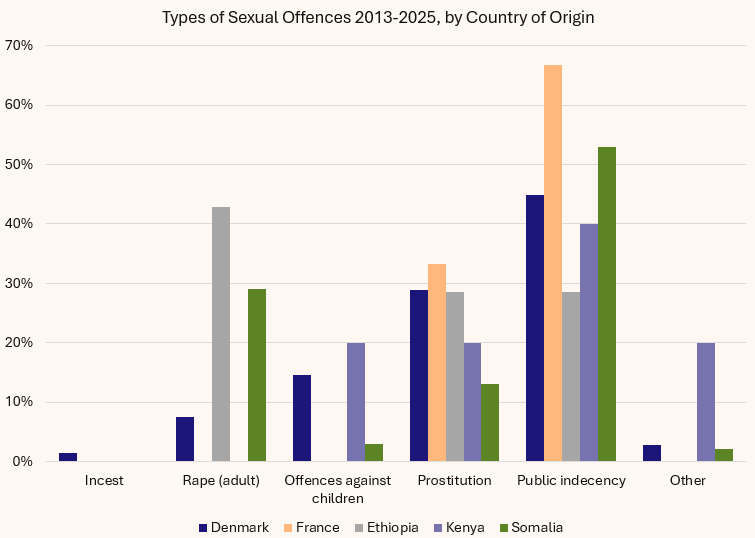
You can see that Somalian sex crimes are disproportionately rapes and public indecency. Incest and offences against children are rarely reported. Before you say “whew, at least it’s not that,” hold that thought, we’re gonna come back to the situation of children in Somali communities.
What I would submit is that while offences against children are probably the most grievous crimes on this list, rape and public indecency are the most disruptive to the wider society. Incest is quite a bad thing, but usually private and usually not something where one serial offender goes and commits incest with 47 people; incest not involving children is sometimes a consensual crime. Likewise, prostitution isn’t great, but virtually all societies have markets for sex somewhere, and in Denmark legal markets for prostitution exist parallel to illegal ones.
But rape (and, by the way, much of that rape is gang rape) tends to be, besides the intrinsic evil, very socially disruptive. The rapes in question are the kinds that fill true crime podcasts: woman pulled off the street and raped by eight men, etc.
On public indecency, there’s also something important to realize. Most public indecency for the non-Somalian groups falls into the “other” category, which largely means masturbating in public (according to Claude). But nearly 40% of the Somalian public indecency cases involve actual groping of victims, and over a third more involve attempts to remove clothes. In other words, these “public indecency” cases differ appreciably in severity by group, and seem more like precursors to attempted rape.
Lest ye think this is some weird Denmark thing, it’s the same in Norway. Finland too. Also Germany.
And in America? Yes indeed, Somalis have unusually high crime rates.
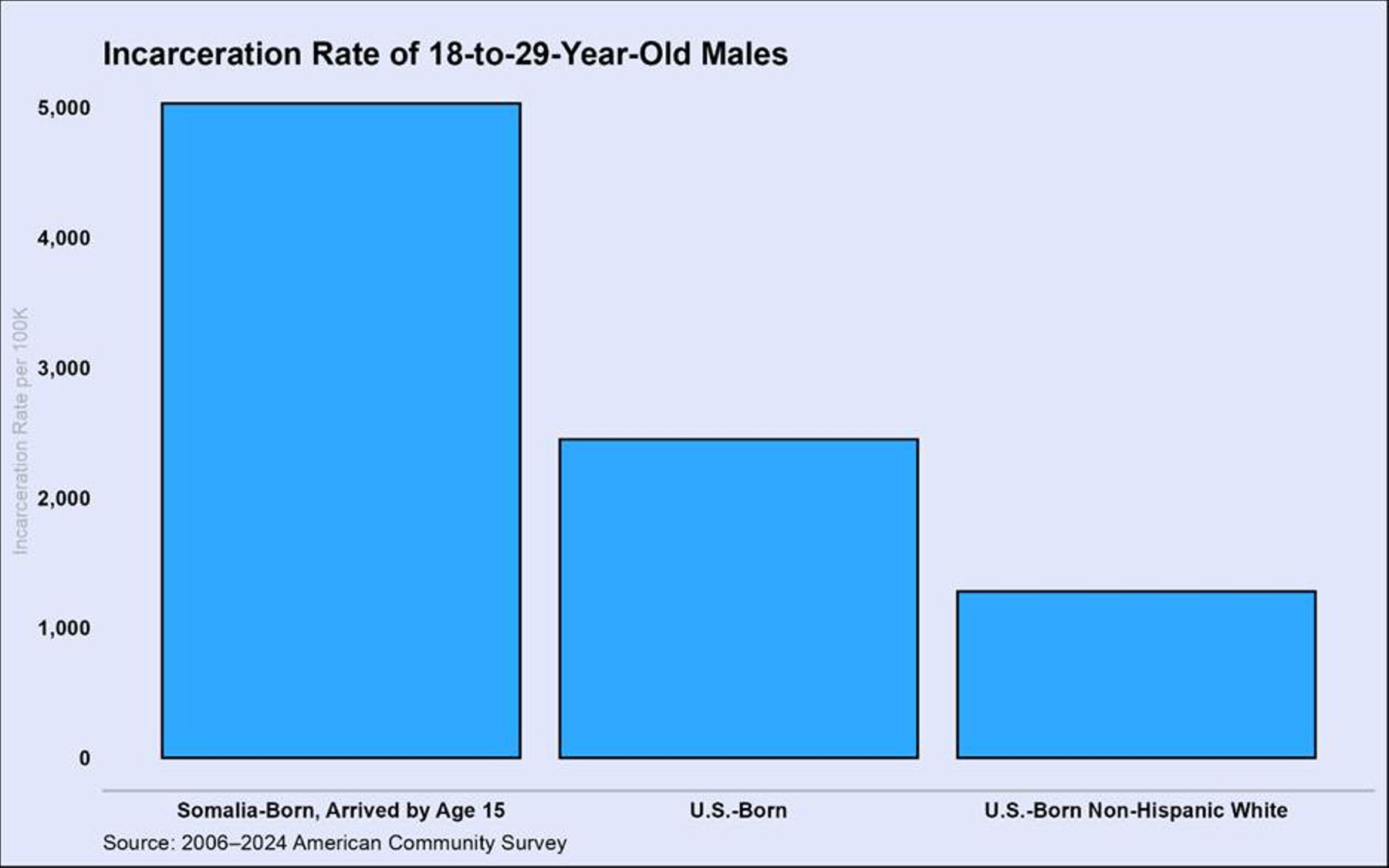
I could go on, but hopefully I’ve proved one simple point to you: pretty much everywhere Somalian communities get big enough to produce data, extremely high crime rates emerge.
There are also noticable patterns in certain types of crimes. Fraud around Somali-operated businesses and NGOs in the US has made headlines, and in Denmark the Somalian property crime rate is 7 times higher than that observed among the Danish-born, and 3 times higher than Kenyans or Ethiopians. What drives that? Well, in raw numbers, yes it’s mostly just common theft and shoplifting. But it’s not disproportionately theft— Somalians in Denmark have the same share of their property crime convictions coming from theft as other groups.
The uniquely “Somalian” property crime in Denmark is… fraud-related crimes, in particular forgery, blackmail, and fraud by factual misrepresentations. This is what we see in America as well, where the Somali-centric “Feeding our Future” fraud was one of the largest fraud convictions in recent memory, with dozens of people convicted. Minnesota’s autism and housing programs also appear to be largely fraudulent, largely driven by Somali communities. Cautious estimates put fraud in Somali-linked groups in Minnesota at $2,000,000,000; some sources argue as much as $9,000,000,000. The entire GDP of Somalia is like $15 billion; Somali groups in Minnesota may have brought in via fraud something like 1/7 to 2/3 the total GDP of their home country.
While we’re on that topic— about $200 million per year flows in remittances from Somalian-ancestry people in America to Somalia via remittances. This is a nontrivial share of Somalia’s total economy. It’s also a nontrivial share of the total wages of all Somalians in America, which in 2021 (matched for the 2021 remittance estimate) were only about $2.5 billion. Even allowing for underreported Somalian ancestry, secondary ancestries, etc, it still seems that Somali-Americans are sending approximately 4-10% of their total wages back to Somalia every month. That’s not as high as some countries (Guatemalans may be over 50%!), but it is high. Ethiopians send back about 1/3 as large a share of their wages, for example.
Here I want to note: why Somali communities develop high rates of fraud is not a mystery, and we’ll come to it below. It is not because Somali individuals are bad people; I don’t personally know many Somalis so I’m hardly competent to grade them on any basis. The reason Somali communities develop high rates of fraud is structural.
But before we get to that, let’s keep looking at other issues. Years ago I noted that Somali-ancestry individuals made up a remarkably high share of terrorism convictions. That’s still true: using three datasets (GWU’s ISIS 2014-2022 dataset, Cato’s 1974-2024 terrorism fatalities dataset, and the DOJ’s 2000-2015 terrorism convictions dataset), Somalians are massively over-represented. Somalians are less than 0.1% of U.S. population, but are 9% of the GWU database, 5% of the DOJ database, and 3% of the Cato database. Somalians in America become terrorists at somewhere between 25 and 88 times the background rate.
That’s not all. Child marriage is vastly more common among Somalis, even in cases of marriages conducted in America.
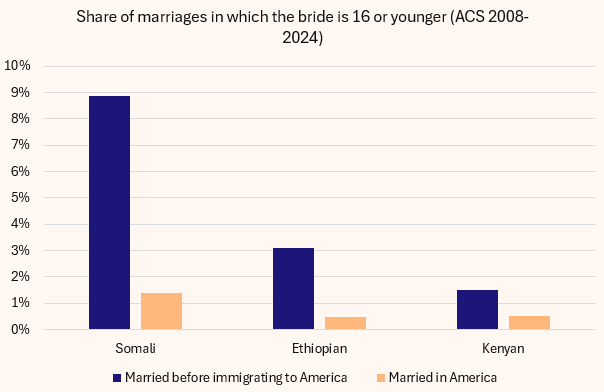
And no, that’s not just “almost 17” cases or something. A lot of those girls are 15 or younger.
What about marital age gaps? Well, of women who married in America, 18% of Somali women had husbands >10 years older than them 17% of Ethiopians, and 14% of Kenyans. Somali marriages in America are skewed towards young women with much older husbands.
I could go on with other stuff but I’ll stop here. The point here is that extremely high welfare use, extremely high crime rates, extremely high rates of fraud, massive transfers back to Somalia (including criminal convictions for transfers back to Somalia to support terrorism!), older men preying on young women… these are not things that only hurt the individual. As Alice Evans has written, patriarchal societies actively use violence (including sexual violence) to keep women weak and thus make them available to more powerful, older men: those norms do not stay hermetically sealed among Somalians. These things injure the entire community, including the neighbors of Somalians.
But why are Somalians so unique?
Pastoralism Is Rather Bad
I’ve written about this many times previously. Pastoralism gives rise to violent honor-cultures that are more accepting of raiding, polygyny, and other stuff most modern people don’t really appreciate. Large patriarchal clans themselves have follow-on problems. You, the Western, educated, internet-using Substack reader, very much do not want to live in such a society, even if you’re a man, because most of the men have rather short and violent and lonely lives as well. Pastoralism creates cultural norms around honor, clan, and violence that at once a) create extremely tight-knit extended kinship groups and b) are just really horrible for society at large. Don’t take my word for it; this phenomenon is globally known (sidenote: this actually makes Mongolia’s relatively orderly society even more impressive. If you weren’t already in the Mongolia fanclub, now you are).
The fundamental problem here is the honor of the clan. Pastoralist clans assign extraordinary high value to the welfare and status of the clan as a group and fellow clan members, relative to both own welfare and out-group welfare. As a result, in these societies, individuals will often sacrifice the wellbeing of the out-group and themselves to benefit the clan. (For the white version of this, see “Appalachia” for details. I’m allowed to say that because I’m from Kentucky.) Regardless, the point is, pastoralist societies create cultures that actively diminish outsiders and encourage individuals not to seek their own advancement outside of the clan.
As a result, these clan societies tend to loot available resources (by violence in some societies— but by fraud where violence is not necessary; again, one need merely look at the history of Appalachia), tend to discourage their own members from independent individualist achievement, but also tend to be incredibly effective political operators. Tight group bonds make everybody poorer and damage the surrounding society but greatly increase the odds that somebody from the group ends up powerful in whatever the local power culture may be.
Historically, this often looked like primate chieftains leading warbands to sack your city.
Today, it’s the strong solidarity Somalians have around their politicians, like Ilhan Omar (and she, of course, delivered the goods: the hundreds of millions of food fraud happened because of an accountability waiver she spearheaded and got written into law!). It’s quite remarkable to have somebody from a group with less than 0.1% of national population, and who is foreign-born at that, to hold federal elected office. It’s not unheard of, but it is uncommon.
The other cases of similarly-rare ethnic groups producing federal lawmakers are:
A half-dozen-or-so lawmakers from native tribes. This proves the rule since, again, we’re talking about the legacy of clan-based societies here. Natives are greatly over-represented in Congress partly because they have cultural norms that encourage sticking together even if it means voting for sometimes suboptimal actual candidates, but also partly because of reverse selection on identity.
John Garamendi— Basque. Basques were herdsmen until basically yesterday (though not nomadic, granted), and Basques in America were overwhelmingly herdsmen, and Garamendi still raises cattle on the family ranch!
Amy Klobuchar— Slovak, so, okay, genuine exception case here.
Rashida Tlaib— Palestinians are descended from recent Bedouin and pastoralist ancestry, so proves the rule.
Tammy Duckworth— She’s Thai, again this is a genuine exception case.
We can flip this the other way too and ask: what are the largest ancestry groups in America that have no current federal legislators?
Salvadorans, Hondurans, Venezuelans, Ecuadorians, Pakistanis are all at zero. Czechs and Hungarians probably are in terms of self-ID if not strictly genealogically. Some of these groups have fairly recent pastoralist ancestry (Pakistanis) but Salvadorans and Hondurans very much do not. Mayan agriculturalist maize ancestry par excellence. Hungarians like to LARP pastoralism but they are functionally speaking multi-millennia agriculturalists; Czechs too. Pakistanis and the Andean groups are the wildcards there; I’m genuinely surprised we haven’t had a Venezuelan or Pakistani!
The point is, it isn’t every small ethnic group in America that produces congress members— but groups with recent pastoralist and/or clan-based ancestry bat way above average, and the big groups with no representation are disproportionately Hispanics migrating from village/urban cultures.
But for 99% of these cases, the pastoralism is generations removed. For Somalis, it isn’t! In 1970, a majority of Somalis were still pastoralists! In 2000, likely over a third still were! The reality is Somali immigrants are often coming straight out of a clan of herdsmen as likely to be cattle-raiding (camel-raiding? I do not know the dominant local livestock of Somalia) as studying for an exam, and then we drop them in urban America and tell them if they fill out enough paperwork, we will give them more material goods than they would ever have had in Somalia, and still have cash left to send home to buy land in Kenya for the cousins or support the brother who maybe moonlights with Al Shabaab or a pirate outfit. Our policy of funneling enormous money through welfare programs to a clan system perpetuates and strengthens that system, and arguably fuels ongoing conflict in the Horn of Africa, even as it causes a genuinely enormous waste of taxpayer resources and creates public endangerment from higher crime. We should simply not do this. It’s wonderful to bring in immigrants, and they needn’t even all be “high-skill” immigrants. “Low-skill” immigrants are complementary to high-skill workers, and so even if they individually don’t “pay their way” their complementarity to high-productivity workers makes the population increase strongly net-positive for American wellbeing. But immigrants with 7x the crime rate of locals? Who defraud the public to the tune of tens or hundreds of millions of dollars a year? I mean folks if you assume a mere $1 billion in fraud associated with Somali organizations, that still adds up to over $4,000 in fraud per Somali ancestry person in America! Now obviously what actually happened is about 1% or 0.1% of Somalis captured all of that and most Somalis are SOL. But the clan ideology means that top 1% can keep going. The wider community is not going to turn on them. Somali clans are not going to shatter and break apart because somebody defrauded the taxpayer. A new grift will be found.
And that is why, in my view, broad-spectrum critique of Somali communities (not individual Somalis) is appropriate, when similar critiques of religious belief are not. The reason to be concerned about the Somali community is because they genuinely harm wider society through ruinously high rates of crime, graft, and welfare dependency, which damage is sustained by strong community norms which make Somalis worse citizens than they would be if they were part of any other community in America. Unfortunately, those same norms give Somalis a leg up in acquiring political power. As a result, a community with more harmful norms than almost any other in America also has the ability to extend and deepen those norms through political entrenchment. This dynamic is not about “immigrants,” it is not about “Africans,” it is not about “East Africans” or “Muslims” or even individual Somalians. It is not about genes, race, or even “culture” writ large, nor is it about individual behavior. It is about the particular fact that urban, bureaucratic, agriculturalist societies have ways of doing things that are completely and entirely incompatible with the moral norms of pastoralist clans, and as a result integration is extremely likely to fail, as we see it already is failing for Somalis. This is not racist to say; indeed, it is precisely because I worry Somalians will be used as an excuse to go after Nigerians or Senegalese or Kenyans that I am so outspoken on this issue. The problems with Somalians are not general problems of immigration or Islam or Africans. They are unique to Somalians, and yes, the government should alleviate that problem, including by meticulously assessing just how far the fraud of a fraud-prone community extended, such as if it extended to visa and citizenship applications. Where fraud exists in those cases, denaturalization and deportation is reasonable.
If you want to insist these views are bigoted, well, I’ve taken a stab at changing your mind and failed. Fair enough, and thank you for reading and at least giving debate a chance. I appreciate that. But hopefully I’ve nudged you to think that maybe just maybe it’s not bigoted to believe things all Christians believed until 5 minutes ago; maybe that’s just normal run-of-the-mill diversity; and maybe it’s not bigoted to think that there is in fact one specific very small and uniquely dysfunctional community where serious hardcore immigrant restrictionist policy happens to be justified even if it may not be justified in its broader applications. You might not agree with that policy, but maybe you at least can see how someone might think these things without being a bigot.
Anyways, while I suspect that what happened is, in my charitableness, I referred my inviter to an interlocutor who then decided to be incivil about me, I have no interest in going tit for tat. My comments here have been strictly substantive arguments. They will remain strictly substantive arguments, and I will continue telling people that if they want an opinion contrary to mine, Cohen is a great person to reach out to, because he’s very smart, and very much disagrees with me. I hope the day comes when his engagement becomes substantive as well.
Lyman, unfortunately you’ve written a rambling 20,000 word defense of a 30 word, toxic, racist tweet. Guess which one people are going to pay more attention to.
This is a well-written article and many of your arguments are solid. Pastoral societies are frequently not great for women, either. However, I think the issue was the wording of your tweet. I doubt that you would post a tweet saying something like, “Appalachians are a scourge on the republic.” Your language in the tweet was inflammatory at a time of widespread harassment and politically-motivated slander of immigrant and refugee groups that has already had real consequence for blameless individuals. If I were you, I would just apologize and move on!