
Longtime readers know that one of my greatest joys in life is reading the Bible, thinking about the Bible, discussing it with others, linking it to things I study, and then using this knowledge to mercilessly troll the most uptight of my brothers and sisters in Christ.
So let’s talk about the censuses of Numbers.
If you know anything about the Bible you probably know that the Israelites were enslaved in Egypt, then through the miraculous aid of God escaped and went to the Promised Land — what we call Israel, the West Bank, and some of Jordan and Lebanon. If you are either a big Bible reader who does not skip the boring bits, or a big Bible skeptic who likes to tell Christians how crazy the Bible is, you also know that during that forty-year road trip they stopped to take some headcounts.
And if you know anything about those censuses, you know one or two things:
1. They count 603,550 men of fighting age.
2. That number is so absurdly high it defies belief, and it is the basis of a lot of people disbelieving the stories.
I want to convince you that we should believe the census numbers in Numbers as they are written — and that “as they are written” does not mean what your English heading thinks it means. My basic thesis is:
1. The wider corpus of scripture strongly rejects the notion of a 603,000-fighting-man Hebrew force, and we should in general adopt readings which allow texts to be internally consistent.
2. The actual words used in the census counts do not add up to the traditional 603,550 figure.
3. The mathematics in the text were heavily edited, almost certainly in the Hellenistic period, by scribes who sincerely thought they were fixing mathematical errors, but who in fact were introducing implausibly anachronistic quantitative units.
4. As a result, the traditional figure is not only contradicted by wider scripture, but in fact is contradicted by other counts in the book of numbers itself.
5. The correct reading with the most plausible numbers implies approximately 6,000 Hebrew fighting men, and less than 75,000 total Israelites.
6. This number has extremely strong archaeological warrant to support it as a migrant settlement group in the highlands of Israel around the transition to the early Iron age.
7. The Bible is true because God Himself wrote it.
Note: I had Grok produce many of the visuals for this post. I wrote it but Grok made pretty pictures.
A brief note on the Bible
This post is about the Bible, a book about which many people, including myself, have a lot of opinions and feelings. I am going to anger somebody with this post, probably several somebodies. Here I will put my cards on the table: I think that the Bible is true, both in the sense that it contains revealed moral and theological truths which have some universal truth status, but also in the sense that it contains historic truth about particular events and persons who in fact existed and did the things attributed to them. You do not have to agree with my belief here to enjoy this post, but I am flagging it, so that you may know. More than true, I believe the Bible to actually be the word of God, inspired by God for his own purposes.
Which may make it surprising that in this post I will argue there is a large glaring error in every Bible published since probably 600 BC in a passage that has been extensively discussed and debated throughout the history of Christianity and Judaism, and that I in fact have solved this error. But anyways, there is such an error, and I have solved it.
How can it be that the Bible is the infallible and inspired word of God, yet contains error?
Well, imagine I got a bunch of pieces of paper and wrote some stuff on it. Then I write on the top sheet “The Bible.” Are Biblical literalists required to believe everything inside is true just because the title sheet says “The Bible”? No, obviously not! To say that the Bible is inspired is to say that the authors and editors and compilers who composed and assembled it acted under divine and infallible inspiration when doing so, and that this inspiration applied at some original point, not to every single chain of transmission after. Your Bible has footnotes on passages where manuscripts disagree. One of those readings — or all of them! — is a scribal error. There are whole stories missing from some texts. When we confess divine inspiration, we are confessing that a divinely inspired text exists and was created. We are not committed to believing that any old book with “Bible” printed on the cover is a valid representation of it. The Message exists. The Message is very fun. But, I am sorry: you cannot refer to reading it as reading the Bible. It is a failed link in the chain of transmission.
I am going to argue that our printed Bibles have failed to transmit what is actually, literally, plainly on the page if you just look at it. In the Biblical censuses, and in Biblical numbers generally, there is almost certainly a grievous scribal error perpetuated throughout the text. Some past scribe misunderstood what the text was saying, tried to correct it, screwed it up, and we inherited the correction.
So, with that, to the text!
Were There Really 603,550 Hebrew Soldiers?
The traditional number of the fighting men of Israel comes from two places. Numbers 1 tallies the tribes and adds them up. Exodus 38 gives the same sum, 603,550 men age twenty and up, because each of them paid a half-shekel in a temple tax.
From the twenty years old and upward, all that were able to go forth to war in Israel: even all those that were numbered were six hundred thousand and three thousand and five hundred and fifty.
Numbers 1:45–46
A bekah for every man, that is, half a shekel, after the shekel of the sanctuary… for six hundred thousand and three thousand and five hundred and fifty men.
Exodus 38:26
Now, note that Numbers 1 there is a summary, a synopsis. The actual census is like this:
Of the sons of Issachar, their descendants by their families, by their fathers’ households, according to the number of names, from twenty years old and upward, whoever was able to go to war, their numbered men of the tribe of Issachar were 54,400.
Numbers 1:28-29
Repeated for each tribe.
Note that Exodus 12 also gives a count.
Now the sons of Israel journeyed from Rameses to Succoth, about six hundred thousand men on foot, aside from children. A mixed multitude also went up with them, along with flocks and herds, a very large number of livestock.
Exodus 12:37-38
So what’s interesting is that when they leave Egypt they are reported as 600,000 men on foot aside from the children (apparently zero women?) and also a “mixed multitude,” i.e. other persons from Egypt who are not “sons of Israel.” So, at departure from Egypt, they are 600,000 men as a floor, not a count.
Now, let’s deal with the problem here head on:
These numbers are nuts.
Other parts of the Bible talk constantly about the relative size of the Hebrew population, and almost always describe Israel as small, weak, least numerous of the peoples, oppressed, etc. What would be especially nice is if Moses — and yes, I think Moses is the authorial source of these books; pick your preferred model of later editing, I do not care — commented on the census result in plain language.
As it happens, he does, in Deuteronomy 7!
The Lord your God has chosen you to be a people for his treasured possession, out of all the peoples who are on the face of the earth. It was not because you were more in number than any other people that the Lord set his love on you and chose you, for you were the fewest of all peoples…
Deuteronomy 7:6–7
So, Moses tells the people they are the fewest in number of the peoples of the area. So if there are 600,000 Israelite fighting men, other peoples must each have more than that.
So how many other peoples are there?
Well, just before that verse, Moses says the land to be conquered has seven peoples more numerous and mightier than Israel (Deut. 7:1). Take the traditional census seriously and you get about 2–5 million total Hebrews (Accounting for women and children and the “mixed multitude” and uncounted Levites—we will get to the Levites, oh boy will we get to the Levites). Call it 3 million. If each of the seven nations is “more numerous,” even a modest reading puts the hill country, the valleys, and the coast at something like thirty million people, perhaps as much as sixty million people.
The combined population of Israel, the West Bank, Lebanon, and Jordan today is about 30 million people. Folks that’s not a plausible reading. These numbers imply that Jordan in 1200 BC arguably had a higher population than it has today. Moses would be describing a Late Bronze Levant as densely settled as the modern one, despite deploying just a fraction of the agricultural technology.
I had Claude make some maps that show, basically, population distribution in the Promised Land if you take the implied totals from the traditional reading, an alternative if you take something more similar to what I’m going to propose (though actually even that is too high), and then also the actual modern distribution of population.
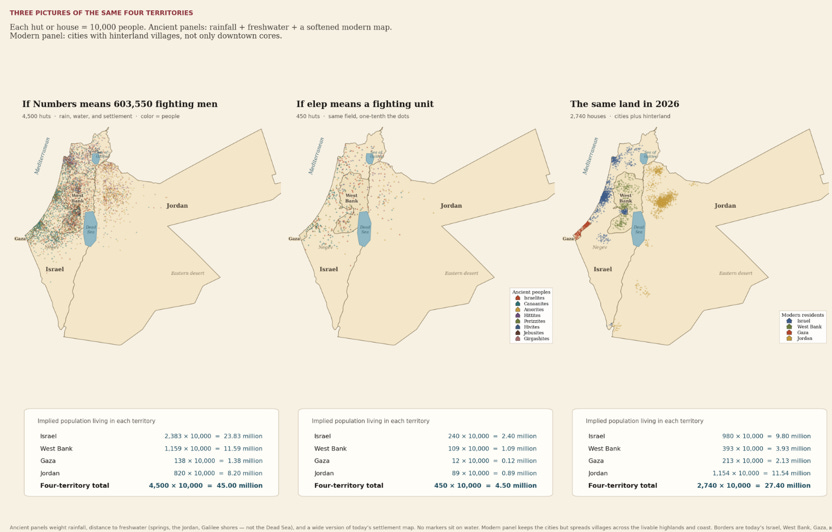
So, you probably can see the issue, right? There are just so many implied people! That’s way too many people for around 1200 BC!
How do we know it’s too many? Well, the Nile valley was universally regarded as one of the most densely populated parts of the known world back in ye olde ancient times. It is a desert with extensive archaeological remains, and it was literate, so we actually know things about it from lots of sources. Scholarly estimates for New Kingdom Egypt’s population typically land somewhere between about 2.5 and 5 million people. It did not have 30 million people in 1200 BC. It did not have 30 million people in 1950 AD!
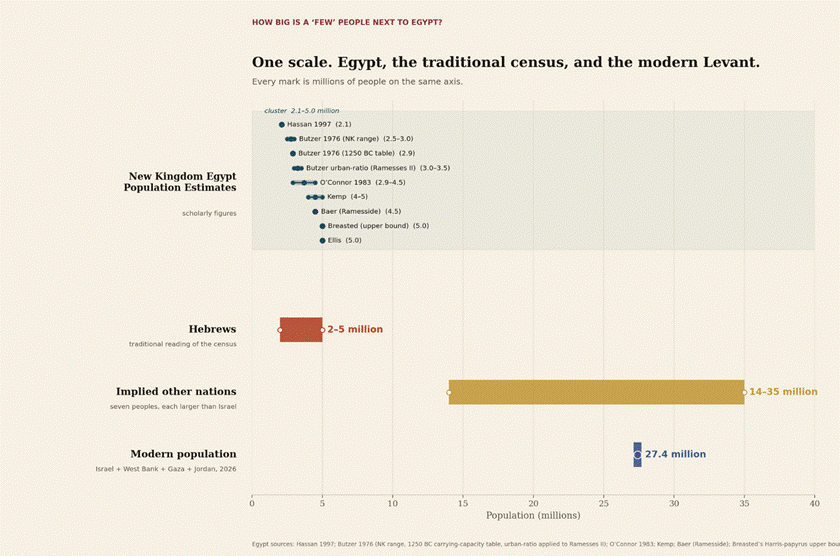
The traditional count implies that Hebrews made up basically 100% of the total population of Egypt, which is wild, since the Bible explicitly says they all lived in one region, Goshen, and were enslaved on one building project, the construction of Pi-Ramesses. You’d have to believe not just that 2-5 million Egyptians kept 2-5 million Hebrews enslaved, but that ~100,000 Egyptians in one city kept 2-5 million Hebrews enslaved in that city, and that the rest of Egypt was basically empty. These numbers make absolutely no sense.
“Milk and honey” promises notwithstanding, the Promised Land is much worse farmland than the Nile valley. Every ancient account, including the Bible, treats Egypt as the rich, fat, irrigated place and Canaan as a contested hill country. The Hebrews complain to Moses at one point reminding him that in Egypt they always had food. Egypt had a large enough population to support long-range expeditionary warfare, huge monumental construction, extensive social stratification—none of that appears in Canaan. There is not a shred of an impression in the Bible that the Biblical authors believed Canaan was more populous than Egypt, yet the traditional Census count numbers imply Canaan had ten times the population of Egypt.
Deuteronomy 8 then promises that the Israelite population will increase in Canaan: the diseases of Egypt will lift, and they will multiply. So 2–5 million would not even be a cap on Hebrew population! It would be a floor! And then when we have later Israelite counts in the same canon, and they do not look like a people that started at two million and grew, as we shall see.
Put bluntly, the problem with the traditional reading of the Biblical Census numbers is that they make a hash of other parts of the Biblical witness, and also defy all comprehension about how populations work. Being a demographer, you may color me intrigued.
What an elep is
Now that we basically know what the traditional reading of the text is and know why this seems like kind of a problem, let me just give the solution.
The Hebrew word being translated “thousand” is elep (אֶלֶף). In the Greek Septuagint it will be translated something like “chiliad” which is Greek for one thousand fighting men. This is gonna be super important so let me repeat it: the Septuagint rendered “elep” as a word that literally, numerically means 1,000 fighting men.
In a great many places, elep indisputably it means “thousand,” especially in some passages about livestock. In a great many other places it means a clan, a tribal subunit, a chief’s following, a fighting band. The related word allup is a clan chief. It’s easy to find cases where elep obviously does not mean 1,000: Genesis 36, Joshua 22, Judges 6, Micah 5. Gideon can call himself the least in his father’s house and his clan the least/weakest/poores elep in Manasseh without claiming that his father’s clan has 1,000 men. In fact, his father’s can does not have 1,000 men, as other parts of the story make clear.
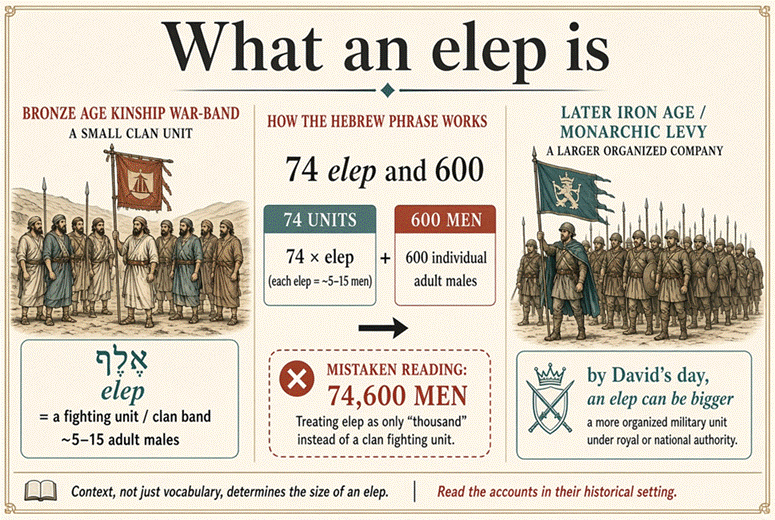
An elep, then, doesn’t mean 1,000. It means, literally, a fighting unit or war band. How many men are in a late Bronze/early iron war band? Well, we don’t usually have clear numbers, but offhand I recall David’s “mighty men” were clearly a single unit and end up as 37 guys, not 1,000. If you think of a tribal kinship network, consider a 70 year old surviving male: how many adult male descendants might he have? If he had 8 children, 4 boys, and 50% survival to adulthood, he has 2 sons. Those sons each having 2 sons means 4 grandsons, so 6 fighting men in their father’s house. If you extend to the patriarch’s brother(s) you get up into the teens. The total fighting force of a great-grandfather lineage in such a society will range from 5 to 30 men, unless he is a top-dog tribal chieftain with a gajillion wives. So, it would be rational to expect a “clan war band” to be about 5 to 30 men. We will see if that is the case in a moment.
But note that this is not a new trick I invented to dodge a hard verse. Flinders Petrie suggested it more than a century ago. George Mendenhall argued this after that, Colin Humphreys worked the arithmetic until the firstborn numbers and the Levite numbers stopped being insane (again, we are coming to that!). I’m going to provide some new arguments around this issue, but the interpretive argument has existed for a long time.
Grok made this sort of goofy graphic:
Now, what happens if we use our newfound understanding to interpret the Numbers 1 census?
Consider again:
Of the sons of Issachar, their descendants by their families, by their fathers’ households, according to the number of names, from twenty years old and upward, whoever was able to go to war, their numbered men of the tribe of Issachar were 54,400.
Numbers 1:28-29
Well, 54,400 doesn’t really read “54,400”. It reads “54 eleps and/or 400 men.” The and/or is the ambiguity; it’s a Hebrew particle waw/vav which… can mean and or can mean or. Super annoying, right? In other Semitic languages today in a use case like this it would indeed usually mean and, thus it has been rendered “and.” But… what if the intended use was or? “54 eleps, or, that is, 400 men.”
Read the census that way and Numbers 1 is no longer 603,550 soldiers. It is 598 fighting-units totaling 5,550 men. The average band size is about nine adult males with a range 5 to 16. Oh look that’s exactly what we would expect!
By the way, Numbers 26 has a census too. Below I show what you get if you treat elep as a unit count for average unit size:
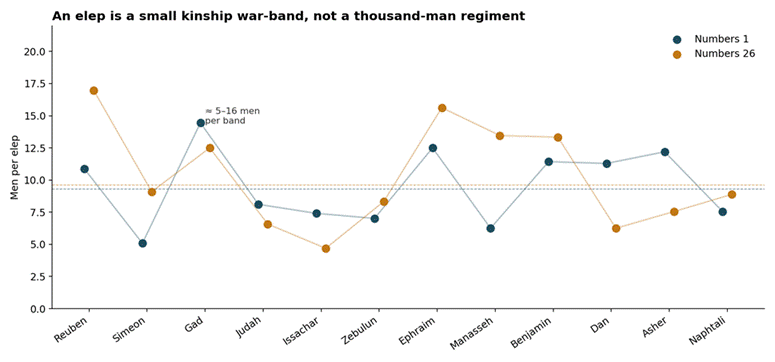
Given that dividing the hundreds/count data by the thousands/elep data produces extremely plausible unit sizes in the Biblical unit size range and consistent with the family structure of Biblical peoples, and given that it’s super freaky the data has no zeroes in hundreds places and extremely consistent ratios of last-three-digits to units (more on that below!), I think this is good evidence the original text was giving a dual count of fighting units and, separately, of fighting men.
And guess what? That is what the Bible says they were counting! With your newfound knowledge that the census is counting father’s households (elep units) separately from fighting men, read the actual census description again:
Now the Lord spoke to Moses in the wilderness of Sinai, in the tent of meeting, on the first day of the second month, in the second year after they had come out of the land of Egypt, saying, “Take a census of all the congregation of the sons of Israel, by their families, by their fathers’ households, according to the number of names, every male, head by head from twenty years old and upward, whoever is able to go to war in Israel. You and Aaron shall count them by their armies. With you, moreover, there shall be a man of each tribe, each one head of his father’s household… So Moses and Aaron took these men who had been designated by name, and they assembled all the congregation on the first day of the second month. Then they registered by ancestry in their families, by their fathers’ households, according to the number of names, from twenty years old and upward, head by head, just as the Lord had commanded Moses. So he counted them in the wilderness of Sinai.
Numbers 1:1-4 and 1:17-19
As a stats nerd I read that as
They will be registered by
Set: Ancestry in their families
Subset: By their father’s households
Items: According to the number of names, from twenty years old and upward, head by head
So the final table should give us
Ancestries
Father’s Houses
Number of men
And it does! Numbers 1 is organized by ancestries (tribes), then father’s houses (eleps), then, finally, number of men.
Why did we mess this up?
I think the vanishing of this understanding began with King David. I used to think it was just all screwed up Hellenistic scribes, but I suspect the monarchy messed it up a bit. When David forms the first kinda-sorta-organized army for Israel after becoming king, he gives his officers titles and hierarchy: commanders over hundreds, and commanders over thousands. Elep is indisputably also used for “thousands” in many cases like livestock! My view is David probably appropriates an established title for a quasi-independent officer (allup, leader of an elep), then assigns it to a new military division which may actually be a thousand (or at least a thousand-on-paper). A traditional rank takes on a new meaning, confusing readers for three thousand years.
Of course, as we will see below, Hellenistic scribes still had a huge part to play in messing this up.
Huge Population Decline in Judges?
But suppose I have not convinced you. Let’s skip ahead a bit to other places where the Bible itself gives us some commentary on Israelite population. The largest military mobilization in Judges, set not terribly long after the Census in Numbers, is the civil war in Judges 20. Israel plus Benjamin field on the order of “42–44 elep,” usually rendered 400,000-plus. The language is emphatic: “all the people of Israel,” “all the men who drew the sword,” gathered “as one man.” A whole plot point of the chapter is that one village failed to send men and is butchered for it. This is presented as a maximum effort.
And the chief of all the people, even of all the tribes of Israel, presented themselves in the assembly of the people of God, four hundred thousand footmen that drew sword.
Judges 20:2
By David’s census in 2 Samuel 24 the Bible reports 500 elep in Judah and 800 in the north.
So: Moses promised the nation would see growth. The people grew. And then, somehow, they lost a couple hundred thousand fighting men before they had finished the book of Judges, down from 600,000 fighting men at the conquest to 440,000 at the end of Judges? And then back up to 1.3 MILLION soldiers in 2 Samuel!?!?! That’s… extraordinary. David’s army was, apparently, larger than the U.S. military today.
To which I say… Nope. Nopenopenope. That makes a hash of the scriptural witness. There’s decline where they should have been growth (post-conquest), and then the absolute numbers just get nuts.
But if what is reported is growth in unit count and numbers of father’s houses, it’s very plausible! The shift from nomadism to sedentary life post-conquest could have altered the ratio of fighters to father’s houses, yielding bigger average father’s houses. David’s own band of mighty men (never referred to as an elep, I grant) is 37, much too big for a father’s house, but it doesn’t seem that anybody sees David’s unit as unusual for its size, just for the quality of the men in it. Later he absorbs 11 Gadites who arrive as a unit.
As I will show below, the overall trajectory of massive growth under David is actually archaeologically correct. Just, not 1.3 million soldiers. The way more obvious reading is that between Numbers and Judges the size of an elep changed. Sedentary villages make bigger kinship structures, maybe more kids survived to adulthood, the Israelites had big families, something like that. By the time David rolls in, larger villages have created a situation where “elep” often doesn’t even refer to a father’s house unit as it did in Numbers, but to something like a village muster, sometimes including multiple kinship groups. Once David establishes the monarchy, he completes the transition of the unit definition away from a kinship-unit to a formal organizational structure. David’s kingdom fails to develop complex centralized bureaucracy, but he is able to create a proficient, organized, and at its elite core somewhat professionalized army.
The table, because I am a pedant
Anyways, here is how the numbers shake out in the various readings.
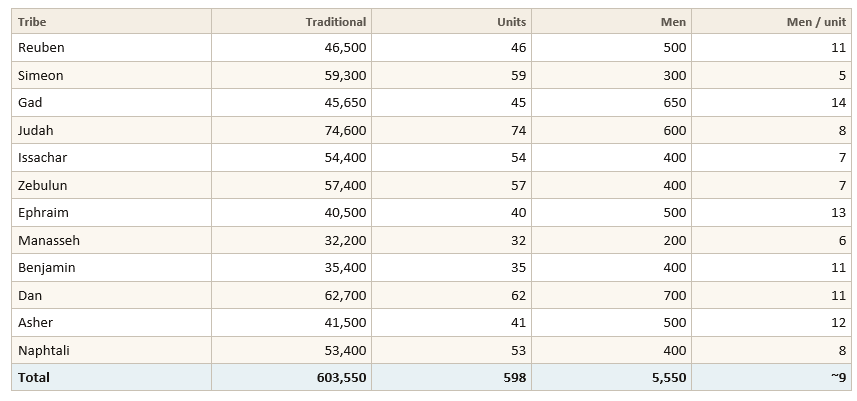
Numbers 26, forty years later, after the wilderness deaths and the Baal-Peor disaster:
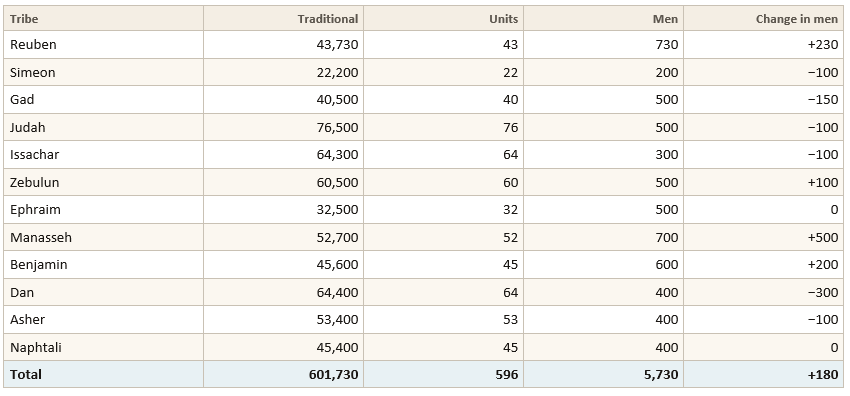
And then here’s what the man counts look like in Numbers 1 and Numbers 26 under my preferred reading:
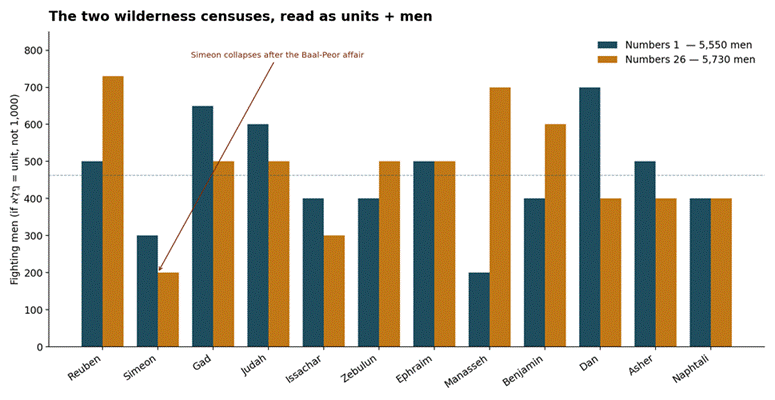
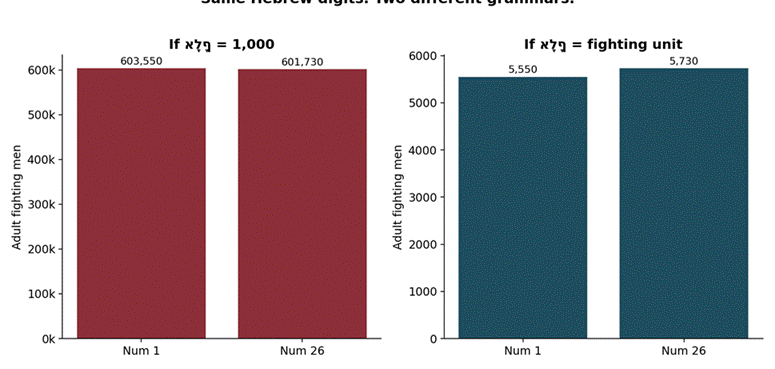
What I love about the elep-as-unit reading is that, if you take the elep-as-fighting-unit reading, you get a very different impression of how population change happened in Israel. In the traditional reading, there is a slight population decline over Numbers, driven especially by Simeon, but also Gad, Ephraim, and Naphtali. While a population decline over Numbers seems Biblically plausible, we are also told they had children robustly in the wilderness. In the elep-as-fighting-unit reading you actually get a sense of what happened to the families. Yes, Simeon still leads the decline (and both sources agree that Manasseh saw huge growth—in fact the correlation of change in implied counts between the two readings is 0.4, and the correlation in percent change is 0.65!!), but we now get a sense of how Simeon leads the decline. Whereas the traditional reading just tells us “Simeon lost 65% of its men,” the unit reading tells us “Simeon lost 33% of its men and 63% of its male lineage groups.” The incident at Shittim in this reading seems to have been extremely selective on the smaller male lineages of the tribe of Simeon.
Is that plausible? Well… the issue was that Israel worshipped a false God (Baal Peor). They did this, the text says, because they committed infidelity with Midianite women. Who tends to commit infidelity? Well, usually youngish men. So we imagine the people causing trouble here were youngish men, who maybe did not have many grown sons. Maybe that’s why they wanted some Midianite wives! To have more sons! Anyways, the text specifically names one of the chief culprits as Zimri, a head of a father’s house in the tribe of Simeon. The text names the tribe, tells us he is the head of a father’s house, then allows us to suspect he is not an old man.
The plague God sends as punishment kills off 24 “thousand” or “alep” (slightly different form of the word). But is it really 24 thousand, or 24 kinship groups? I dunno, but Simeon sheds thirty seven elep between the censuses. So I think the Baal-Peor incident fits better with the elep-as-unit reading than the traditional one! The traditional reading should make us surprised that the tribe of Simeon was so hard-hit in the census. The unit reading gives us the reason: Simeon’s overall population was not as hard hit as the traditional reading suggests, but the young male elites were basically decapitated by a divine plague (and a zealous priest’s spear).
As an aside, the traditional reading has Simeon’s fighting male population at 59,300 in Numbers 1, then 22,200 in Numbers 26… but then only 500 Simeonite soldiers are described in 1 Chronicles 4! And that is even after the text says they expanded greatly in good pasture. But the elep-as-unit reading says their fighting-male population was 300 at the Exodus, 200 at the Conquest, and 500 in 1 Chronicles 4, which fits the Biblical narrative.
How Many Hundreds?
Look at those “men” columns again. Across twenty-four tribal figures in two censuses, not one tribe comes out to an exact thousand. Nobody is 27,000. Nobody is 40,000. The hundreds place is always occupied. Often the tens place too (Gad 650; Reuben in the second census 730).
If these were large rounded totals of the “forty-six thousand five hundred” type, that is weird. Large military roundings land on thousands all the time. The odds of never once hitting a clean thousand across two dozen figures are poor. How poor? Well, if we assume that the figures are true natural numbers rounded to the nearest 50 (since they do seem to be hundreds or fifties), what are the odds that there would never be a 0 in the 24 hundreds places? For this I outsourced to Grok, so I haven’t absolutely confirmed this, but Grok says the odds are about 8%. That’s pretty low!
On the other hand, if the “hundreds” are the actual (rounded) headcount inside each set of units, they should wander around 200–900 never be zero. That is what they do.
This is a pretty good tell that the original list was two numbers sitting next to each other: a count of units, and a count of men. Again, the header on the census text already tells us this is what happened, we’re just showing it another way. You can easily see how the numbers got messed up.
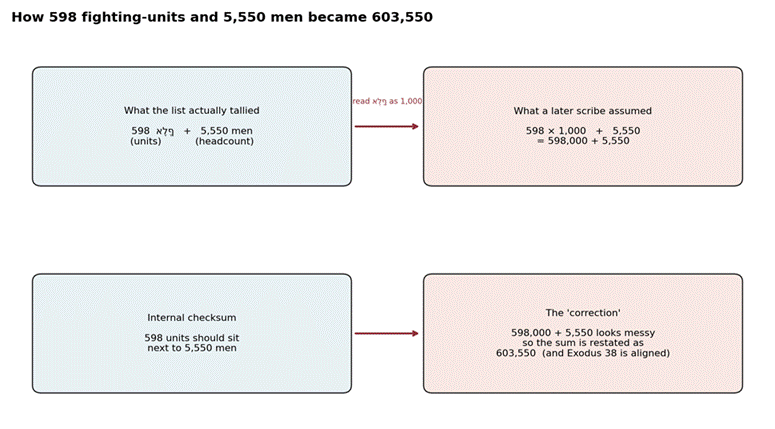
All you have to assume is that some scribe, writing after elep had transformed into a more pure mathematical/military usage, thought he was encountering an error. He read “598 elep and/or 5 elep and/or 500 and/or 50” and he had a weird problem. He could render it as “598,000 5,000 500 50” which is crazy, or he could combine it somehow. Instead of assuming it was “598, or, 5,550” which is a lot of 5s, he chose “603,550.” Notably, this was a smart scribe—because “repeated numbers” are often errors! It’s actually a common scribal error to repeat numbers! So he may have genuinely had good reason to suspect the correct number was 603,550!
But as we hopefully realize by now, 603,550 was not the correct number. The correct number was 598 units containing 5,550 men.
You can watch the same instinct at work elsewhere in the Bible. 2 Samuel and 1 Chronicles disagree about chariot numbers, stall numbers, casualty counts, army composition, Jehoiachin’s age, at various places. The Septuagint “fixes” Saul’s age in 1 Samuel 13, where the Hebrew text as we have it says something close to “Saul was a year old when he began to reign.” Scribes fix numbers. Saul wasn’t a baby when he became king. Scribes fix numbers because numbers often have typos or errors in societies where people don’t learn math, and because numbers usually don’t have big theological “stakes.” You don’t usually need as many Boss Scribes to sign off on the “fix” as if you, like, remove the Virgin Birth.
A Ptolemaic scribe who thought he was being helpful and messed it up is a lot more plausible than the stack of assumptions required to keep 603,550 as a headcount.
The firstborn problem
There are yet more problems!
Numbers 3 says the firstborn males of Israel a month old and upward were 22,273, and the Levites who substitute for them were 22,000, leaving 273 extra firstborn to be redeemed with silver.
All those listed of the Levites… were 22,000. … The firstborn listed of the people of Israel… were 22,273.
Numbers 3:39, 43
Imagine 603,550 adult men and 22,273 firstborn males of any age. If you assume more like 1-2 million men total, then there’s something like 44 to 90 non-firstborn-males per firstborn male.
This matters for the obvious reason of what it implies about fertility. If there are 27, or 44, or 90 non-firstborn-males per firstborn male, then, including females, that implies that the average woman had… 50, or 100, or 200 children!! That’s, uh, not possible. Even 27 isn’t possible for a populationwide norm!
Interpreters have tied themselves in knots for centuries over this — maybe “firstborn” only counts sons born after the Exodus, maybe the Levite figure is rounded, maybe we should not look directly at the verse and just hope it will go away.
But this isn’t a hard problem for the elep-as-unit approach.
First of all, the Levite count changes. It’s 1300 Levites ages 1 month and older, across 21 elep. That’s some big eleps but we’re looking at a different age definition so probably not a huge issue. If we assume the “273 extra firstborns” is valid historical text, that yields a count of 1,573 firsborn males aged 0 and up in Israel. Assuming the 5,550 fighting-age men come from a population of 9,000-18,000 total males, that means 5-12 male births per mother, or 10-24 total births per mother.
That still seems too high! But, we have some sort of plausible rules to edge it down: maybe it’s only firstborns who are sons not firstborn sons. That would mean daughter-first families get off scot free, meaning that in fact the implied fertility rate really is 5-12 births per mother, eminently plausible. Maybe some men have multiple wives, and only the first wife’s firstborn counts. We can be confident most men weren’t polygamous because most men are never polygamous in any society, but even an average wife count of 1.25 puts it at 4-10 births per woman, which is exactly what we observe in historic societies.
Could these tricks save the traditional reading? No: 22,273 firstborn sons divided by 1-2 million total males still gives 44-90 as the sons-per-mother range; assuming it’s just firstborns who are sons rather than “firstborn sons” makes that 44-90 kids-per-mother, and assuming 1.25 wives/man makes it 28-58 kids/mother. That’s still insane.
Reading elep as a unit instead of a “thousand” solves a 2,000 year old interpretive problem around Levite counts. Cool, eh?
How high was Biblical fertility?
Before I go on, I want to violate the broken corpse of the traditional reading in an additional way. I have heard defenders of it say “Well, maybe they just did have 50 kids each! God can do amazing things! Why do you lack faith?”
Please.
Ya know what the Bible really loves? Genealogy. Ya know what demographers really love? Genealogy. Ya know what most Bible readers skip? Genealogy. Ya know why this matters? Because genealogical records often give us explicit data about fertility and family size.
Genealogical data can be used as a way to check and see “What was a typical number of surviving children.” We can assume genealogies mostly exclude children who died in infancy, and also usually exclude women. For many men they just appear “son of… father of…” and we can exclude thoe cases. But if we just limit to cases where we are told stuff like “Bob had 5 sons…” we can actually cobble together a true demographic record of family size in the old testament.
Not just “can.” I have. Someday I will write another piece on the genealogies themselves because dumdums skip them in the Bible and skipping the genealogies is actually why they are dumdums; genealogies are cool.
It turns out that we can infer the fertility of 393 women (some by name, but most just known via their male partners)! Excluding women with fewer than 2 linked children as cases of improper data censoring on availability from genealogies, we find that, of women who had 2+ children, the average such woman had 3.52 reported sons. Assuming this excludes some early deaths, call it five sons. Assuming 50-50 sex ratios, that’s 10 births per woman who had 2+ surviving kids. Then, assuming that it truly is the case that ~10% of women had no surviving children and ~10% had just 1 surviving child (typical in premodern societies), that yields fertility of 8.1 children per woman, a number which is high, but nowhere near the highest population-wide human record (14, Hutterites). Since the attested women are mostly wives of very elite men and elite fertility tends to be higher in ancient societies, we may presume true fertility rates are lower, maybe 7-7.5 children per woman. Regardless, this is comfortably within the range implied by elep-as-unit, and suggests that the Biblical authors did not intend to communicate that there were 25+ children being born to typical Israelite women.
Whose talent?
Now then, if you’re a serious Bible-knower and you made it this far, you are sitting there, all smug, leafing through your ESV, getting increasingly mad that I’m ignoring the obvious rebuttal, ready to absolutely destroy me like the walls of Jericho in the comments, to just completely flame me like the burned remains of Hazor. Hold off, dear sir—I’m about to wreck you so hard you’re literally going to cry and admit that I’m right and the Bible in your hands has a serious scribal error.
Numbers 1 is not the first account of the census in Numbers 1. Confusing, eh? In fact, Exodus 38 is the first introduction to the census. Exodus 38 tells us that every counted man paid a beqah, a “half-shekel of the sanctuary,” and that the silver came to 100 talents and 1,775 shekels. If you assume 603,550 men and that a talent had 3,000 shekels, the arithmetic is perfect:
603,550 men × ½ shekel = 301,775 shekels
100 talents × 3,000 shekels + 1,775 shekels = 301,775 shekels
That is why people treat Exodus 38 as independent confirmation of the big census. But, dear reader, the text of Exodus 38 as you are holding it in your furious, angrily shaking hands is actually even Wronger McWrongerson than the text of Numbers 1.