Unfair Play
Bad boardgame design, biased task coverage, and a broken model of marriage

I really like boardgames. My wife and I play lots of them. We are particular fans of Terraforming Mars, but recently we’ve also enjoyed Roll for the Galaxy, Ark Nova, King Domino, and we did a throwback round and really enjoyed playing Bohnanza again after years of hiatus from it. We’ve had phases where we played tons of Carcassonne, phases where we made all our guests play Ticket to Ride… we are boardgame people. We really like them.
I am also a family sociologist. Family is what I study all the time. It’s literally my job to figure out “what works” for family life (within a particular quantitative framework). This makes me great at parties.
Thus a little while back when Eve Rodsky released a cardgame for family life, I was intrigued.
In this post, I will make three arguments:
The Fair Play Deck is a badly designed game. Its stated goals are misaligned from the actual game structure in ways that render its results difficult for players to interpret in important ways.
The Fair Play deck is fundamentally unfair— in the tasks it identifies or doesn’t, in the implicit weights it provides across tasks, it systematically generates unfair (and, in particular, female-biased) results.
The theoretical idea underlying Fair Play is fundamentally erroneous: while domestic task division does matter for couples, overall task load, task efficiencies, and various external stressors are more important. Marriages are happier when they can reduce total task loads and get more support from society, not when they adjust their task divisions.
But before the main post I should offer one huge caveat.
Arguments about division of labor are extremely common among couples. They are one of the singularly most common things marriage counselors report couples complaining about. Women in particular tend to complain that men do not help enough at home, and men often complain that their wives do not take domestic work as seriously as the husband takes market work (or his share of domestic work, whatever it may be). These conversations tend to become heated. Because domestic work is a repetitious and habitual activity, arguments about it tend towards saying things like “You NEVER…” or “You ALWAYS…” The structure of the subject lends itself towards sweeping judgments and unfairness by all parties.
Smart couples realize this. As such, they totally legitimately often seek tools to ease these conversations. They may have structured or semi-scripted conversations, jointly managed task charts, objective metrics for each other; they may pursue couples counseling; they may discuss their concerns with trusted friends for sanity checks and outside input. The question of “Is my spouse doing their fair share” is exactly the area where lots of couples want help having hard conversations.
Boardgames are rising in popularity and complexity, and gamification in general is very much having a moment right now. It is not prima facie totally unreasonable to think it might make sense to gamify your marital squabbles. In the post below I will somewhat question the wisdom of that approach, but I want to flag that I totally understand the intuition behind it. It’s not crazy to want help having these conversations and it’s not crazy to think some kind of game-like tool might be that help.
So this post will have two thrusts: first, a critique of this specific tool. This critique will include some comments on intrinsic game design issues, some background caveats couples often don’t realize “going in,” and suggestions for how a couple could modify the game for outcomes more conducive to marital stability. Second, a critique of the entire approach to married life Fair Play represents. You can disagree with this broader critique while still accepting the narrower critique, or vice versa. This is in some sense “two posts in one.”
Past the paywall you’ll find some theoretic summarization, and lots of links and sources for various claims in the post.
Fair Play Is a Bad Game
Basic Game Structure
Fair Play is a deck-builder game, albeit an extremely simple one. You can watch a video explaining it here. Players receive a deck of 100 cards. The players consensually decide which of the 100 cards to keep in their joint deck for the actual gameplay, based on which of the 100 activities they find meaningful for their life together. Of the 100, 30 are “daily grind” activities couples are recommended to keep all or almost all of. A small number of couple-specific recreational cards also have happy faces on them to indicate them. You can think of them as free spaces. Of the 100 tasks, 36 refer to children; of the 30 daily grind tasks, 17 refer to children.
Once couples have made their deck, they then distribute the cards. When I first encountered Fair Play, I mistakenly believed this was perhaps a well-designed game, and I thought that after the deck build players would be dealt cards at random, or else the couple would go through the deck and deal cards to whomever in practice does the chore more, and then commence play from these initial positions. That is how a rational game designer would design this game. But that is not what happens. Instead, the players simply draw cards one at a time and debate who should take the card, i.e. who should commit to doing that task for the household. Play proceeds sequentially, card-by-card, discussing and assigning cards as they deem appropriate, through consensus. The game does not have a built-in mechanism for breaking deadlocks; it rests wholly on consensus. Couples unable to reach consensus cannot play the game; ergo, the game is not available for couples with really serious marital disagreements.
At any point in the game, couples can “redeal” i.e. trade cards. However, trading must be consensual. This is the basic crux of the game: because each move must be consensual, once a card has moved, either player can veto a subsequent move. Thus, players have incentives to acquire “good” cards when they come up, and hold them against “bad” cards.
The game has no scoring system. Couples are not required to end up with a 50-50 card split. This is a common misunderstanding (we’ll see below why it’s so common). “Fair does not mean equal” in this game. And that leads us to the first game problem:
Problem 1: It’s Just A Shame-Game (And Some People Are Shameless)
You may wonder how Fair Play would influence chore division at all given that there is no scoring. You just distribute the cards to match the current distribution of tasks and bam, you’ve made your current distribution fair!
This isn’t how it works, because Fair Play does have a score. Read any of the commentary on it and you’ll hear people talking about how it feels to see your partner holding way more cards (or way fewer cards) than you. The actual mechanism Fair Play leverages is cards as visual markers of investment into the household, causing the partner not holding cards to experience shame or guilt. When one player holds tons of cards, it is easier to shame the other player into taking a card they may not prefer to take. That’s the actual mechanism of the game. The videos don’t say shame; they say discuss, explain, talk about why it’s important to you— the actual mechanism is “create reasons for your partner to feel bad about not taking the card” and/or “create justifications for you to feel mad about taking the card.” That’s literally what the game is! All moves occur by consensus, you can never “force” a card, yet the cards must get dealt. You sit at the table until the cards are all dealt! Eventually somebody breaks! The mechanism for breaking the holdout player is to use piles of cards to intuitively visualize to them how badly they are under-contributing. That just is the game. That’s how you play it. You win by heaping shame on your partner.
But some people are very hard to shame! More sociopathic personalities just don’t care as much about shame. As such, this game tends to favor sociopaths— they’re more willing to just look at their partner’s visually-uneven load and say “I don’t feel bad about that.” This is a problem for game design. You don’t want a game dynamic that advantages the kind of player the game is literally putatively designed to rein in! The game is supposed to help overburdened spouses acquire a fairer distribution, not to give sociopathic spouses an opportunity for self-justification-by-cardgame!
Problem 2: Incentives to Lie
As such, to win the game (i.e. achieve a task division which is better than status quo ante from your perspective), you need to get enough cards to gain leverage on the other player, but also to not dislike your own cards too much.
In a normal boardgame this is a decent design feature: you want to look like you’re suffering but actually like the cards you have. You have an incentive to communicate to the other player that you HATE doing the dishes doing the dishes gives you NIGHTMARES… when actually you don’t mind doing the dishes, you just want your partner to agree to take out the garbage. Optimal gameplay involves making your partner more sympathetic to your acceptance of your cards than you actually deserve, because that means you dislike the chores less than they think you do.
This kind of incentive to lie is, I think, very bad for a marriage! You may object, “But Lyman, couples will know better than to behave in that way!” They love each other, surely they wouldn’t engage in this kind of deceptive gameplay?
To which I respond: If the couple ordered a boardgame on Amazon to settle their domestic task division rather than just talking to each other, then I think we have to take it as a very likely reality that one or both members of the couple may engage in strategic, aggressive, less-than-above-board gameplay. Moreover, gameplay dynamics draw out gameplay typical behaviors. Even if your spouse might not be a cuthroat liar in other arenas, turn the chore list into a game they can min-max, watch the throat-cutter come out. By encouraging strategic misrepresentation about task preferences, Fair Play basically rewards couples for lying to each other. There is no in-game method for truth-elicitation.
Problem 3: Deck-Size Meta-Gaming
If your deck is small (i.e. you and your partner chose to keep few cards in the deck), card-counting is pretty easy: you can approximately remember the 20-40 cards you kept in the deck. Thus you can make statistical trades against expected future card draws. If your deck is large, you cannot adopt this gameplay strategy, unless you have an unusually good memory. This makes the game problematic: players have incentives in deck-structuring to alter the number of cards kept, i.e. to misrepresent their true beliefs about what matters for the family. Generating a shorter initial deck makes it easier to recall which cards remain in the deck, and thus to make strategic judgements about whether you are willing to “take” a given card when it comes up. This in turn gives a strategic player opportunities to trap their partner: they can “nicely” take many cards early on if they happen to draw more tolerable cards early, and effectively “stick” their partner with the residual cards.
Remember, the win strategy here is to acquire cards you don’t actually dislike that much and then use them to bully the other player into accepting cards you do dislike. Thus, having a clearer recall of what cards remain in the deck is a huge advantage! Generally speaking I would suspect that when couples are heterogamous on intelligence and memory the Fair Play deck probably leads to the lower-intelligence partner getting a pretty raw deal, because a player more able to visualize how much they dislike the chores remaining in the deck can pro-actively accept less disliked cards then use their cardstack to shame their less-engaged partner into picking up the cards still in the deck.
This is an intrinsic problem of the card-dealing structure of the game. If instead the game worked by immediately dealing all cards according to some ruleset, and so players had equivalent information, this issue would be alleviated. But that’s not how the game is played.
Thus, at the outset, the game has a meta-game which enables partners to effectively target the other player using a form of gameplay most people consider hostile. Caveat here: this is my gameplay style. I play games very aggressively, as do most of my friends. If we play Skulls, there is always a skull. Most people find very aggressive, other-targeting gameplay styles “not fun” or “jerkish,” but in fact they are the optimal strategy for victory in many games and thus rational players are obligated to adopt them, since failure to pursue victory is in-game-unethical. People who throw games are as bad as cheaters. Couples who refuse to go for the kill in a game because of emotions or love do not get invited back to the Stone House for a second game night. I will not play games with people who don’t play to win, which is to say, my wife and I play games correctly, as they are designed to be played.
But bringing this logic into marital conversations seems like a very bad idea to me! Nonetheless, Fair Play is designed such that the more amoral, game-aggressive, strategic, intelligent player can in fact pretty easily engineer a favorable outcome against a less cutthroat opponent.
I actually suspect Rodsky is aware of this game vulnerability. Why? Because she actually recommends keeping the deck as small as possible. Why? Well, you may think a small deck is easier to meta-game, but given the distribution of memory capabilities in human populations, the fact is a small deck probably makes it more likely that both partners can act strategically against each other, whereas a larger deck creates systematically larger advantages for the player with better card-counting abilities. But I only suspect this is the motivation: I have not read Rodsky discussing this particular vulnerability of the game.
On the whole, I think Fair Play would be improved by having a full initial deck-deal of some kind. This would eliminate the memory advantage meta-gaming strategy. Either a random deal or a status quo deal would likewise somewhat adjust incentives to lie, though not wholly eliminate them. You could also consider an initial deal where all tasks couples agree can’t be re-allocated are pre-dealt to that partner, then you randomly deal remaining tasks, and players simply trade cards until they reach equilibrium. Any of these are better options than sequential-dealing. On lying, the incentives to lie are just baked into the game. So too the shaming mechanism. The mechanism of shaming your partner with a stack of cards seems just overall really an adverse strategy for behavioral change to my eyes, YMMV. But there’s also a gendered dynamic to implicit or explicit accusations of inadequacy. Which brings us to…
Fair Play Is Unfair
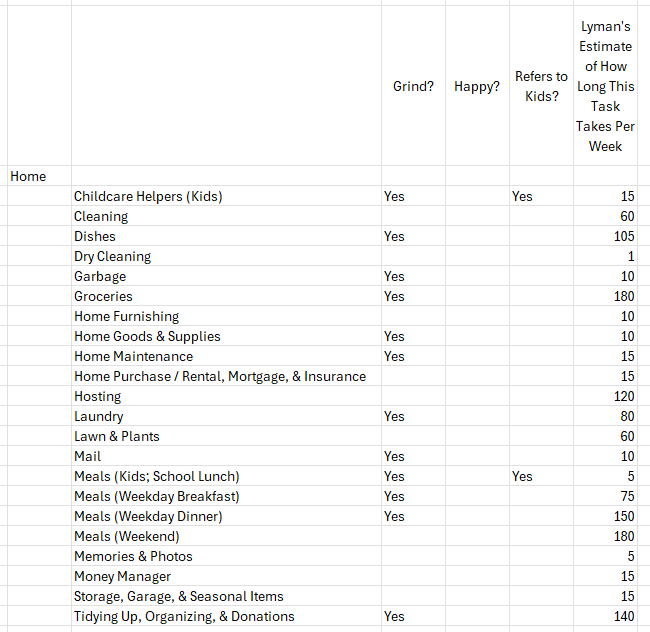
Let’s take a closer look at the cards. Here’s the cards in the “Home” category. I’ve labeled them by if they are “Grind” or have a happy face on them or refer to kids. I’ve also labeled about how much time my wife and I together spent on that task in an average week. Some things don’t happen every week so the average week score is low.
Problem 1: Time Judgments
Your times may vary. But what I want to note is how variable the times are. We take stuff to the dry cleaner maybe 2 times a year; about 1 minute of time a week is spent on that errand. But dishes are every night. “Home goods and supplies” is a daily grind but home furnishing isn’t, yet we spend similar time on each (for example, in just the last week I built a new bed and new shelving units).
The variance in how much time tasks take is enormous. Of course, Rodsky is clear, not all tasks are the same, so you don’t expect to have the same number of cards, but this is obviously a red herring— the way the game works is by comparing numbers of cards. The cards don’t have a scoring method for how bad they are or how long they take. The only in-game method for guiding decisions is number of cards. Thus, while players don’t have to end at 50-50 card splits, the actual game mechanism predisposes visual comparison of equal-weight cards.
As such, massively different cards “appear” to have similar weights. If we look at the Caregiving section:
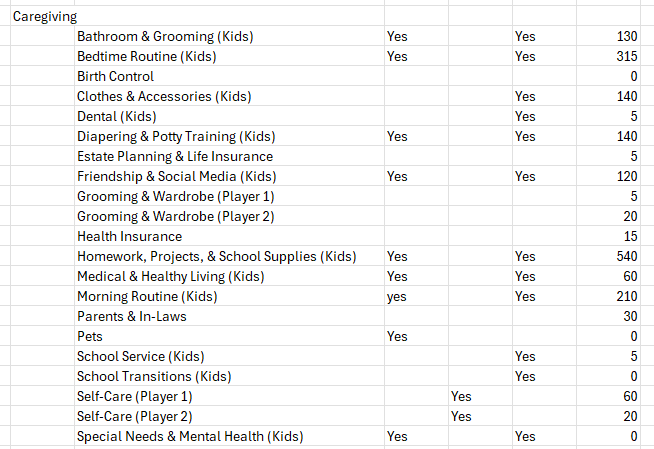
The single most time-demanding task for my wife and I is “Homework, Projects, & School Supplies.” Weird, right? No, Rodsky assumes your kids are in school and/or childcare— there’s not a card for “Homeschooling.” My wife (and some of our friends with kids the same age) homeschools our kids. So I guess that’s “Homework”?
On the other hand, one of our other most time-demanding tasks is our bedtime routine. It’s long. My friends make fun of us for it. Most of it is me solo. But while bedtime takes a shockingly large total volume of time, it’s easy and fun. So time-demands also misrepresent! And in particular, Fair Play tends to undercount the contributions of whichever partner is a minority-performer of a task. If a wife does 51% of every task, she’d in principle be holding 100% of the cards, even though the husband is doing 49% of the labor in that scenario. Indivisibility of cards of necessity causes Fair Play outcomes to erroneously represent actual divisions of labor.
Problem 2: Preference Judgments
And this gets to the next problem. Again, it doesn’t matter how many times Rodsky says “You may not need to end up with an equal number of cards,” literally the way the game works is you compare numbers of cards. To the extent it is a game at all, that is the game.
We already addressed above the fact that couples may vary in how much they disprefer activities. But here it’s worth quantifying it. Let’s take the following example, using some back-of-the-envelope guesses for my wife and I:
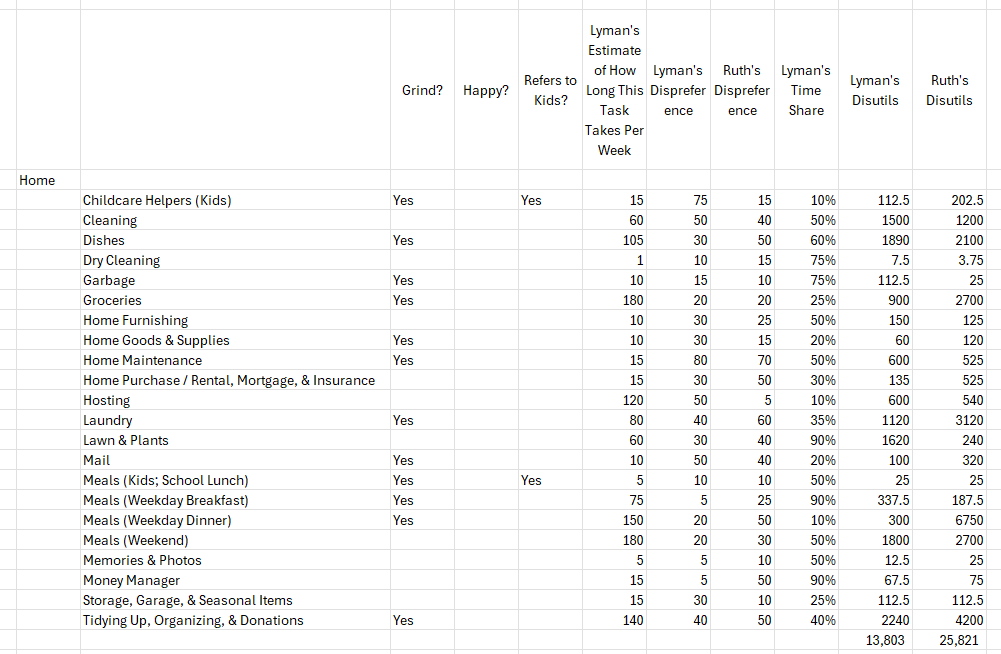
As you can see, multipling time on chore by our share of time on it by our disutils per minute of that chore, my “home” chores generate 13,803 disutils for me. My wife’s home chores generate 25,821 disutils for her. So my wife gets a pretty bad deal on the home front!
But does Fair Play capture that? Well, if we assign cards by who mostly does it, here’s how percentages break down:
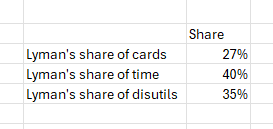
I do 40% of the time spent on home tasks, I incur 35% of the disutils from it, but on the cards-basis I am only 27% of the cards.
Note, the very first “rule” of Fair Play is “everyone’s time is equally valuable.” This seems like an innocuous assumption, but the implicit argument of it is “Just because this time-use is particularly unpleasant for you doesn’t mean it counts for extra.” I disagree, I think couples should consider each others’ whole utility functions, but regardless, on a pure time basis I do 40% of the home tasks, yet on a cards basis I do just 27%!
Personally, I think the disutils measure is actually more correct! I do about 35% of the “work,” i.e. the expenditure of physical, emotional, mental, and psychological energy to keep up our life. By ignoring preference judgments, Fair Play incorrectly identifies task divisions.
Again, in principle couples could de facto incorporate preference judgments, but remember 1) Fair Play’s rules encourage you to weight all time equally, you literally are not supposed to be applying weights, 2) Fair Play provides no in-game method for tracking preference judgments, 3) Fair Play’s in-game method for tracking gameplay actually does visually weight all tasks equally. So claims it isn’t aimed at 50-50 card mixes are, while not lies, difficult to apply in reality.
Problem 3: The Missing Tasks
The 100 tasks listed in the Fair Play deck cover a lot of things. But there are some weird things missing. For example, “Lunch.” Apparently people who use the Fair Play deck do not eat lunch; they subsist purely on breakfast and dinner. The Fair Play deck also does not know about elevensies, second breakfast, or tea time.
Why is lunch excluded? Well, if we think about some other exclusions like “Homeschooling” and “Going to Work” and “Earning Money” and “Being Away from Your Kids Because You Were Deployed To Afghanistan,” we can see that the Fair Play deck assumes an extremely specific kind of family. It assumes two earners with relatively similar incomes and hours, whose children are enrolled in center-based care or schooling, and whose work is “morally neutral,” i.e. they do not incur major negative utility from doing their work. So basically the Fair Play deck describes white collar two-earner households, and only such households. If “work travel” for your job is basically something which is good, which is basically a vacation, and your spouse also has that kind of job, then the Fair Play deck might, maybe, kind of, work for you. But for most Americans, for whom “work travel” is a deployment or an oil rig or a long-haul trucking run or a season in some fields or having to stay with a family member for 6 months at a time, or a conference which is basically unpleasant when you’d rather be home, or coworkers who aren’t your best friends, or work which is painful, unpleasant, or alienating, the Fair Play deck fundamentally just doesn’t work.
The Fair Play deck literally has no card for market work! None! None at all! Working 40 hours per week gives you zero cards! I would suggest the deck actually should include one card for every 5% of family income a spouse earns. So if you earn 100% of your family’s income, you start with 20 cards. Given that there’s up to 100 cards to be dealt in the deck and 30 daily grind tasks almost all decks include, this would still more-or-less require the breadwinner spouse to take ownership of tasks. But the implicit model of Fair Play which assumes both couples are “fair” contributors to household income is absolutely bonkers. That applies to less than 20% of couples.
Alternatively, another way to address this would be to put a price on each task. Most of the “Home” tasks can, in various forms, be “hired out.” If we put a price tag on each task, we can estimate how much money each partner “saves” the family by doing the task!
Here’s some rough ballparks (note that I live in a cheap metro area):
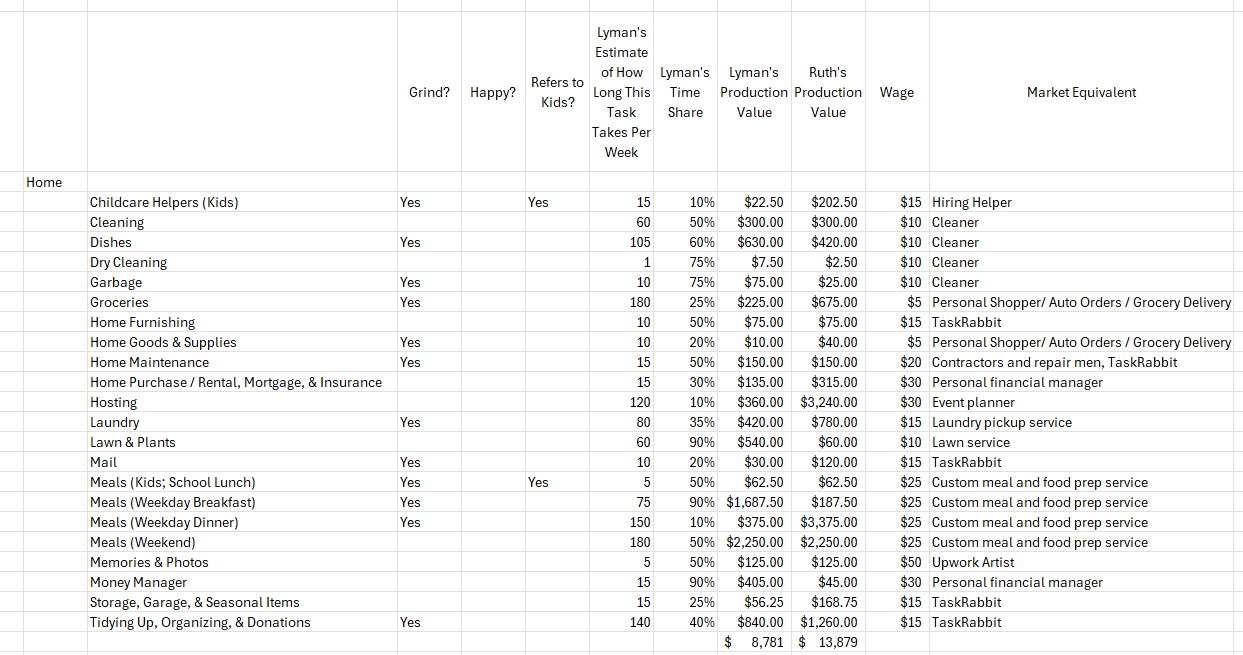
And if we look at the shares of home tasks we get:
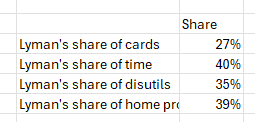
So my share of home production value is 39%! Now, for the record, across Home, Out, and Caregiving, the three main categories of chore-like cards, I am just 23%.
But in principle you could do this exercise across all of the tasks, add them up, and treat them as “income” earned by each spouse, comparable to market income earned. And I actually value the work my wife does at home a lot more than the market rate for those services, because contra what it probably seems like so far in this post, I am not an asshole husband. But, if we were to take the market value of my wife and my Fair Play-listed chores and add them to the market value of our incomes, it would suggest that I do 81.5% of the work in my family.
I do not do 81.5% of the work in my family! But Fair Play fundamentally misses a key intuition: market work is not fairly distributed. Many spouses work more than they would like to, and scaling back isn’t an option; or they work less than they’d like, and scaling up isn’t an option. I have argued this dynamic plays out on a national scale in East Asia, where complaints about “unhelpful husbands” are actually wrong, what’s actually going on is insane working hours.
The point isn’t to say I do 81% of the work in my household: obviously, for the technical market value of my wife’s home production, I could not purchase labor which would be equivalently good and make my home life equivalently happy. The point is to say that having no acknowledgement at all of a the single largest male-biased task is crazy!
Rodsky admits on average couples find the cards “fair” when the split is around 70/30 or so. Yet she doesn’t seem to see that as a problem, when the only in-game benchmark remains objectively lopsided in a circumstance players consider fair! The obvious reason for this is the person at “30” is doing something else! Maybe they’ve taken longer tasks or more dispreferred tasks, or maybe the Fair Play list is just the wrong list of tasks.
I don’t think adding 50 more cards to Fair Play to represent more tasks would suddenly make Fair Play good. But I do think the biased list of tasks reveals one specific way in which Fair Play is quite bad: it explicitly ignores tasks performed for the family in the marketplace.
Fair Play Is a Four-Player Game
Fair Play is advertised as a two-player game. But it has two other players. One is explicitly named in the game, the other lurks in the background. Ignoring these players ignores the actual dynamics shaping most of the difficulties Fair Play is trying to address.
The Third Player: Children
Child labor laws are ruining this country. You can allocate cards to children. There is a built-in helicopterish assumption in Fair Play that parents will handle these tasks. But children should handle some of them!
Adding children obviously creates new tasks, but as they get older children can also take on some of the tasks. Fair Play explicitly acknowledges kid’s status as a game-player in terms of generating tasks (parents will have bigger decks, on average), but does not recognize the fact that children can and should take some of the tasks. Children of various ages can perform quite a lot of the home tasks, and it is beneficial for their development to do so. Obviously nothing in Fair Play prohibits dealing in your kid, but the tasks are all adult-focused: kids’ tasks are mostly left out, and the game certainly does not envision dealing in a kid.
The Fourth Player: The World
Probably the biggest problem with Fair Play, however, is its exclusion of the fourth player: the world, or society, or everybody who is not your nuclear family. So take this data from time diaries:
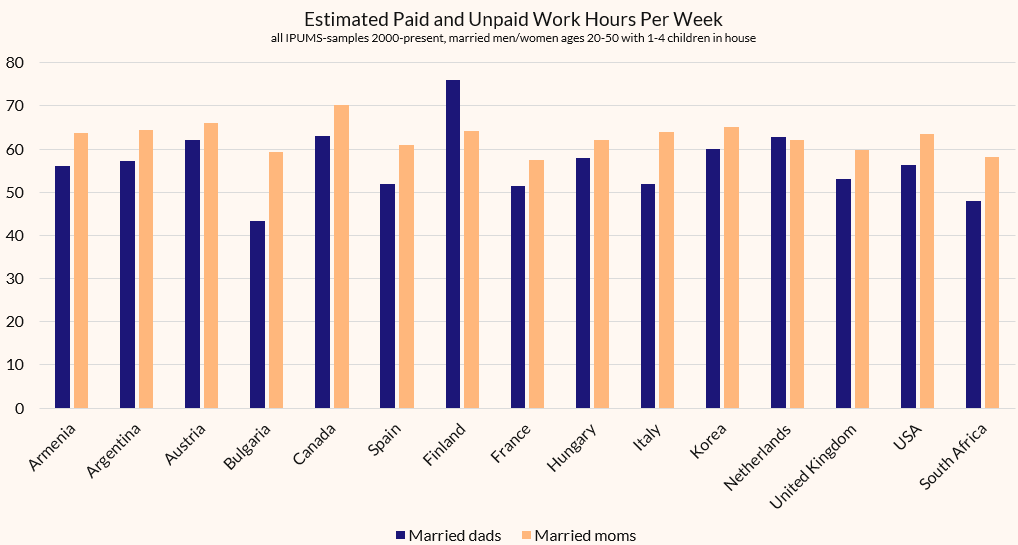
This is total paid and unpaid work for married moms and dads ages 20-50 with 1-4 kids. It’s a hugely broad category which means the IPUMS data is highly comparable. It includes all chores, schooling, paid work, commuting, and childcare.
One thing that probably jumps out to you is 1) moms do more work in most societies and 2) but there’s a lot of variation!
In Bulgaria, dads have it incredibly easy. Similar things are true in South Africa, Italy, and Spain. On the other hand, Finnish dads have a pretty raw deal compared to moms and absolutely! Literally no parents devote as much of their time to work instead of leisure as Finnish dads! The 2nd place award goes to Canadian moms.
Here it is as shares of work:
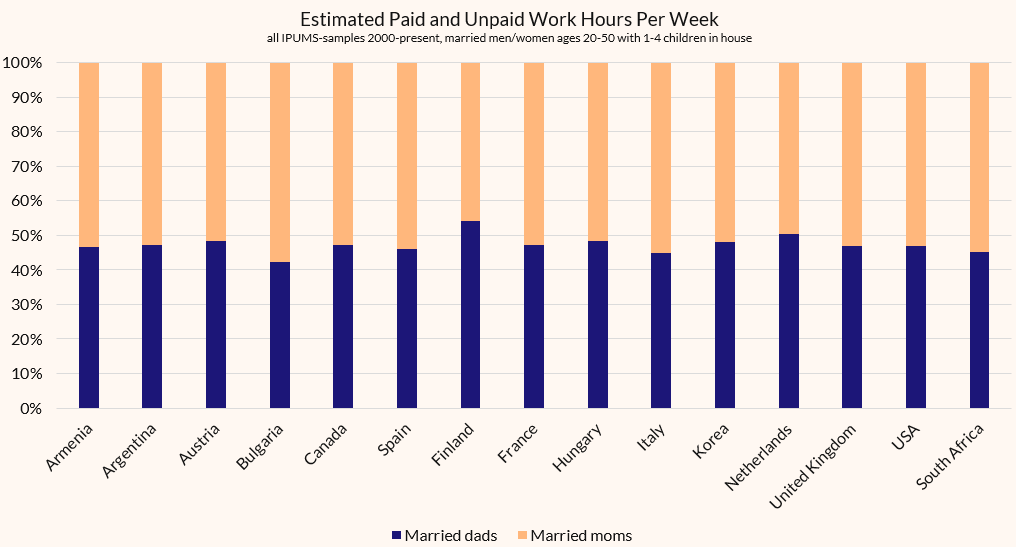
So you can see Finnish dads do the largest share of any dads, then Dutch dads, then Austrian dads, then Hungarian dads, etc. I think this kinda tracks with a mental model of the prevalence of egalitarian ideas.
But now let’s look at the graph another way:
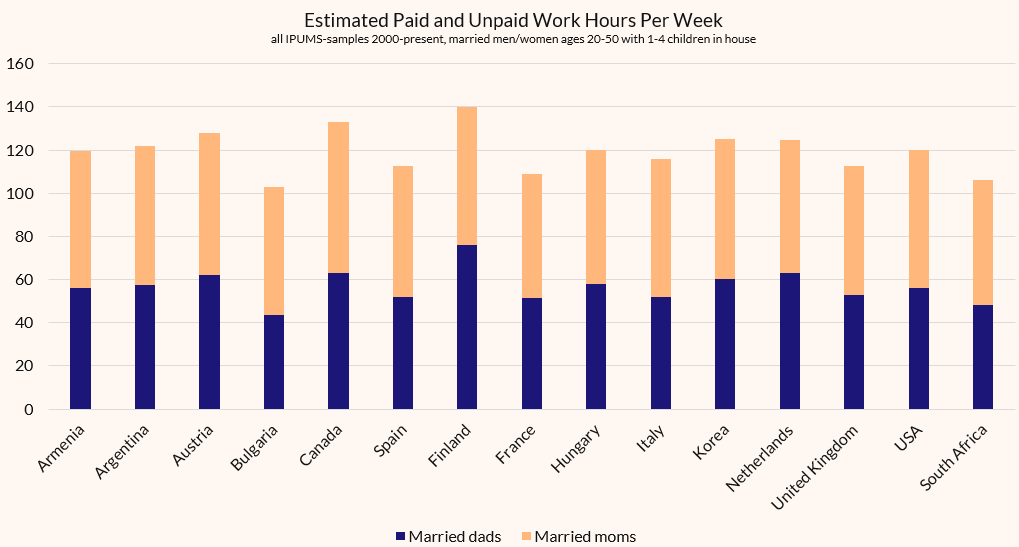
Here we are comparing the total work hours.
Bulgarian parents only do a bit over 100 weekly combined hours of childcare, chores, schooling, commuting, eldercare, civic obligations, and paid work. Finnish parents do 140, 40% more! Spanish, French, Italian, British, and South African parents all manage to log under 120 hours a week of work, whereas Austrian, Canadian, Finish, Korean, and Dutch parents are all quite clearly over 120. Armenian, Argentinian, Hungarian, and American parents are all around 120.
This tells us that couples aren’t just deciding how to divide labor, there’s also very real optionality and cultural/economic/policy variance in how much labor should be done. And while maybe you think Finland and Canada and Austria have good labor laws and good social support for parents, actually, they suck! They’re awful! They’re the worst places to be a parent! You spend tons of time working!
The best places? Bulgaria. Spain. France.
What I enjoy about this divide is both ends of the spectrum have lower- and higher- fertility countries. France has one of the highest rich-world TFRs, Spain and Bulgaria among the lowest. Finland is rather high, Austria rather low. In other words, the culture of work and parenting varies within fertility levels.
People live in different “worlds” of work. Fair Play acts like everybody is dealt 100 cards— but some people live in societies where you’re dealt 140 cards! Other people live in societies where you’re dealt 120! And yes, you and your spouse can kinda sorta choose not to keep all 140 cards in your deck, but when everybody else is doing that, it feels weird to do so. Most people follow prevailing social norms most of the time. What Fair Play neglects is that there’s a hidden fourth player dealing you extra cards. Note that Fair Play does have a “Wild Card” section intended to deal with select cases of this, so credit where credit is due, but the academic literature suggests that more egalitarianism has no effect on family outcomes like fertility and divorce. Mismatched expectations do, but that’s a case of the world dealing you bad cards: excessive expectations and/or excessive competing demands.
How to Beat the Fourth Player
Why does the fourth player matter? Well, because a better thing for couples to do than divide up their tasks in a new way might be to find ways to offload tasks. You can play against the fourth player. You can be as cuthroat and strategic against the fourth player as you absolutely should not be against the 2nd and 3rd players. By hiding the fourth player, Fair Play hides the avenue most likely to lead families to a happy life (more on why that is below).
Here are ways you can offload tasks that my wife and I use, in order of “easiest” to “hardest to pull off.” After this, I’ll discuss why I think people don’t “play against the fourth player” more. By the way, my wife homeschools our of-age kids thus has a large number of hours stacked up there, I’m a workaholic with a demanding job and a top-1% income, our house looks very nice at least some of the time, we have 3 kids and a 4th coming in October, and yet we average 105-115 hours of paid and unpaid work per week. We are spiritual Southern Europeans I guess. So these are some of our “hacks” to squaring intense work and high-investment home life with not feeling like you’re working every waking hour.
Just don’t do it.
You can just not do things! It may cause you some stress about being a bad parent to reduce bathing frequency for your kids from 7/week to 5/week, but you’ll get used to it and save time! You can just not tidy up the toys on weekends! You can simply set the mower blade lower and mow less often and have your yard look patchier! You can review your budgeted expenditures every 60 days instead of every 30! Your kid can miss soccer practice sometimes! Your linen shirt can just be wrinkled! The children are arguing? They will probably work it out! Your kid is bored? That’s why God made yards and podcasts! A great way to save time is to just not do a bunch of tasks.
Make a robot do it.
Some things have machines to do them. A Roomba will save you time. Screw the environment, use the dishwasher. Don’t even buy pans that don’t go in the dishwasher. Learn to stop worrying and put the plastic stuff for the kids in the dishwasher. It’s amazing to me how often I’ve been talking to somebody and they’re stressed about chores and they literally aren’t even using the available home appliances! That shirt’s not non-wrinkle? Throw it away, son. Live a machine-readable life. A 3-year old can operate their own Yoto (or Kindle if you’re a screen-time positive household; we are hardcore not a screen-time positive household but it is a solid hack for reducing time demands!). I am optimistic than in the next 15 years we will have better consumer robotics for more home tasks, and I plan to be a customer.
Hire somebody else to do it.
Groceries can be delivered. Mowers can be hired. Cleaners will come twice a week if you want. You can simply deal cards to people you pay to take care of it. You set up the service once, you put it on autopay, now it’s nobody’s card! This one obviously requires you to have money. But you really can just hire a babysitter or just send your kid to daycare or just use a laundry pickup service. You can have meals! Delivered to your house! As often as you like! An excellent way to not have an argument with your spouse is simply to hire somebody else to do the thing you’re arguing about! For the two-income-and-small-family-size couples Fair Play is aimed at, “hire other people to do it” seems to me like the obvious best answer for any highly contested chore. I’ll note that of the four major strategies outlined here, my wife and I are equally enthusiastic about 1 and 2, I’m definitely the “hire help” fan, but her hack, which I grant is in fact the best hack but also the hardest is…
Recruit allies to help with it.
I’m writing this article obliquely responsive to this wonderful article responding to Fair Play. This one too. The article is about the importance of community. In the childcare literature we call this “alloparenting,” i.e. other people watching your kids for free. As a broader strategy, I call it “recruiting allies.” You can move closer to your parents. You can pour energy into befriending the retirees next door and making them surrogate grandparents for your kids. You can post up at the park and aggressively befriend every parent with similar age children. You can accept that Jesus is the Christ, receive the gift of baptism, and join a church. You can just do these things! You can offer to watch someone’s kids some night, then ask if they will watch yours on another night! Ya know what’s easier than a 5 year old and a 3 year old? A 5-year old and a 3-year old with same-age playmates. You host a playdate for the other couple’s date night, then they host one for your date night. It works! We do it! You can simply choose to accept that other people are safe helpers for your family’s needs! Be the high trust society you want to see in the world! Recruiting allies into the sociocultural project of your family life is hard, it takes work, but it is massively high-reward, and it’s no surprise the total burden of family work is lowest in the societies with extended-kinship models as the norm! They have more cousin-playmates and grandparent-babysitters around! If I had Israeli data, I bet Israelis look like Bulgarians— or lower!
Why Don’t People Play Against the Fourth Player?
Keep reading with a 7-day free trial
Subscribe to Lyman Stone to keep reading this post and get 7 days of free access to the full post archives.